Gaya Patna rail section disruption and overhead wire theft
Source:indiatvnews ↗
Why It Matters
Understanding Bihar's infrastructural divisions (like the East Central Railway and its Danapur division) is crucial for BPSC Prelims, as the state's transport network and key operational zones (e.g., Hajipur ECR headquarters) are frequent subjects of geographical and administrative questions. This article also highlights security challenges surrounding public infrastructure in the state.
Summary
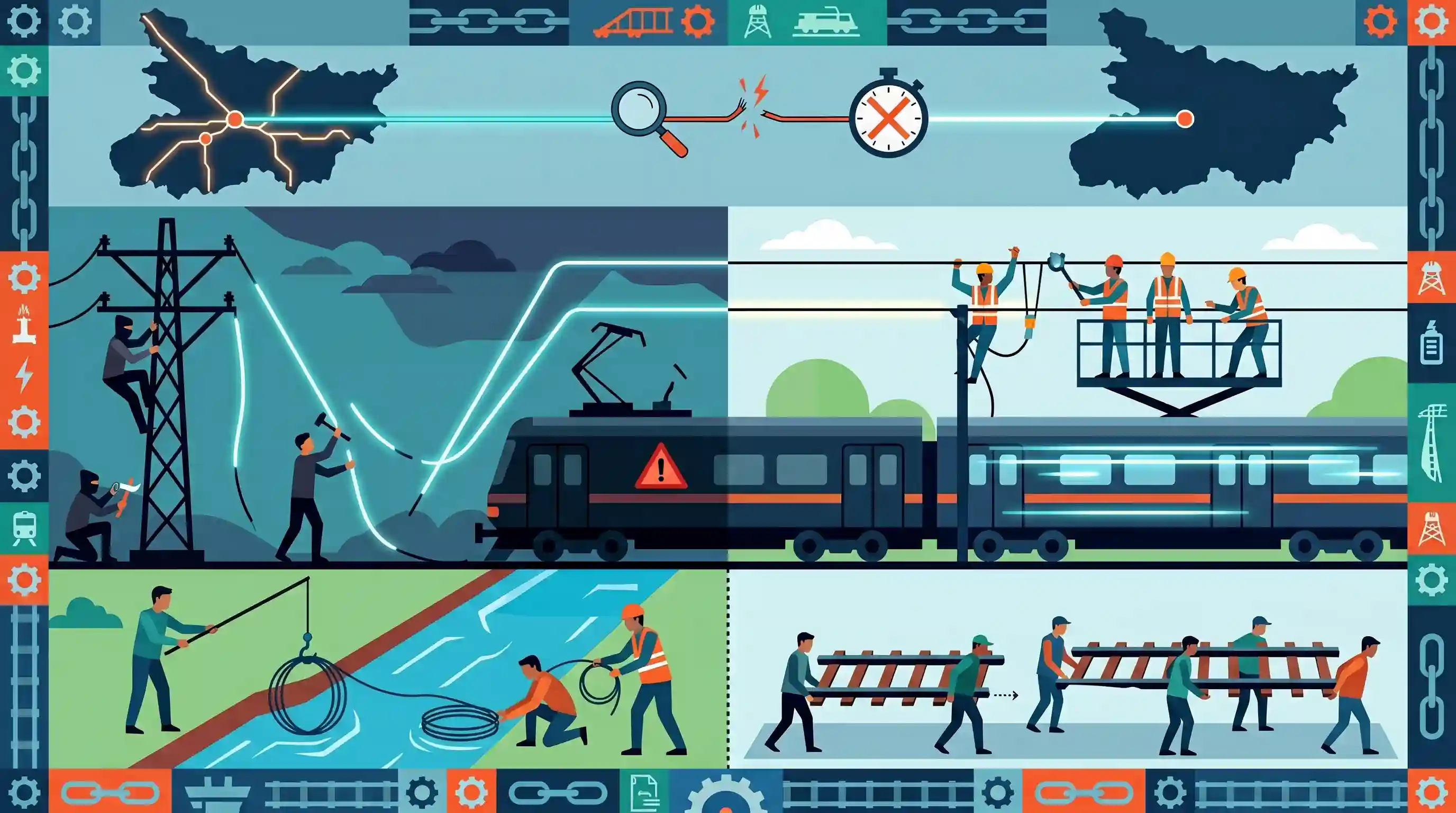
Train movement on the Gaya–Patna rail section in Bihar was disrupted for three hours after thieves stole nearly 100 meters of 25,000-volt overhead electric (OHE) wire between Tehta and Jehanabad stations. The damaged line, managed under ECR's Danapur Rail Division, was eventually restored by technical teams, and the stolen wire was recovered from a nearby water channel. The incident highlights law and order challenges facing railway infrastructure in Bihar, recalling a similar bizarre incident in 2023 where a 2-km railway track in Samastipur was stolen.
Key Points
- A bizarre theft occurred on the Gaya–Patna rail section in Bihar where thieves cut and stole nearly 100 meters of 25,000-volt overhead equipment (OHE) electric wire.
- The incident took place between Tehta and Jehanabad railway stations (near Madarpur Railway Gumti), disrupting down-line train services for nearly three hours.
- The affected rail section is managed by the Danapur Rail Division of the East Central Railway (ECR) zone. The stolen wire was later recovered by the Railway Protection Force (RPF) from a nearby water channel.
- The article highlights Bihar's history of unusual thefts, including the 2023 incident where a 2-kilometer defunct railway track connecting Lohat Sugar Mill to Pandaul railway station in Samastipur was stolen.
Important Terms
East Central Railway (ECR)

One of the 19 zonal divisions of Indian Railways, headquartered in Hajipur, Bihar, managing key rail networks across Bihar, Jharkhand, and parts of neighboring states.
UPSC context
GS Paper III (Infrastructure: Railways), testing regional transport networks, administrative divisions, and public sector operations.
Danapur Rail Division
An administrative division under the East Central Railway zone, established in 1925, responsible for operating and maintaining key rail infrastructure in parts of Bihar and Uttar Pradesh.
UPSC context
GS Paper III (Infrastructure), testing knowledge of zonal railway divisions, critical transport nodes, and infrastructure management.
Railway Protection Force (RPF)
A specialized security force under India's Ministry of Railways, established under the RPF Act 1957, mandated to safeguard railway property, passengers, and passenger premises.
UPSC context
GS Paper III (Internal Security), testing roles of central armed forces and security architecture for critical national infrastructure.
Lohat Sugar Mill
A historic sugar mill in Madhubani, Bihar, established in 1914 by the Darbhanga Sugar Company, representing the history and decline of the state's agro-based industries.
UPSC context
GS Paper I (Modern History/Geography) or GS III (Economic Development), testing regional industrial history and agro-based industries.
Prelims Trap
The Railway Protection Force (RPF) is solely responsible for investigating criminal offenses and maintaining law and order on train coaches.
Law and order is a State subject. The Government Railway Police (GRP), which falls under state police jurisdiction, registers and investigates Indian Penal Code (IPC) crimes.
Static Concepts Connected
How is security jurisdiction split in Indian Railways?
- RPF Role: Under Ministry of Railways; mandated with protecting railway property, tracks, and passenger safety under the RPF Act.
- GRP Role: Under respective State Governments; responsible for crime prevention, maintaining law and order, and investigating IPC offences on railway premises.
- Coordination Gap: Requires constant coordination between federal RPF and state GRP, sometimes creating investigative delays during security incidents.
What are the key features of the Barabar Caves?
- Mauryan Patronage: Dating to the 3rd century BCE, they were patronized by Emperor Ashoka and his grandson Dasharatha in Jehanabad, Bihar.
- Ajivika Sect: Mainly dedicated to the Ajivikas, an ancient heterodox sect contemporary to early Buddhism and Jainism.
- Architectural Marvel: Famous for high-glass polish on granite walls and the Lomas Rishi Cave's iconic ornamental archway.
Cross-Topic Patterns
Infrastructure security and federal policing
The theft of railway assets highlights the friction between Union-controlled RPF and state-controlled police forces in securing critical national economic corridors.
Mauryan legacy in contemporary geography
Infrastructure developments and modern administrative divisions in Bihar, such as Jehanabad, overlay ancient cultural hubs like the rock-cut cave sanctuaries of the Mauryan era.

Jurisdictional friction between RPF and State GRP in protecting critical national infrastructure is a highly probable GS3 security theme.
Linked PYQs · 2
Linked PYQs · 2
- 2011BPSC_PRELIMSGS1
The East Central Railway zone headquarters is located at:
- 2008BPSC_PRELIMSGS1
The railway zone headquarters Hajipur is located in:
