Unopposed Election Results for Bihar Legislative Council Seats
Source:indiatvnews ↗
Why It Matters
This event highlights critical constitutional processes governing bicameral state legislatures, legislative council elections, and the stringent six-month rule for non-legislator ministers under Article 164(4). Understanding these dynamics is essential for BPSC polity and state governance topics.
Summary
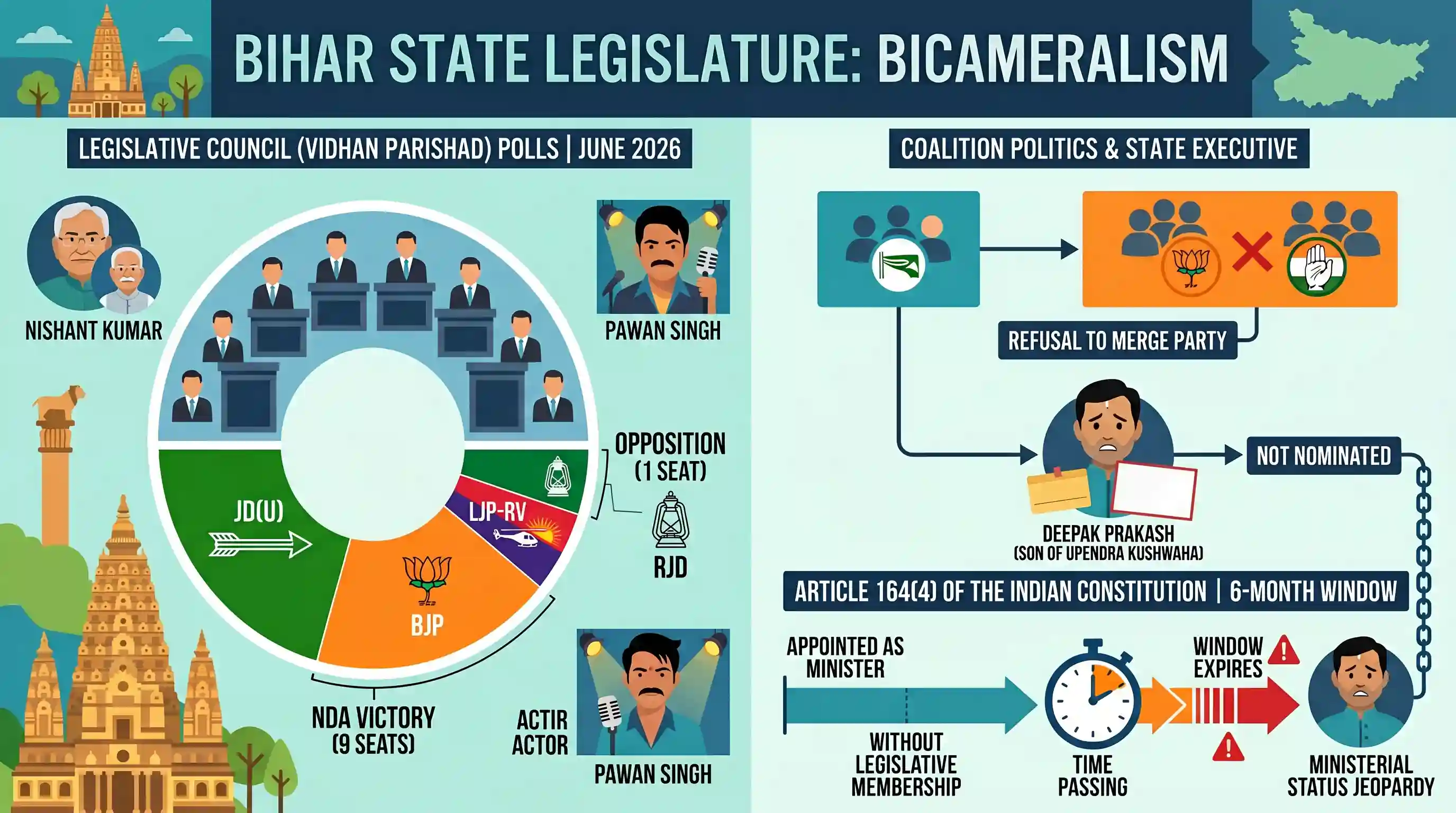
The Bihar Legislative Council (MLC) polls in June 2026 concluded with all 10 candidates being elected unopposed. The NDA secured a major victory by winning 9 out of 10 seats (4 for JD(U), 4 for BJP, 1 for LJP-RV), while the RJD secured 1 seat. Prominent figures elected include former CM Nitish Kumar's son Nishant Kumar and Bhojpuri actor Pawan Singh. However, current minister Deepak Prakash (son of Upendra Kushwaha) was not nominated following Kushwaha's refusal to merge his Rashtriya Lok Morcha with the BJP. Consequently, Prakash's ministerial status is in jeopardy as his six-month constitutional window under Article 164(4) without holding legislative membership is set to expire.
Key Points
- All 10 candidates for the Bihar Legislative Council (MLC) seats, including nine regular biennial seats and one by-election seat, were elected unopposed.
- The ruling National Democratic Alliance (NDA) secured 9 seats, with the JD(U) winning 4, BJP winning 4, and LJP (Ram Vilas) taking 1 seat. The opposition RJD won 1 seat.
- The by-election seat, which was vacated by former Chief Minister Nitish Kumar after he moved to the Rajya Sabha, was won by JD(U) candidate Lalan Prasad.
- Prominent winners include Nishant Kumar (son of Nitish Kumar), Bhojpuri actor Pawan Singh (BJP), and Sanjay Prakash Mayukh (BJP).
- Deepak Prakash, a Bihar minister and son of Rashtriya Lok Morcha chief Upendra Kushwaha, missed out on a nomination, jeopardizing his continuation as a minister due to the six-month constitutional limit (Article 164(4)).
- The denial of nomination to Deepak Prakash follows Kushwaha's refusal to merge his Rashtriya Lok Morcha with the BJP, despite pressure from the BJP leadership to consolidate alliance partners.
Important Terms
Article 164(4) of the Constitution of India

A constitutional provision stating that a state minister must get elected to the state legislature within six consecutive months of appointment, or cease to hold office.
UPSC context
GS Paper II (Indian Polity). Tests understanding of cabinet responsibility, executive eligibility, and the executive-legislature interface.
National Democratic Alliance (NDA)
A prominent center-right political coalition in India, led by the Bharatiya Janata Party (BJP), comprising various national and regional parties.
UPSC context
GS Paper II (Indian Polity). Analyzes coalition politics, federalism, and alliance dynamics in state and national governments.
Rashtriya Lok Morcha (RLM)
A regional political party in Bihar, founded in 2023 by Upendra Kushwaha, advocating for OBC interests and allied with the NDA coalition.
UPSC context
GS Paper II (Indian Polity). Examines the role of regional parties, pressure groups, and caste politics in state governance.
Rashtriya Janata Dal (RJD)
A major socialist regional political party in Bihar, founded by Lalu Prasad Yadav, primarily advocating for social justice and secularism.
UPSC context
GS Paper II (Indian Polity). Important for studying regional opposition blocks, federal structures, and social-justice-driven electoral politics.
Lok Janshakti Party (Ram Vilas)
A regional political party in Bihar led by Chirag Paswan, representing marginalized communities and acting as a key ally of the NDA.
UPSC context
GS Paper II (Indian Polity). Explores political party factionalism, regional representation, and Dalit-focused identity politics in northern India.
Prelims Trap
The fields for nomination of members to the Rajya Sabha by the President are identical to those for the State Legislative Council.
The Governor can nominate members based on 'Co-operative Movement' under Article 171(5), but this field is entirely absent from the Rajya Sabha nomination list under Article 80(3).
Static Concepts Connected
What are the constitutional limits on appointing a non-legislator as a Minister?
- Article 164(4): A minister must become a member of either house of the State Legislature within six consecutive months or face automatic termination of office.
- Judicial restriction: The Supreme Court (S.R. Chaudhuri v. State of Punjab) barred the consecutive re-appointment of a non-legislator minister without them winning an election in between.
- Eligibility age: To be appointed, the candidate must possess the minimum eligibility qualifications of a legislator, including age, at the time of appointment.
How does the Legislative Council nomination process differ from the Rajya Sabha?
- Co-operative movement: Under Article 171(5), the Governor can nominate members from 'co-operative movement' fields, which is not an option for Presidential Rajya Sabha nominations.
- Proportion nominated: The Governor nominates approximately one-sixth of the MLCs, whereas the President nominates a fixed number of 12 members to the Rajya Sabha.
Cross-Topic Patterns
Bicameralism: Revisionary chamber vs political rehabilitation
The utility of Legislative Councils is debated; they frequently serve to bypass direct elections for ministers rather than acting as genuine revisionary chambers, unlike the Rajya Sabha.
Coalition dynamics and ministerial survival
Article 164(4) limits can be leveraged by major coalition partners to force smaller regional allies into mergers, using cabinet seats and nominations as bargaining chips.

Article 164(4) limits on non-member ministers and Article 171 nomination fields are highly likely to be tested in a multi-statement MCQ.
Linked PYQs · 3
Linked PYQs · 3
- 2024-IBPSC_PRELIMSGS1
Which of the following Acts converted Unicameral Legislature of Bihar into Bicameral : Bihar Legislative Assembly and Bihar Legislative Council?
- 2024-IBPSC_PRELIMSGS1
Under the Government of India Act 1935, who was the first elected Chairman of Bihar Legislative Council ?
- 2022BPSC_PRELIMSGS1
In which year was the first sitting of the Bihar Legislative Council convened?
