Newly discovered Somato Cognitive Action Network linked to Parkinsons
Source:The Hindu ↗
Why It Matters
UPSC frequently tests knowledge of emerging scientific discoveries, especially concerning human biology and diseases. Understanding new paradigms like SCAN is relevant for GS3 Science and Technology, as well as tackling health-related challenges associated with India\'s aging population.
Summary
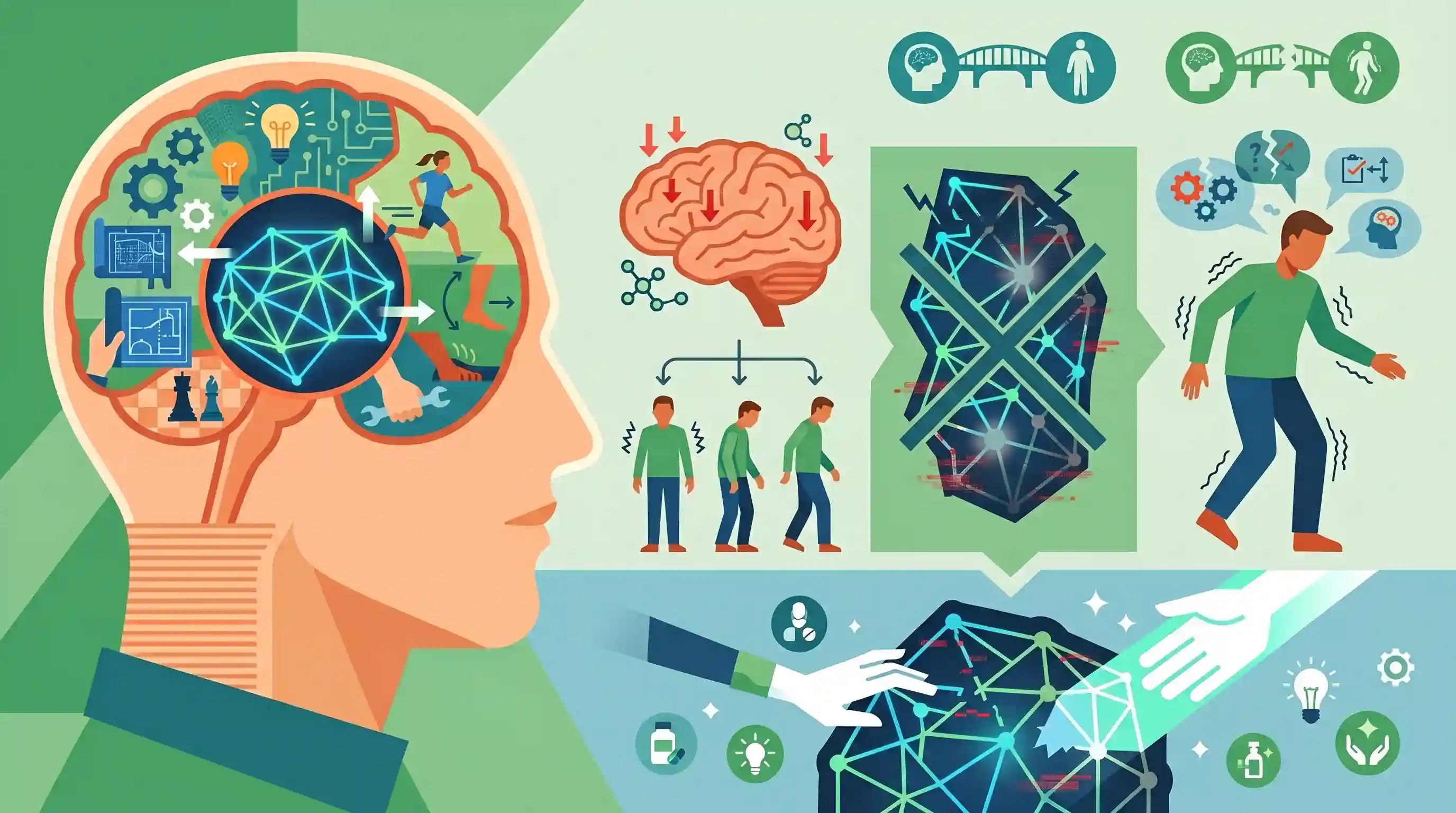
Recent research has implicated a newly identified brain network, the Somato-Cognitive Action Network (SCAN), in Parkinson\'s disease. SCAN integrates physical movement (motor control) with cognition (planning, thought, and action). Parkinson\'s disease, traditionally viewed primarily as a movement disorder caused by the loss of dopamine-producing neurons, may be better understood by examining defects or disruptions in the SCAN. Recognizing SCAN’s role provides a scientific bridge to understand the cognitive and physical overlap in Parkinson’s and potentially points to new therapeutic pathways targeting this mind-body connection.
Key Points
- A newly identified brain network called the Somato-Cognitive Action Network (SCAN) integrates physical movement with cognitive planning.
- SCAN has been implicated in the pathophysiology of Parkinson\'s disease, highlighting that it is not merely a motor disorder but a complex neurodegenerative condition affecting both body and mind.
- The network helps explain why patients with Parkinson\'s experience a combination of motor symptoms (tremors, stiffness) and non-motor symptoms (cognitive changes, anxiety).
- Understanding SCAN provides a new framework for diagnosing neurodegenerative diseases and developing therapies that target the mind-body connection in the brain.
Prelims Trap
"SCAN is a recently developed neuroimaging technology used to detect Parkinson's disease."
SCAN (Somato-Cognitive Action Network) is a newly identified biological neural pathway inside the human brain, not a diagnostic medical device or MRI-like imaging tool.
Static Concepts Connected
How do key neurotransmitters affect major neurodegenerative diseases?
- Dopamine: A chemical messenger critical for coordinating smooth physical movements. Its depletion in the basal ganglia (substantia nigra) causes Parkinson's disease.
- Acetylcholine: A neurotransmitter involved in memory and learning; its progressive decline is a primary hallmark of Alzheimer's disease.
What are Deep Brain Stimulation (DBS) and Transcranial Magnetic Stimulation (TMS)?
- DBS: A surgical treatment involving implanted electrodes that deliver electrical impulses to specific brain regions to mitigate Parkinson's motor symptoms.
- TMS: A non-invasive procedure using magnetic fields to stimulate nerve cells in the brain, newly eyed for modulating networks like SCAN.
Cross-Topic Patterns
Med-Tech + Applied Biology overlaps
UPSC frequently tests emerging therapeutic tech (e.g., CAR-T, CRISPR). Deep Brain Stimulation (DBS) targeting the SCAN network fits this pattern of testing applied biomedical technologies.
Demographic aging + Neurological NCD burden
India accounts for 10% of the global Parkinson's burden. As India's life expectancy rises, the shift from communicable diseases to geriatric neurodegenerative care becomes a critical social policy challenge.

Expect a 2026 'Terms in News' Prelims question asking what "SCAN" refers to, likely mixed as a distractor with neuroimaging technologies.
Linked PYQs · 2
Linked PYQs · 2
- 2021PrelimsGS1
Magnetite particles, suspected to cause neurodegenerative problems, are generated as environmental pollutants from which of the following? 1. Brakes of motor vehicles 2. Engines of motor vehicles 3. Microwave stoves within homes 4. Power plants 5. Telephone lines Select the correct answer using the code given below.
- 2022MainsGS3
The increase in life expectancy in the country has led to newer health challenges in the community. What are those challenges and what steps need to be taken to meet them?
