New Zealand Eases Pathway Student Visa Course Switch Rules
Source:Indian Express ↗
ఇది ఎందుకు ముఖ్యం
India is a leading source of international students globally. Changes to student visa policies in popular destination countries like New Zealand directly impact the educational and career opportunities of Indian students, which in turn influences the dynamics of the Indian diaspora and bilateral relations.
సారాంశం
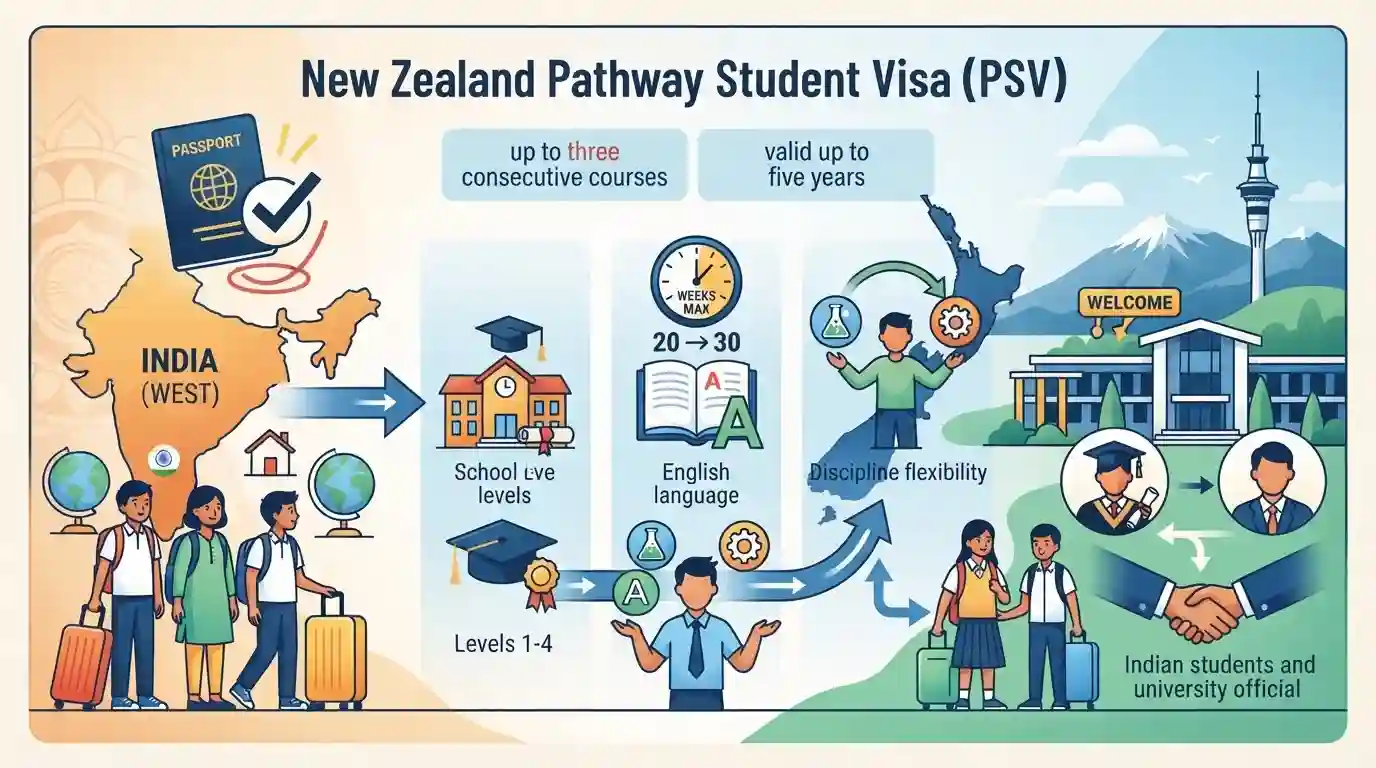
New Zealand has updated its Pathway Student Visa (PSV) regulations to offer greater flexibility and convenience for international students. Key policy changes include increasing the maximum duration of English language study from 20 to 30 weeks, expanding coverage to lower academic levels (Levels 1 to 4), and allowing students moving from school to tertiary education to switch their academic disciplines without the need to apply for a new visa. The PSV permits international students to enroll in up to three consecutive courses under a single visa valid for up to five years. These revisions are designed to reduce financial and administrative burdens on students and enhance New Zealand's appeal as a global education hub.
ముఖ్య అంశాలు
- New Zealand has relaxed the rules for its Pathway Student Visa (PSV), enhancing flexibility for international students.
- The maximum permitted duration for English language study under the PSV has been increased from 20 to 30 weeks.
- Students transitioning from high school to tertiary education can now change their academic discipline without applying for a new visa.
- The PSV allows enrollment in up to three consecutive courses under a single visa, which is valid for up to five years, covering study pathways starting at Levels 1 to 4.
- These changes aim to reduce administrative and financial burdens for international learners, making New Zealand a more attractive study destination.
ముఖ్యమైన పదాలు
Pathway Student Visa (PSV)

A New Zealand visa allowing international students to study up to three consecutive courses with approved education providers under a single visa for up to five years, reducing administrative and visa renewal burdens.
UPSC context
GS Paper II: Effects of policies of developed nations on India’s interests; crucial for analyzing international student mobility and educational migration pathways.
Immigration New Zealand
The official government agency responsible for managing New Zealand’s borders, issuing visas, and regulating the entry, stay, and employment rights of international visitors, workers, and students.
UPSC context
GS Paper II: Bilateral relations and international policies; tests understanding of foreign government agencies that dictate immigration rules affecting Indian nationals.
Indian Diaspora
The global community of overseas Indians, including Non-Resident Indians (NRIs) and Persons of Indian Origin (PIOs), who contribute significantly to India's foreign exchange, soft power, and bilateral relations.
UPSC context
GS Paper II: Indian Diaspora; tests understanding of the political, economic, and cultural influence of overseas Indians on foreign policy.
Student Mobility
The cross-border movement of individuals for the purpose of receiving tertiary education, acting as a key driver of international relations, service exports, and brain circulation between countries.
UPSC context
GS Paper II: Bilateral relations and education; tests appreciation of global migration trends, human capital exchange, and soft power dynamics.
New Zealand Qualifications and Credentials Framework (NZQCF)
The national system that lists and quality-assures all secondary and tertiary qualifications and credentials in New Zealand, divided into ten levels based on complexity of learning.
UPSC context
GS Paper II & III: Education and Human Resources; tests understanding of international educational frameworks, quality assurance standards, and vocational pathways.
International Education Going for Growth Plan
A policy initiative launched by the New Zealand government in 2025 aimed at doubling the economic contribution of the international education sector to NZ$7.2 billion by 2034.
UPSC context
GS Paper II: Policies of developed countries affecting India's interests; highlights strategies used by nations to attract skilled Indian students.
ప్రిలిమ్స్ ఉచ్చు
The Pathway Student Visa is an exclusive bilateral arrangement for Indian students.
The PSV is New Zealand's global visa policy for all international students, not a bilateral treaty outcome, despite the recent India-NZ Strategic Partnership.
అనుసంధానమైన స్థిర భావనలు
What are the key provisions for internationalizing higher education under NEP 2020?
- Foreign Campuses: Top 500 globally ranked Foreign Higher Educational Institutions (FHEIs) are allowed to establish branch campuses in India with operational autonomy.
- Academic Collaborations: Permits twinning, joint, and dual-degree programs between recognized Indian and foreign higher educational institutions.
- Credit Mobility: The Academic Bank of Credits (ABC) facilitates the seamless international transfer of credits to promote global mobility.
How does the Indian government legally categorize its diaspora?
- Non-Resident Indians (NRI): Indian citizens residing abroad for employment or education (more than 182 days); they retain full constitutional rights including voting.
- Overseas Citizens of India (OCI): Foreign citizens of Indian origin; they enjoy lifelong visa-free entry and parity in economic fields but cannot vote or buy agricultural land.
అంతర-అంశ నమూనాలు
Visa Restrictions vs Emerging Hubs
As traditional "Big Four" hubs (US, UK, Canada, Australia) tighten student visa norms, nations like NZ and Germany are easing rules, fundamentally shifting Indian diaspora and global student mobility patterns.
Student Mobility as Soft Power
The elevation of India-New Zealand ties to a "Strategic Partnership" in 2026 highlights how student mobility acts as a foundational bridge for deepening geopolitical, defense, and trade engagements.

Mains 2026 could test how restrictive visa policies in traditional western hubs shift India's student diaspora and soft power to new regions.
అనుసంధాన PYQలు · 2
అనుసంధాన PYQలు · 2
- 2015MainsGS2
The quality of higher education in India requires major improvements to make it internationally competitive. Do you think that the entry of foreign educational institutions would help improve the quality of higher and technical education in the country? Discuss.
- 2020MainsGS2
Indian diaspora has a decisive role to play in the politics and economy of America and European Countries'. Comment with examples.
