New baseline US tariffs implemented following supreme court ruling
Source:The Hindu ↗
Why It Matters
This issue is critical for UPSC aspirants as it intersects global economic trends (protectionism, tariff wars, and balance of payments) covered in GS3, with key polity and international relations concepts (separation of powers, judicial review, and executive limits) covered in GS2. The developments in US trade policy have direct ripple effects on the Indian economy and global multilateralism.
Summary
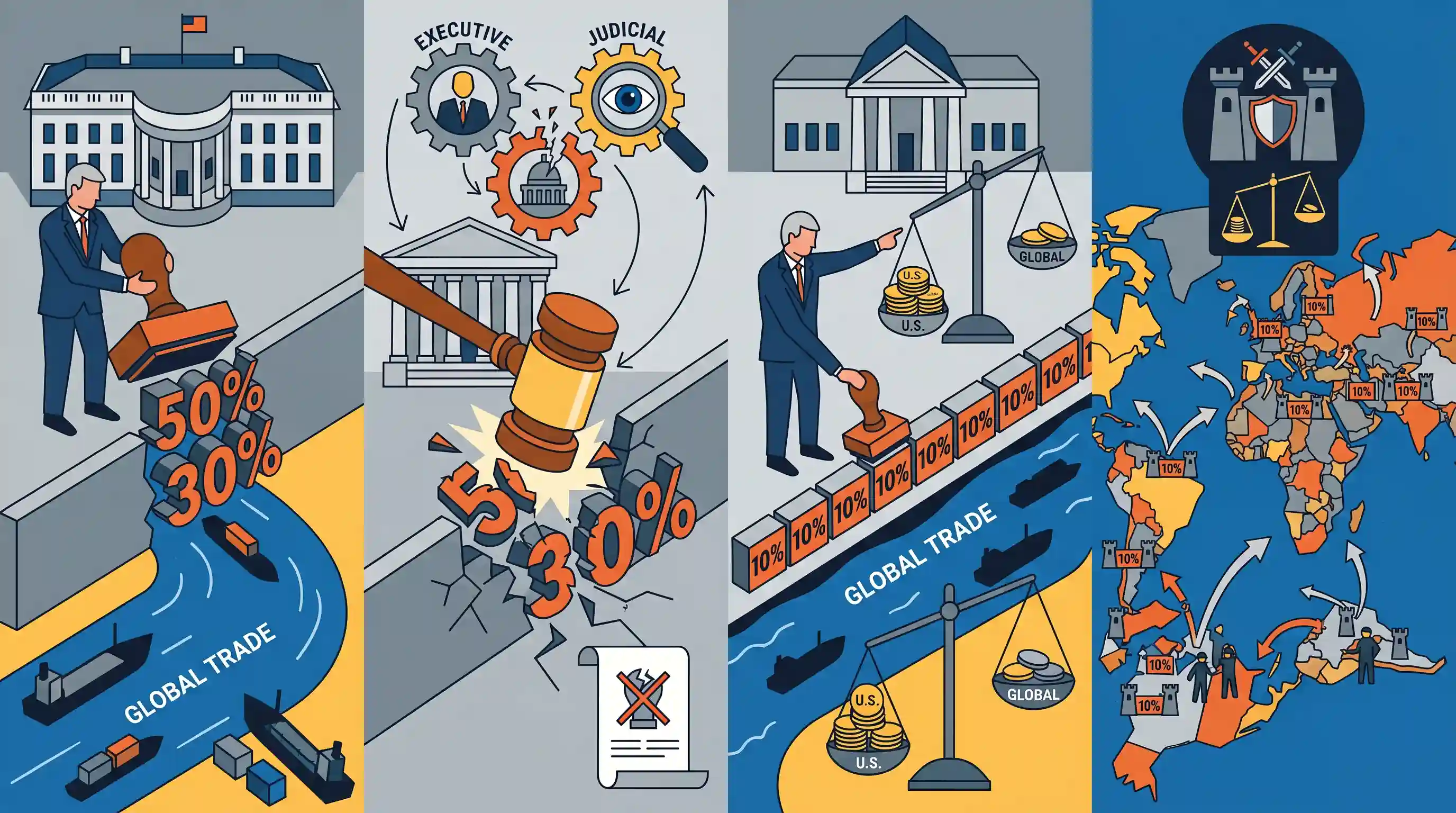
The article discusses the enforcement of a new 10% universal baseline tariff by U.S. President Donald Trump, following a Supreme Court ruling that struck down his previous sweeping tariffs enacted under the International Emergency Economic Powers Act (IEEPA). The Supreme Court deemed the initial tariffs an unconstitutional executive overreach. To bypass this, the administration is justifying the new tariffs by citing U.S. balance-of-payments deficits. This development highlights the increasing shift towards global protectionism and trade wars while offering a prominent example of judicial review acting as a check on executive power—a core facet of the separation of powers relevant to comparative constitutional studies.
Key Points
- The U.S. Supreme Court struck down sweeping tariffs previously imposed by President Trump under the IEEPA, citing executive overreach and reinforcing the separation of powers.
- In response to the judicial setback, the Trump administration implemented a new 10% universal baseline tariff, justifying it on the grounds of addressing U.S. balance-of-payments deficits.
- The reliance on balance-of-payments deficits to impose tariffs represents a significant protectionist measure that threatens to trigger global trade wars and disrupt macroeconomic stability.
- This legal conflict underscores the critical role of judicial review in checking executive power, providing an important comparative case study for constitutional frameworks like India's.
Important Terms
International Emergency Economic Powers Act (IEEPA)

A 1977 U.S. law allowing the President to regulate international commerce and freeze assets during a declared national emergency arising from external threats.
UPSC context
GS II/III: Tests executive power limits and the use of economic tools in foreign policy/trade wars.
Judicial Review
The power of the judiciary to examine and invalidate legislative or executive actions that violate the constitution.
UPSC context
GS II: Core feature of Indian and U.S. constitutions; tests the check-and-balance mechanism.
Balance of Payments (BoP)
A comprehensive record of all economic transactions between a country's residents and the rest of the world over a specific period.
UPSC context
GS III: Essential macroeconomic concept; tests understanding of trade deficits and currency stability.
Protectionism
An economic policy of restricting imports through tariffs, quotas, or regulations to shield domestic industries from foreign competition.
UPSC context
GS III: Key topic regarding the impact of developed-nation policies on India's export economy.
Section 122 of the Trade Act, 1974
A provision of the U.S. Trade Act of 1974 allowing the President to impose temporary import surcharges to address serious balance-of-payments deficits.
UPSC context
GS II/III: Specific legal bypass used for trade unilateralism; relevant for comparative trade law studies.
Separation of Powers
The constitutional principle dividing government duties into three branches—legislative, executive, and judicial—to prevent the concentration of power.
UPSC context
GS II: Fundamental feature of democratic governance; tests comparisons between rigid and fused systems.
Major Questions Doctrine
A legal principle in the U.S. requiring clear Congressional authorization for executive agencies to make decisions of great economic or political significance.
UPSC context
GS II: Advanced concept in comparative law regarding judicial checks on administrative and executive overreach.
Prelims Trap
WTO rules strictly prohibit tariffs aimed at correcting Balance of Payments deficits.
GATT Article XII and XVIII(B) explicitly allow countries to restrict imports to safeguard their Balance of Payments, provided the measures are temporary and proportional.
Static Concepts Connected
What are the WTO provisions regarding Balance of Payments (BoP) exceptions?
- GATT Article XII: Allows developed members to temporarily restrict imports to safeguard their external financial position and balance of payments.
- GATT Article XVIII(B): Provides special flexibility for developing countries to apply import restrictions to correct severe BoP deficits.
- Temporary Nature: Measures must be temporary, transparent, price-based (preferably), and not exceed what is necessary to stabilize monetary reserves.
How does the Separation of Powers differ between the US and India?
- Constitutional Framework: The US features a strict separation of powers. India follows a fusion model where the executive is drawn from and part of the legislature.
- Executive Accountability: The US President is not directly accountable to Congress. India's Council of Ministers is collectively responsible to the Lok Sabha (Article 75).
- Judicial Review Scope: US courts have broad review powers under 'due process'. Indian courts traditionally operate under 'procedure established by law', though judicial activism has blurred this line.
Cross-Topic Patterns
Protectionism + Currency Wars
Tariffs justified by BoP deficits often trigger retaliatory currency devaluations, linking global trade policy directly to forex market dynamics and monetary policy interventions by the RBI.
Executive Powers + Delegated Legislation
The US Court striking down IEEPA tariffs provides a comparative anchor for Mains questions on the limits of delegated legislation and executive rule-making in Indian economic policy.

A 2026 Prelims multi-statement question will likely test WTO's Balance of Payments exceptions (GATT Art XII) alongside currency manipulation.
Linked PYQs · 5
Linked PYQs · 5
- 2025MainsGS3
What are the challenges before the Indian economy when the world is moving away from free trade and multilateralism to protectionism and bilateralism? How can these challenges be met?
- 2018MainsGS3
How would the recent phenomena of protectionism and currency manipulations in world trade affect macroeconomic stability of India?
- 2013PrelimsGS1
The balance of payments of a country is a systematic record of
- 2014PrelimsGS1
With reference to Balance of Payments, which of the following constitutes/constitute the Current Account? 1. Balance of trade 2. Foreign assets 3. Balance of invisibles 4. Special Drawing Rights Select the correct answer using the code given below.
- 2020MainsGS2
Judicial Legislation is antithetical to the doctrine of separation of powers as envisaged in the Indian Constitution. In this context justify the filing of large number of public interest petitions praying for issuing guidelines to executive authorities.
