United States Implements New Import Tariffs Following Judicial Ruling
Source:The Hindu ↗
Why It Matters
The shifting U.S. trade policy has profound implications for global supply chains, directly testing India's macroeconomic stability. Understanding the 'balance of payments' rationale and the rising trend of protectionism is central to GS3 Economy and GS2 International Relations.
Summary
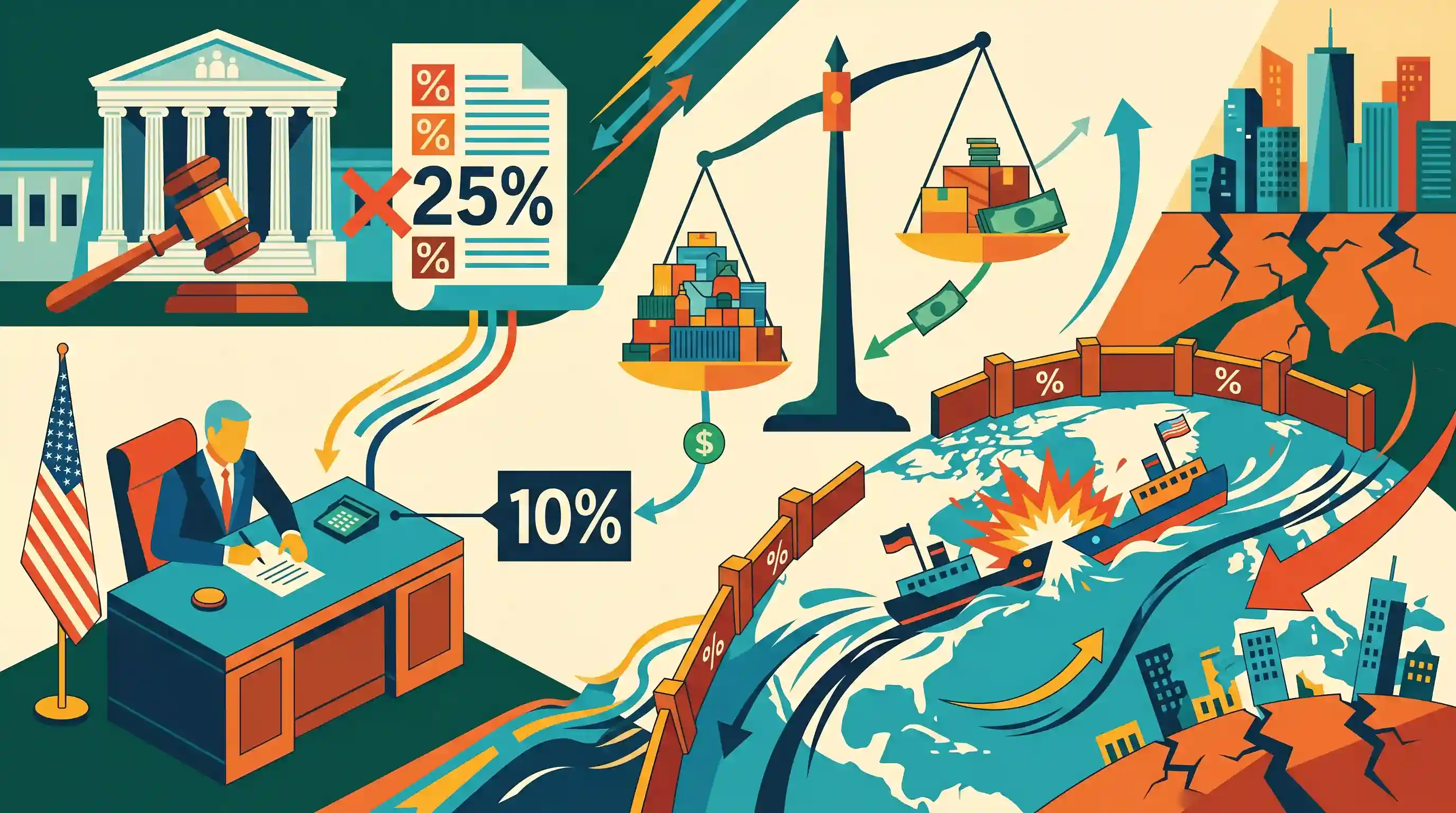
Following the U.S. Supreme Court's decision to strike down sweeping 25% global tariffs as an executive overreach of the 1977 International Emergency Economic Powers Act, President Donald Trump immediately enacted a new 10% tariff on imports. This new duty is uniquely justified under a 1974 trade law provision designed to combat 'balance-of-payments deficits'. The ongoing developments underscore systemic constitutional separation-of-powers conflicts in the U.S., while signaling intensified protectionism, trade wars, and risks to global macroeconomic stability.
Key Points
- The U.S. implemented a new 10% tariff on all imported goods, immediately after the U.S. Supreme Court struck down previously imposed, broader 25% tariffs.
- The U.S. Supreme Court ruled that the executive branch had exceeded its authority under the 1977 International Emergency Economic Powers Act, illustrating constitutional checks and balances.
- To bypass the judicial block, the new 10% tariff was uniquely justified under an obscure provision in the 1974 Trade Act meant to address 'balance-of-payments deficits'.
- These unilateral policies threaten to trigger retaliatory tariffs, disrupt global supply chains, and further shift the global economy from multilateralism toward protectionism.
Important Terms
Protectionism

Economic policy of restricting imports through tariffs, quotas, or regulations to shield domestic industries from foreign competition.
UPSC context
GS Paper III (Economy); relevant for topics on global trade wars and their impact on Indian exports.
Balance of Payments (BoP)
A systematic record of all economic transactions between residents of a country and the rest of the world over a specific period.
UPSC context
GS Paper III (Economy); critical for understanding external sector stability and foreign exchange reserves.
1974 Trade Act (Section 122)
U.S. law, specifically Section 122, empowering the President to impose temporary import surcharges (up to 15%) to address serious international payments deficits.
UPSC context
GS Paper II/III; highlights developed nations' policies affecting global trade and legal justifications for protectionism.
International Emergency Economic Powers Act (IEEPA)
A 1977 U.S. federal law allowing the President to regulate international commerce during a declared national emergency involving an external threat.
UPSC context
GS Paper II; illustrates executive vs. judicial powers and the legal framework for international sanctions.
Separation of Powers
The constitutional principle dividing government authority among legislative, executive, and judicial branches to prevent any single branch from abusing power.
UPSC context
GS Paper II (Polity); essential for comparative constitutional studies between India and the U.S. system.
Prelims Trap
WTO rules allow member countries to freely impose unilateral tariffs to correct Balance of Payments (BoP) deficits.
GATT Article XII permits BoP-related trade restrictions, but they must be temporary, non-discriminatory, and subject to WTO consultation, not unilateral executive fiats.
Static Concepts Connected
What are the primary components of a country's Balance of Payments (BoP)?
- Current Account: Records trade in goods (visibles), services (invisibles), net investment income, and current transfers.
- Capital Account: Records foreign investments, loans, and foreign exchange reserves (including FDI, FPI, and external commercial borrowings).
- BoP Deficit: Occurs when overall autonomous receipts from the rest of the world fall short of autonomous payments.
How does the Separation of Powers differ between the USA and India?
- US Strict Separation: The Executive is completely separate from the Legislature, relying heavily on rigid constitutional checks and balances.
- Indian Fusion of Powers: The Executive is drawn from and remains accountable to the Legislature (Parliamentary system).
- Judicial Review: Both nations allow the judiciary to strike down unconstitutional executive or legislative actions.
Cross-Topic Patterns
US Protectionism + India's Bilateral FTAs
As the US turns to unilateral tariffs, India's export strategy increasingly relies on bypassing multilateral gridlock through bilateral Free Trade Agreements (FTAs) with partners like the UAE and Australia.
Separation of Powers + Judicial Review
The US ruling highlights judicial checks on executive overreach, a frequent GS2 comparative polity theme when contrasted with India's Article 13 and debates over judicial activism.

Expect a mixed-concept Prelims question testing BoP components alongside WTO safeguard clauses that permit trade restrictions for deficits.
Linked PYQs · 4
Linked PYQs · 4
- 2025MainsGS3
What are the challenges before the Indian economy when the world is moving away from free trade and multilateralism to protectionism and bilateralism? How can these challenges be met?
- 2018MainsGS3
How would the recent phenomena of protectionism and currency manipulations in world trade affect macroeconomic stability of India?
- 2019MainsGS2
Do you think that Constitution of India does not accept principle of strict separation of powers rather it is based on the principle of 'checks and balance'? Explain.
- 2013PrelimsGS1
The balance of payments of a country is a systematic record of
