United States Protectionist Tariffs and Global Trade Implications
Source:The Hindu ↗
Why It Matters
The article underscores the continued volatility in global trade and the acceleration of U.S. protectionist policies. For UPSC aspirants, understanding the shift from multilateral free trade to unilateral tariffs is crucial for GS3 (Economy), as it directly impacts global supply chains, inflation, and India's macroeconomic stability.
Summary
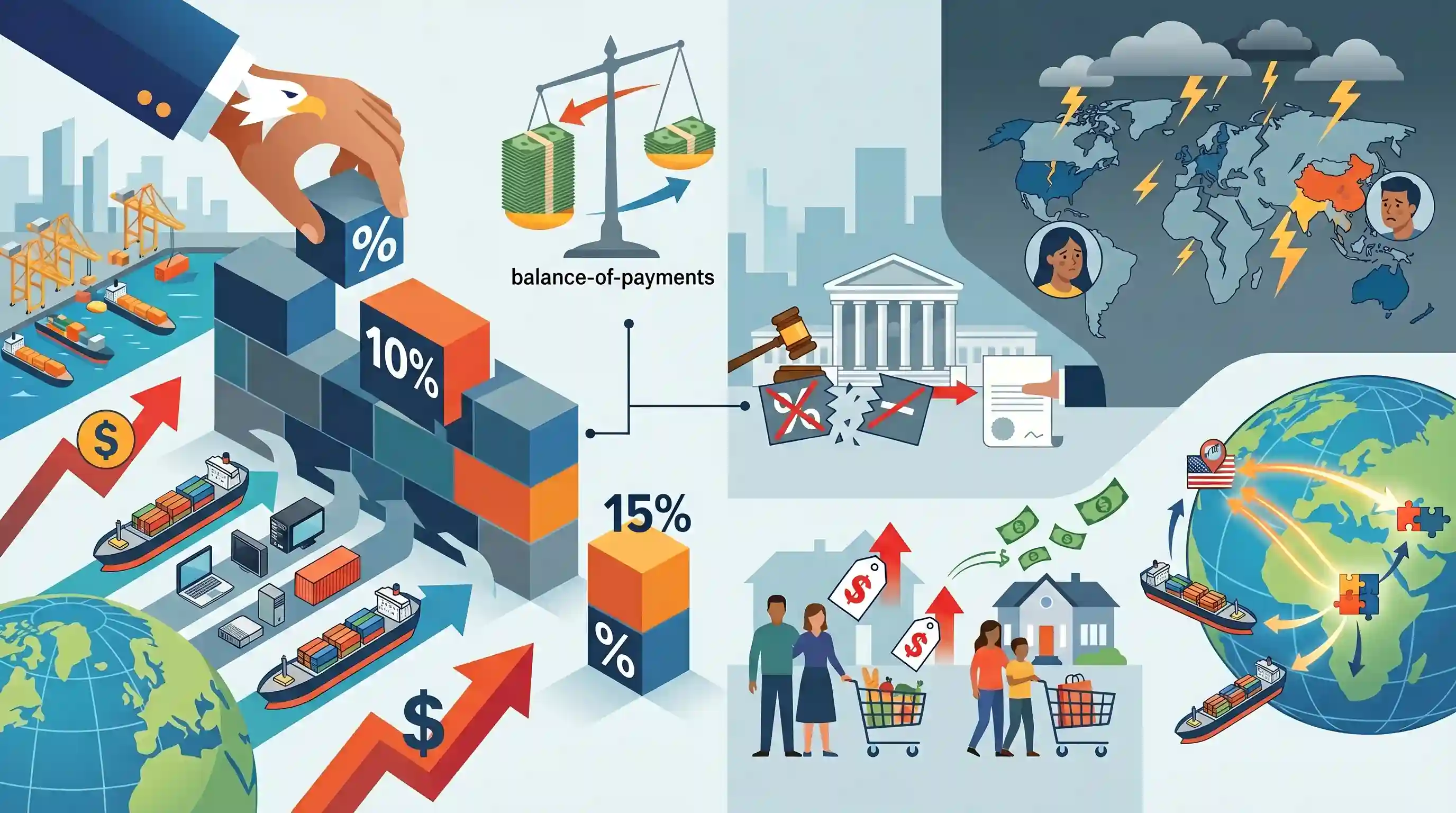
The U.S. has enforced new 10% tariffs on $1.2 trillion of imports—with threats to raise them to 15%—justified by 'balance-of-payments deficits,' immediately following a Supreme Court ruling that struck down previous tariffs imposed under the 1977 IEEPA. This aggressive protectionist pivot raises concerns about global trade instability, with experts warning of increased costs to U.S. consumers and potential shifts by international partners to diversify supply chains away from American markets.
Key Points
- The Trump administration imposed new 10% tariffs (with a threat to increase to 15%) on imported goods, citing the need to address large 'balance-of-payments deficits.'
- This action follows a U.S. Supreme Court ruling that struck down previous tariffs imposed under the 1977 International Emergency Economic Powers Act (IEEPA), deeming the executive overreach illegal.
- The new tariffs will apply to approximately $1.2 trillion worth of imports (34% of total goods imported), projected to cost the average U.S. household $700 in 2026.
- While broad tariffs under IEEPA were struck down, sector-specific duties on steel and autos remain intact, and the administration has threatened 'licensing fees' as an alternative leverage tool.
- Trade experts warn that unpredictable U.S. protectionist measures may prompt global trade partners to diversify away from the U.S. market rather than retaliate directly.
Important Terms
International Emergency Economic Powers Act (IEEPA)

A 1977 U.S. law granting presidential authority to regulate commerce during declared national emergencies. Recently limited by judicial review to exclude broad, unilateral tariff imposition without explicit legislative backing.
UPSC context
GS-II (Separation of Powers); GS-III (Trade). Tests knowledge of executive-legislative balance and its impact on the rules-based global trade order.
Office of the U.S. Trade Representative (USTR)
The cabinet-level agency responsible for developing U.S. trade policy and conducting 'Section 301' investigations into unfair trade practices, often impacting Indian exports like textiles and solar modules.
UPSC context
GS-II (Bilateral Relations); GS-III (Economy). Relevant for understanding institutional drivers of India-U.S. trade friction and intellectual property diplomacy.
U.S.-Mexico-Canada trade pact (USMCA)
A 2020 trade pact replacing NAFTA, featuring stricter 'rules of origin' for automobiles and enhanced labor standards. It represents the modernization of North American regional trade blocs.
UPSC context
GS-II (Global Groupings). Tests awareness of regional trade agreements and their role in reshaping global supply chains away from multilateralism.
Supreme Court of the United States
The highest U.S. judicial body; recently invoked the 'Major Questions Doctrine' to rule that significant economic decisions like broad tariffs require clear congressional authorization rather than executive decree.
UPSC context
GS-II (Comparison of Constitutions). Tests understanding of judicial checks on executive overreach in economic policy compared to the Indian framework.
U.S. Customs and Border Protection (CBP)
The primary U.S. enforcement agency for trade laws, responsible for collecting import duties, detecting commercial fraud, and managing the logistics of tariff-related refund processes.
UPSC context
GS-III (Economy/Security). Tests understanding of institutional mechanisms that enforce protectionist policies and secure national economic borders.
U.S. Congress
The U.S. legislative branch vested with the constitutional power to levy taxes and regulate foreign commerce, regaining primary trade authority following judicial curbs on presidential mandates.
UPSC context
GS-II (Separation of Powers). Relevant for analyzing the 'Power of the Purse' and legislative primacy in foreign trade governance.
Prelims Trap
WTO rules strictly prohibit member nations from imposing import restrictions to address Balance of Payments (BoP) deficits.
GATT Article XII explicitly contains a carve-out allowing temporary trade barriers to safeguard a country's external financial position during genuine BoP difficulties.
Static Concepts Connected
What exceptions exist in WTO rules for imposing unilateral import restrictions?
- BoP Exception: GATT Article XII permits temporary import restrictions to safeguard a country's external financial position during genuine Balance of Payments (BoP) difficulties.
- Security Exception: GATT Article XXI allows member states to take any action they consider necessary for the protection of essential security interests.
- Trade Remedies: Anti-dumping, countervailing, and safeguard duties can be legally applied to counteract unfair trade practices or sudden, damaging import surges.
Who holds the constitutional authority to levy taxes and tariffs?
- India (Article 265): Under Article 265 of the Indian Constitution, no tax shall be levied or collected except by authority of law (Parliament/State Legislature).
- US Congress Power: Similarly, under the US Constitution, the power to lay and collect taxes, duties, and tariffs is vested exclusively in the Congress, not the Executive.
- Delegated Legislation: The Executive branch can only alter tariff rates if explicitly delegated the power by legislative statutes (e.g., India's Customs Act).
Cross-Topic Patterns
WTO bypass and plurilateral shifts
The bypassing of WTO consensus via unilateral tariffs accelerates the shift towards minilateral trade pacts and fragmented supply chains, directly impacting developing export economies like India.
BoP deficits as tariff justification
Using BoP deficits to justify tariffs blurs the line between monetary policy and trade barriers, a recurrent Mains theme linking macroeconomic stability to global trade dynamics.

Expect a Prelims statement testing GATT Article XII (BoP exceptions) embedded in a broader question on WTO trade remedies and protectionism.
Linked PYQs · 2
Linked PYQs · 2
- 2025MainsGS3
What are the challenges before the Indian economy when the world is moving away from free trade and multilateralism to protectionism and bilateralism? How can these challenges be met?
- 2018MainsGS3
How would the recent phenomena of protectionism and currency manipulations in world trade affect macroeconomic stability of India?
