India rejects UNSC permanent membership without veto power
Source:The Hindu ↗
কেন এটি গুরুত্বপূর্ণ
Crucial for understanding India's stand on multilateral institutions and its diplomatic efforts to secure a permanent seat in a reformed UN Security Council with full and equal rights.
সারসংক্ষেপ
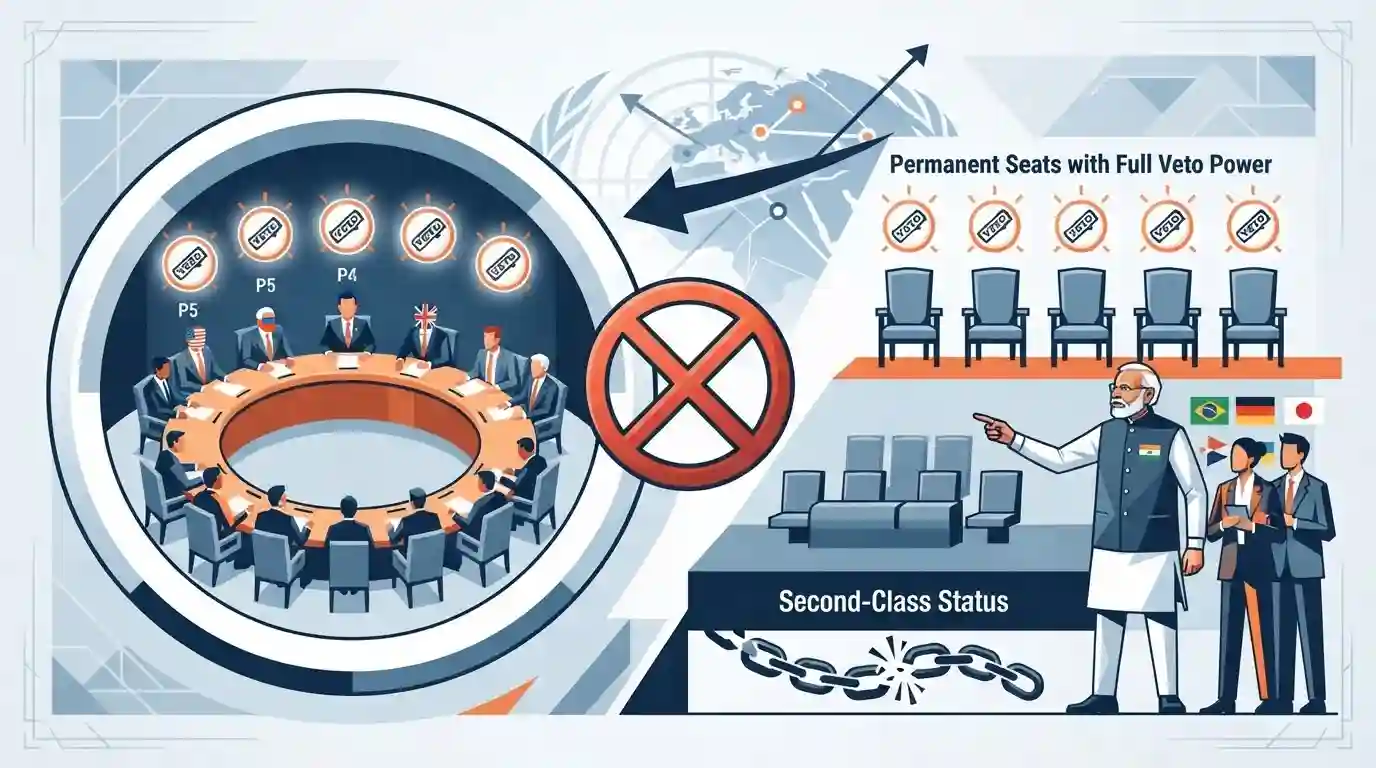
India strongly opposed any UN Security Council reform model that creates permanent members without veto power, asserting that such an arrangement would institutionalize 'second-class' status and fail to address true structural representation in global governance.
মূল বিষয়
- India has firmly rejected any proposal to expand the UN Security Council with permanent members who do not possess veto power, calling them 'second-class' members.
- India emphasized that true multilateral reform requires equal rights and responsibilities for all permanent members to reflect contemporary geopolitical realities.
- The debate highlights ongoing friction in UN reform negotiations, particularly regarding the privileges of the P5 nations versus aspiring global powers like the G4.
গুরুত্বপূর্ণ শব্দ
United Nations Security Council

The principal organ of the United Nations charged with maintaining international peace and security, consisting of five permanent members with veto power and ten rotating non-permanent members.
UPSC context
UPSC GS Paper II: Important International institutions, agencies and fora - their structure, mandate, and functioning.
UNSC
Abbreviation for the United Nations Security Council, which is central to discussions on global multilateral governance reform and equitable representation.
UPSC context
UPSC GS Paper II: Bilateral, regional and global groupings and agreements involving India and/or affecting India's interests.
India
A major global power advocating for comprehensive structural reforms of multilateral institutions, opposing any UNSC expansion that creates second-class permanent members without veto powers.
UPSC context
UPSC GS Paper II: India's foreign policy, multilateral diplomacy, and pursuit of permanent membership in global governance bodies.
প্রিলিমস ফাঁদ
India has never compromised on its demand for immediate, unconditional veto power upon entering the UNSC.
Aspirants often assume India demands an immediate permanent seat with full veto rights without compromise, missing that the G4 previously offered a tactical 15-year veto deferral.
সংযুক্ত স্থির ধারণা
What is the composition and voting procedure of the UN Security Council?
- Membership breakdown: Total 15 members comprising 5 permanent (P5) and 10 non-permanent members elected for two-year terms.
- Veto power: Procedural decisions require 9 votes; substantive decisions require 9 votes including the concurring votes of all P5 members.
- Abstention rule: Abstention by a permanent member is historically not considered a veto under Article 27(3).
আন্তঃবিষয় প্যাটার্ন
UNSC Veto vs WTO Appellate Body Deadlocks
The deadlock in UN reform mirrors deadlocks in WTO appellate body appointments, where institutional design prevents major emerging economies from exercising commensurate governance roles.

Expect a statement-based question pairing the IGN framework, G4 composition, and the legal mechanics of Article 108 of the UN Charter.
সংযুক্ত PYQ · 2
সংযুক্ত PYQ · 2
- 2015MainsGS2
Discuss the impediments India is facing in its pursuit of a permanent seat in UN Security Council.
- 2025MainsGS2
"The reform process in the United Nations remains unresolved, because of the delicate imbalance of East and West and entanglement of the USA vs. Russo-Chinese alliance.” Examine and critically evaluate the East-West policy confrontations in this regard.
