US universal tariff proposals threaten multilateral trading system
Source:Indian Express ↗
Why It Matters
As protectionism rises in the global north, UPSC aspirants must understand its macroeconomic fallout on India's exports and the systemic challenge it poses to multilateral institutions like the WTO.
Summary
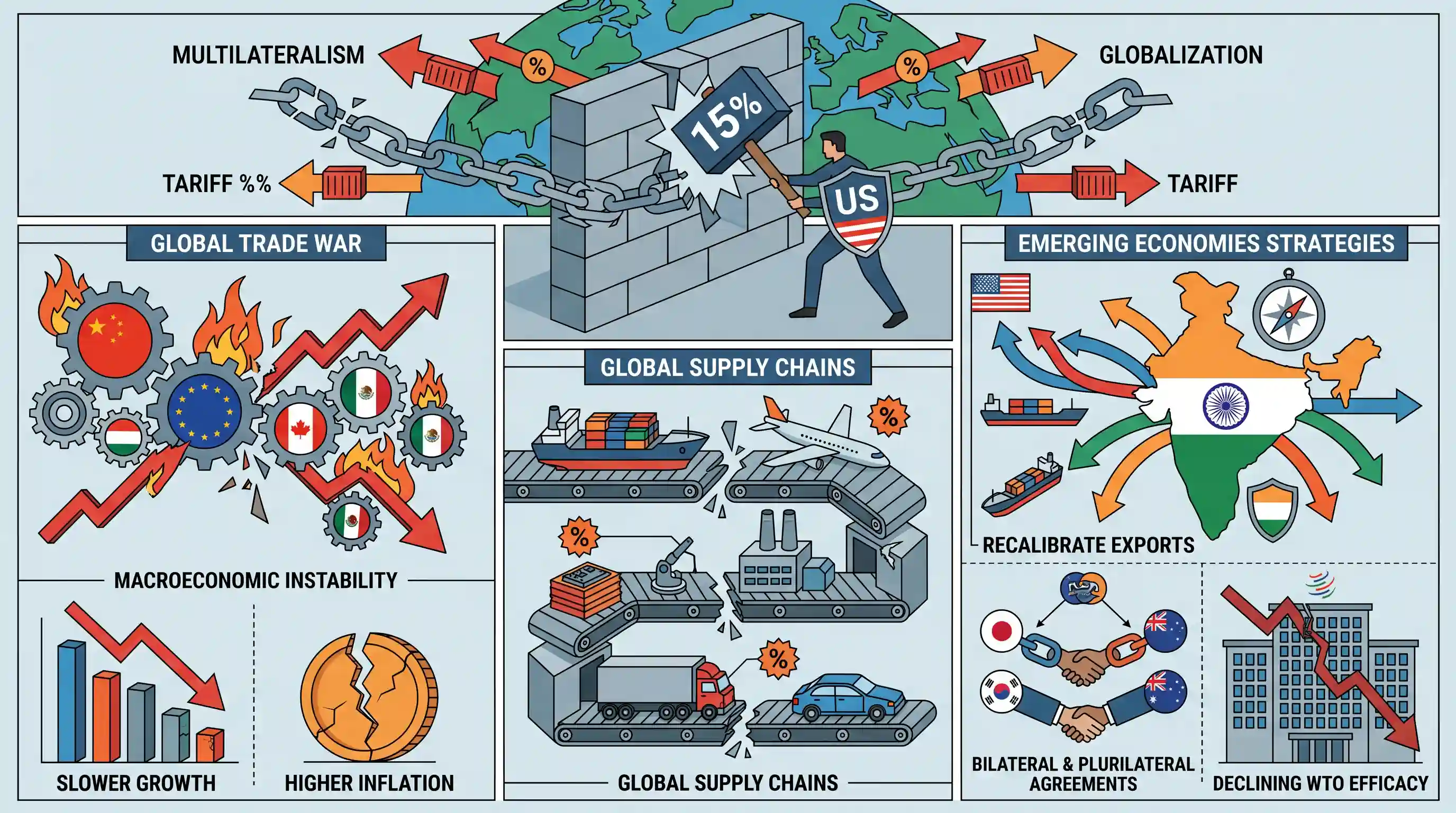
The article analyzes the economic implications of the newly proposed 15% US tariff hike under Donald Trump's administration. This steep increase signals a broader shift towards protectionism and sovereign nationalism, departing from post-Cold War globalization and multilateralism. The policy threatens to ignite a global trade war, prompting retaliatory measures that could disrupt supply chains and stoke inflation worldwide. For emerging economies like India, navigating this shift requires recalibrating export strategies and seeking robust bilateral agreements amid the declining efficacy of the World Trade Organization (WTO).
Key Points
- The US administration's proposal to hike universal baseline tariffs to 15% reflects a steep escalation in protectionist trade policies.
- Such unilateral tariff impositions threaten to violate WTO principles like the Most Favoured Nation (MFN) rule, challenging the global rules-based trading system.
- The move risks triggering a global trade war as other nations may impose retaliatory tariffs, which could disrupt international supply chains and fuel inflation.
- For India, the tariffs pose a challenge to export competitiveness, necessitating a strategic pivot towards stronger bilateral trade agreements to buffer the macroeconomic impact.
Important Terms
Protectionism

Economic policy of shielding domestic industries from foreign competition by imposing barriers like tariffs, quotas, or subsidies. It aims to safeguard local jobs and infant industries.
UPSC context
GS Paper 3 (Economy); important for analyzing trade deficits and "Make in India" versus global trade trends.
Multilateralism
Diplomatic practice where three or more nations coordinate policies on global issues through international organizations (e.g., WTO, UN) to achieve collective, rules-based goals.
UPSC context
GS Paper 2 (IR); tests understanding of global governance versus rising bilateralism and minilateralism like the QUAD.
World Trade Organization (WTO)
The only global international organization dealing with rules of trade between nations. Established in 1995, it facilitates negotiations and resolves trade disputes among members.
UPSC context
GS Paper 2 (IR); vital for topics like the Appellate Body crisis and India's food security subsidies.
Free Trade Agreements (FTAs)
Treaties between two or more countries to reduce or eliminate barriers to trade, such as tariffs and quotas, providing preferential market access to member nations.
UPSC context
GS Paper 2 & 3; relevant for India's trade strategy and agreements with the UAE and Australia.
Sovereign Nationalism
Geopolitical trend where states prioritize national interests, borders, and self-reliance (e.g., Atmanirbhar Bharat) over liberal globalization and international cooperative frameworks.
UPSC context
GS Paper 2 (IR); tests critical analysis of "Deglobalization" and India’s strategic autonomy in a multipolar world.
Global Supply Chains
Transnational networks of production and distribution. Current strategies emphasize "resilience" (Just-in-case) over "efficiency" (Just-in-time) to withstand geopolitical and pandemic shocks.
UPSC context
GS Paper 3 (Economy); critical for discussing the Supply Chain Resilience Initiative and manufacturing hub aspirations.
Trade War
Economic conflict where countries repeatedly retaliate by raising trade barriers, leading to increased consumer prices, disrupted production networks, and global market volatility.
UPSC context
GS Paper 3 (Economy/IR); tests ability to evaluate external shocks on India’s macroeconomic stability and exports.
Prelims Trap
"Most Favoured Nation (MFN) status allows a country to grant special, exclusive tariff concessions to a favoured trading partner."
MFN actually means non-discrimination (treating all members equally). Exclusive concessions are exceptions to MFN, allowed only under specific FTAs or the Generalized System of Preferences (GSP).
Static Concepts Connected
What is the Most Favored Nation (MFN) principle under the WTO?
- Non-discrimination: Ensures a level playing field by mandating equal trade treatment among all WTO member nations.
- GATT Article I: Dictates that any tariff reduction or trade privilege granted to one nation must automatically be extended to all members.
- Allowed Exceptions: Strictly permitted for comprehensive Free Trade Agreements (FTAs) and preferential access given to developing countries.
How do global trade wars trigger imported inflation?
- Cost-Push Mechanism: Retaliatory tariffs raise the landing cost of imported raw materials and intermediate goods, driving up domestic manufacturing costs.
- Currency Depreciation: Trade uncertainty often leads to capital flight, weakening domestic currency and further inflating the rupee cost of essential imports.
- Monetary Policy Impact: Forces the central bank (RBI) to tighten monetary policy or intervene in forex markets, slowing broader economic growth.
Cross-Topic Patterns
Protectionism vs. PLI manufacturing schemes
Rising global tariffs complicate India's export-driven manufacturing ambitions under PLI, forcing a strategic tension between self-reliance (Atmanirbhar) and integration into global value chains.
Geopolitics of Global Value Chains (GVCs)
US tariffs accelerate the "China Plus One" strategy, linking Western trade protectionism directly to India's geopolitical push for resilient supply chains via the Quad.

Expect a multi-statement Prelims question testing the technical exceptions to WTO's MFN principle, linking FTAs and security clauses.
Linked PYQs · 4
Linked PYQs · 4
- 2025MainsGS2
"With the waning of globalization, post-Cold War world is becoming a site of sovereign nationalism.” Elucidate.
- 2025MainsGS3
What are the challenges before the Indian economy when the world is moving away from free trade and multilateralism to protectionism and bilateralism? How can these challenges be met?
- 2018MainsGS3
How would the recent phenomena of protectionism and currency manipulations in world trade affect macroeconomic stability of India?
- 2018MainsGS2
What are the key areas of reform if the WTO has to survive in the present context of "Trade War', especially keeping in mind the interest of India?
