Scientists develop new synthetic cell capable of division
Source:The Hindu ↗
Why It Matters
This development represents the frontier of bottom-up bioengineering. Moving beyond simple genetic modification, the creation of self-replicating artificial life from non-living chemicals challenges our definition of life and has direct relevance to GS3 Science & Technology (biotechnology achievements, ethical/regulatory frameworks like the Cartagena Protocol) and GS4 (the ethics of creating artificial life).
Summary
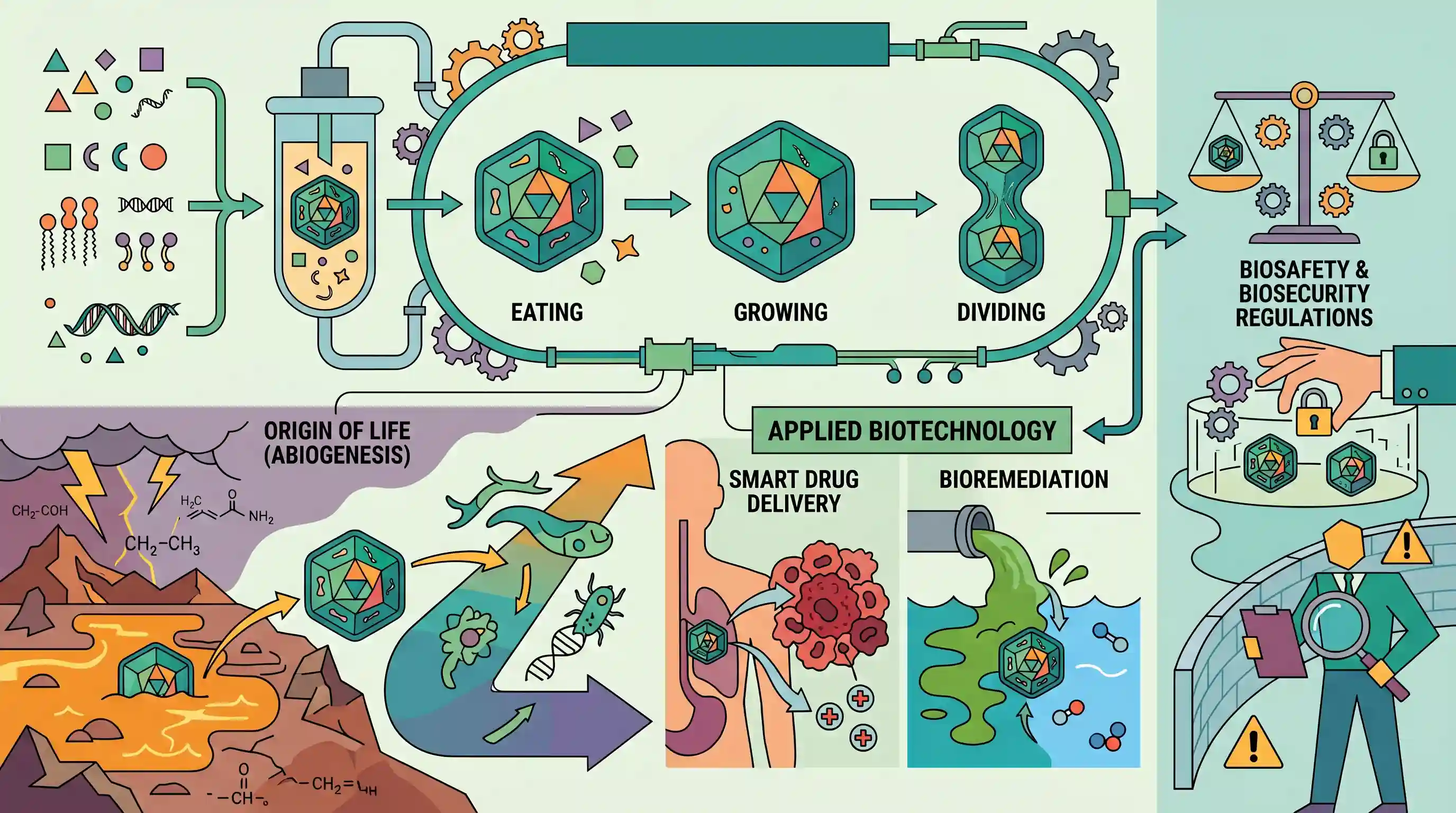
The article details a major scientific breakthrough: the development of a synthetic cell that can independently eat, grow, and divide. This bottom-up engineering of a functional artificial cell from non-living components mimics the core pillars of life and holds profound implications for understanding the origins of life on Earth, advancing smart drug delivery, and creating self-sustaining bioremediation tools, while raising crucial ethical and biosafety considerations.
Key Points
- Scientists have developed a new synthetic cell that mimics three fundamental processes of life: eating (nutrient intake and metabolism), growing (membrane expansion), and dividing (reproduction/fission).
- This represents a breakthrough in bottom-up synthetic biology, where lifelike systems are engineered from scratch using non-living biochemical components (lipids, proteins, nucleic acids), rather than stripping down existing living organisms.
- The artificial cell employs giant lipid vesicles that actively import nutrients to drive metabolic reactions, allowing the membrane to expand and eventually pinch off into daughter cells autonomously.
- The research provides deep insights into abiogenesis (the origin of life), showing how early prebiotic protocells could have maintained metabolism and self-replicated before complex genomic machinery evolved.
- Potential real-world applications include targeted, smart drug delivery systems (that seek out, consume local tumor microenvironment resources, and divide/release drugs) and environmental bioremediation (eating and degrading pollutants like microplastics).
Important Terms
Cartagena Protocol on Biosafety

An international treaty under the Convention on Biological Diversity that regulates the transboundary movement, transit, handling, and use of living modified organisms (LMOs) to protect biodiversity from biotechnology risks.
UPSC context
Important for GS Paper III (Environment & Biodiversity), testing international treaties, biosafety regulations, and genetically modified organisms (GMOs).
Convention on Biological Diversity
A key multilateral treaty opened at the 1992 Rio Earth Summit, aiming for the conservation of biological diversity, sustainable use of its components, and fair, equitable sharing of genetic resource benefits.
UPSC context
Crucial for GS Paper III (Environment), testing global conservation frameworks, the Rio Conventions, and international ecological policies.
J. Craig Venter Institute
A non-profit research organization renowned for pioneering genomic science and synthetic biology, famously creating the first functional synthetic bacterial genome and minimal living cells.
UPSC context
Relevant for GS Paper III (Science & Technology), testing advancements in synthetic biology, genetics, and biotechnology milestones.
Max Planck Institute of Biochemistry
A world-class German research institute leading in molecular biology and bottom-up synthetic biology, focusing on reconstructing cellular modules and minimal self-dividing membranes from scratch.
UPSC context
Relevant for GS Paper III (Science & Technology), testing emerging biotechnology fields, international scientific research, and cellular engineering.
University of Tokyo
A leading Japanese institution whose researchers have made pioneering breakthroughs in bottom-up synthetic biology, including self-reproducing artificial lipid vesicles coupled with DNA amplification.
UPSC context
Relevant for GS Paper III (Science & Technology), testing international collaborative research and breakthroughs in nanotechnology and artificial cell systems.
Prelims Trap
Bioremediation techniques using synthetic cells can degrade and eliminate toxic heavy metals like lead and cadmium from contaminated ecosystems.
Inorganic heavy metals cannot be degraded or destroyed by biological processes; they can only be chemically transformed, bio-accumulated, or immobilized. Only organic pollutants are truly degraded.
Static Concepts Connected
What are the core features of the Cartagena Protocol on Biosafety?
- Parent Treaty: It is a supplementary agreement to the Convention on Biological Diversity (CBD) adopted in 2000.
- Primary Objective: It ensures the safe handling, transport, and use of Living Modified Organisms (LMOs) across international borders.
- Precautionary Principle: It allows member nations to restrict LMO imports even in the absence of absolute scientific certainty regarding risks.
How do top-down and bottom-up synthetic biology differ?
- Top-down approach: Starts with existing living cells and strips or replaces their genomes with synthesized DNA to modify functions.
- Bottom-up approach: Chemically assembles functional, life-like protocells from scratch using completely non-living molecular components like lipids and nucleic acids.
Cross-Topic Patterns
Bioremediation limits + Eco-restoration
While synthetic cells can degrade organic microplastics, they cannot destroy heavy metals, highlighting thermodynamic boundaries in technology-driven ecological cleanup.
LMO regulations + National Biosecurity
Autonomous synthetic cells challenge the classic definition of Living Modified Organisms, necessitating updates to international biosafety laws under the Cartagena Protocol.

Distinction between top-down/bottom-up synthetic biology and the physical limits of heavy metal bioremediation likely to feature in 2026.
Linked PYQs · 2
Linked PYQs · 2
- 2019PrelimsGS1
With reference to the recent developments in science, which one of the following statements is not correct?
- 2021MainsGS3
What are the research and developmental achievements in applied biotechnology? How will these achievements help to uplift the poorer sections of the society?
