Scientists Discover New Solid Liquid Hybrid State of Matter
Source:The Hindu ↗
Why It Matters
Fundamental discoveries in physics regarding states of matter lay the groundwork for next-generation materials science and nanotechnology. Understanding these hybrid states is crucial for India's scientific competitiveness and the future development of advanced industrial applications.
Summary
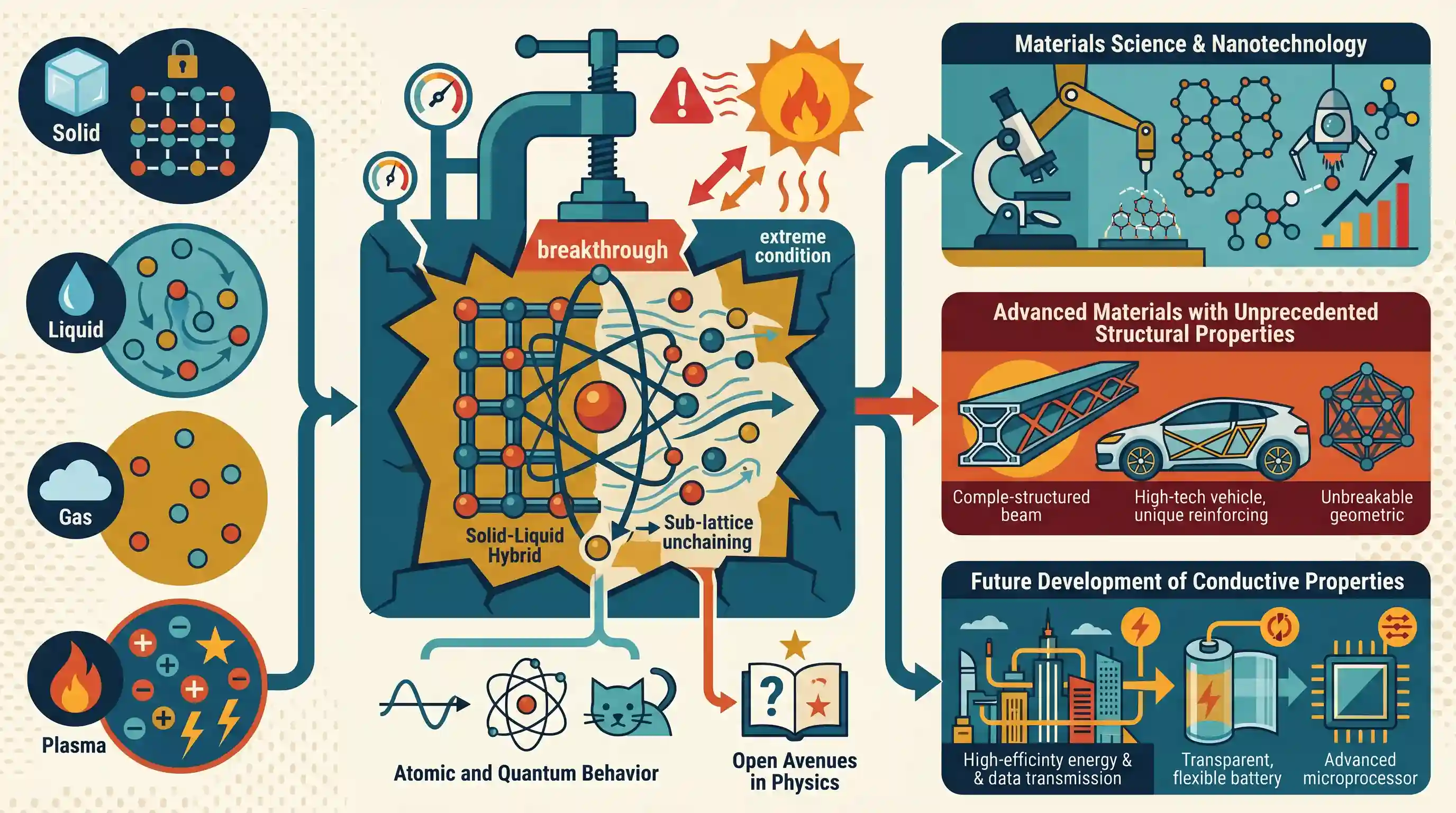
A recent scientific discovery highlights a new state of matter that acts as a solid-liquid hybrid, defying traditional classifications like solid, liquid, gas, and plasma. Similar to phenomena like the chain-melted state, this hybrid state occurs when materials exhibit both a rigid atomic lattice and fluid-like atomic flow simultaneously. This fundamental breakthrough in physics deepens our understanding of atomic and quantum behavior under extreme conditions. Furthermore, it opens new avenues in materials science and nanotechnology, promising the future development of advanced materials with unprecedented structural and conductive properties.
Key Points
- Scientists have reported a new state of matter that exhibits properties of both a solid and a liquid simultaneously, challenging the traditional categorization of matter into strictly solid, liquid, gas, or plasma.
- This 'solid-liquid hybrid' state is conceptually similar to the 'chain-melted state' observed in certain elements (like potassium) under extreme pressure and temperature, where a rigid lattice coexists with flowing, molten atoms.
- The discovery expands the fundamental understanding of atomic structures and quantum mechanics, which forms the bedrock of basic science research.
- Such dual-property states hold significant potential for breakthroughs in materials science and nanotechnology, potentially leading to the development of novel materials with unique thermal, electrical, and structural characteristics.
Prelims Trap
The solid-liquid hybrid state forms when materials are cooled to near absolute zero, similar to a Bose-Einstein Condensate.
This hybrid state (chain-melted) occurs under extreme high pressure and temperature, which is the complete opposite of a Bose-Einstein Condensate.
Static Concepts Connected
What are the key exotic states of matter beyond solid, liquid, and gas?
- Plasma: Superheated, highly ionized gas that generates and responds to electromagnetic fields; it is the most abundant state of matter in the visible universe.
- Bose-Einstein Condensate (BEC): Formed near absolute zero when uncharged bosons lose individual identities and merge into a single macroscopic quantum entity.
- Chain-melted state: Occurs under extreme heat and pressure (e.g., in potassium), where a strong, rigid atomic lattice coexists with flowing, molten atoms.
Why do fundamental properties alter at the nanoscale or under quantum extreme conditions?
- Surface-Area Ratio: As materials shrink, their surface-area-to-volume ratio exponentially increases, drastically enhancing chemical reactivity, mechanical strength, and thermal properties.
- Quantum Dominance: At atomic scales or under extreme pressures, quantum mechanical effects dominate macroscopic classical physics, radically altering a material's optical, electrical, and magnetic behaviors.
Cross-Topic Patterns
Quantum physics enabling Nanotech
Exotic material states provide the fundamental atomic understanding needed to engineer novel nanomaterials, highly conductive structures, and topological insulators for next-generation electronics and quantum computing.
High-pressure physics & planetary cores
The extreme pressure-temperature conditions creating solid-liquid hybrids in labs mirror environments inside gas giants and planetary interiors, linking basic material physics directly to astrophysics.

Expect a 2026 multi-statement question contrasting the formation conditions of BECs (absolute zero) vs. chain-melted states (extreme heat).
Linked PYQs · 3
Linked PYQs · 3
- 2013PrelimsGS1
The efforts to detect the existence of Higgs boson particle have become frequent news in the recent past. What is/are the importance/importances of discovering this particle?
- 2020PrelimsGS1
With reference to carbon nanotubes, consider the following statements: 1. They can be used as carriers of drugs and antigens in the human body. 2. They can be made into artificial blood capillaries for an injured part of human body. 3. They can be used in biochemical sensors. 4. Carbon nanotubes are biodegradable. Which of the statements given above are correct?
- 2012PrelimsGS1
Graphene is frequently in news recently. What is its importance? 1. It is a two-dimensional material and has good electrical conductivity. 2. It is one of the thinnest but strongest materials tested so far. 3. It is entirely made of silicon and has high optical transparency. 4. It can be used as 'conducting electrodes' required for touch screens, LCDs and organic LEDs. Which of the statements given above are correct?
