New START treaty expiry and global nuclear arms control implications
Source:The Hindu ↗
Why It Matters
The collapse of the US-Russia nuclear arms control architecture fundamentally alters the global security environment. For UPSC aspirants, understanding this shift is crucial for analyzing the evolving geopolitics of deterrence, the crisis in the global non-proliferation regime (like the NPT), and the broader implications for international stability and India's own strategic posture.
Summary
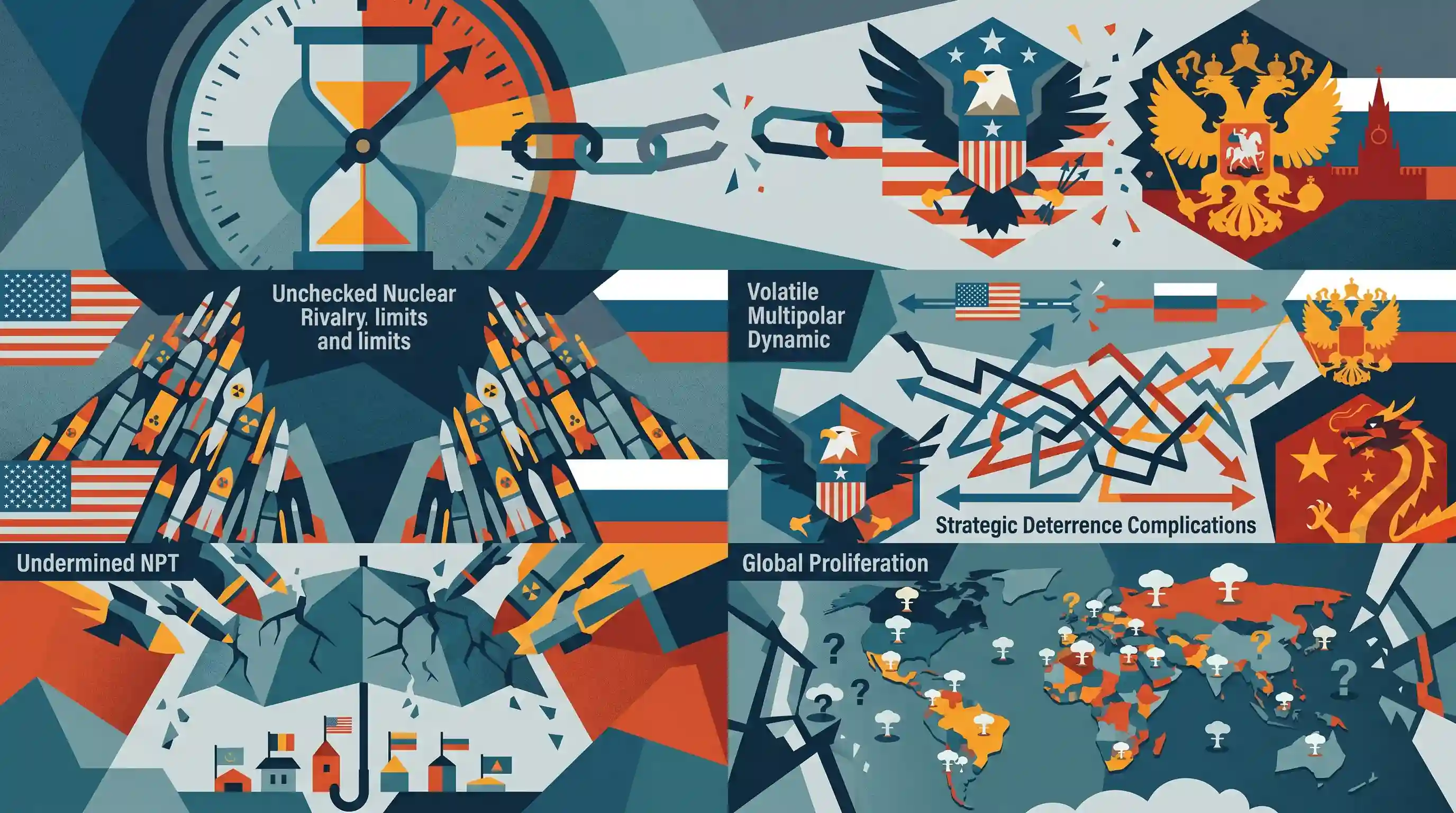
The impending expiration of the New START treaty in February 2026 marks a critical juncture for global security, as it threatens to eliminate the last remaining bilateral nuclear arms control pact between the United States and Russia. The article highlights that without a replacement or extension, the world risks entering an era of unchecked nuclear rivalry. This vacuum in arms control not only paves the way for a quantitative arms race but also complicates strategic deterrence, particularly as China rapidly modernizes and expands its own nuclear capabilities, transforming a bipolar dynamic into a volatile multipolar one. Furthermore, the failure of the two largest nuclear powers to limit their arsenals severely undermines the Treaty on the Non-Proliferation of Nuclear Weapons (NPT), potentially weakening the global non-proliferation framework and increasing the likelihood of nuclear proliferation globally.
Key Points
- The impending expiry of the New START treaty in 2026 removes the last remaining cap on deployed strategic nuclear warheads between the United States and Russia.
- The collapse of this bilateral framework threatens to trigger a new, unconstrained nuclear arms race, shifting the global strategic dynamic from a bipolar to a more complex multipolar environment involving China.
- Without verifiable limits on arsenals, strategic deterrence becomes significantly more volatile, expensive, and difficult to manage.
- The absence of US-Russia arms control undermines their commitments under Article VI of the NPT, weakening the global non-proliferation regime and potentially encouraging other states to pursue nuclear weapons.
Important Terms
New START (Strategic Arms Reduction Treaty)

The last remaining bilateral nuclear arms control treaty between the US and Russia, capping deployed strategic nuclear warheads at 1,550. It expired in February 2026 after its final 2021 extension.
UPSC context
GS II (International Relations). Essential for understanding the collapse of bilateral arms control and its impact on global strategic stability and Indian security.
Treaty on the Non-Proliferation of Nuclear Weapons (NPT)
A 1970 international treaty aiming to prevent the spread of nuclear weapons, promote peaceful nuclear energy, and pursue disarmament. It designates five "Nuclear-Weapon States" based on pre-1967 tests.
UPSC context
GS II (Agreements affecting India's interests). Tests knowledge of India's stance against "atomic apartheid" and why it remains a non-signatory despite nuclear status.
Nuclear Suppliers Group (NSG)
A 48-member export control regime that regulates the global trade of nuclear materials and technology to prevent proliferation. It was formed in 1974 following India's first nuclear test.
UPSC context
GS II (International Institutions). Key for analyzing India's 2008 waiver and ongoing diplomatic efforts to gain membership for civil nuclear expansion.
Strategic Deterrence
A military doctrine where the threat of nuclear retaliation prevents an adversary from attacking. It relies on the "second-strike capability" to ensure a mutually assured destruction (MAD) outcome.
UPSC context
GS III (Security Challenges). Critical for assessing India's nuclear doctrine, including "No First Use" and "Credible Minimum Deterrence" in a volatile neighborhood.
Multipolar Deterrence
A nuclear landscape involving three or more significant powers (US, Russia, China) with expanding arsenals. This shift complicates traditional bipolar arms control and increases the risk of miscalculation.
UPSC context
GS II (Global Politics). Tests the ability to evaluate how China's modernization transforms global security dynamics beyond the traditional US-Russia framework.
Prelims Trap
New START limits all nuclear weapons of the US and Russia.
The treaty only caps deployed strategic (long-range) nuclear warheads and their delivery vehicles. It does not cover tactical (short-range) nuclear weapons or inactive stockpiles.
Static Concepts Connected
What are the core pillars of the NPT?
- Non-proliferation: Prevent the spread of nuclear weapons and weapons technology to non-nuclear-weapon states.
- Disarmament: All recognized Nuclear-Weapon States must pursue negotiations in good faith towards complete nuclear disarmament (Article VI).
- Peaceful Use: Promote cooperation in the peaceful uses of nuclear energy under IAEA safeguards.
How does New START differ from the INF Treaty?
- New START (2010): Limited deployed strategic nuclear warheads and delivery systems (ICBMs, SLBMs, heavy bombers). Expires in 2026.
- INF Treaty (1987): Banned all ground-launched ballistic and cruise missiles with ranges between 500 and 5,500 km. Collapsed in 2019.
- Key Difference: While INF eliminated an entire class of intermediate missiles, New START only caps the overall numbers of deployed strategic weapons.
Cross-Topic Patterns
China's Nuclear Rise + Indo-Pacific deterrence
The shift to a US-Russia-China tripolar nuclear dynamic complicates India's deterrence calculus and drives deeper strategic realignments within the Quad framework.
Vertical Proliferation + NPT Hypocrisy
The expiry highlights 'vertical proliferation', validating India's long-standing critique that the NPT is fundamentally discriminatory and fails to mandate universal disarmament by recognized powers.

Expect a 2026 GS-2 mains question linking New START’s expiry to China's nuclear modernization and the stress on India's NFU doctrine.
Linked PYQs · 3
Linked PYQs · 3
- 2011PrelimsGS1
The "New START" treaty was in the news. What is this treaty?
- 2015PrelimsGS1
Consider the following countries: 1. China 2. France 3. India 4. Israel 5. Pakistan Which among the above are Nuclear Weapons States as recognized by the Treaty on the Non-Proliferation of Nuclear Weapons, commonly known as Nuclear Non-Proliferation Treaty (NPT)?
- 2018PrelimsGS1
What is/are the consequence/consequences of a country becoming the member of the 'Nuclear Suppliers Group'? 1. It will have access to the latest and most efficient nuclear technologies. 2. It automatically becomes a member of "The Treaty on the Non-Proliferation of Nuclear Weapons (NPT)". Which of the statements given above is/are correct?
