New Legless Amphibian Species Discovery in Maharashtra Western Ghats
Source:The Hindu ↗
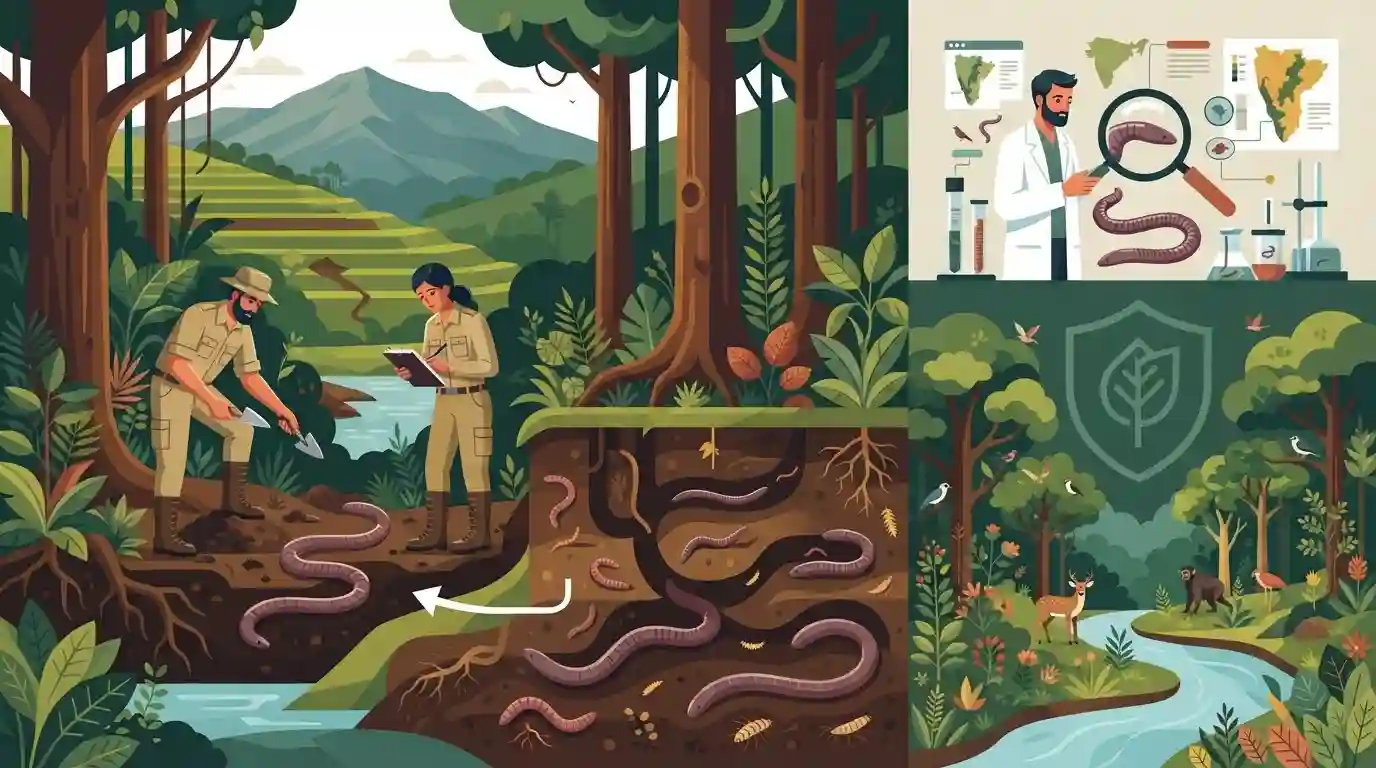
Why It Matters
New species discoveries in biodiversity hotspots like Maharashtra and the Western Ghats are critical for understanding India's faunal wealth, planning protected areas, and addressing conservation challenges for lesser-known taxonomic groups like amphibians.
Summary
Researchers have discovered a new species of legless amphibian (caecilian) in Maharashtra, adding to India's rich biodiversity profile. The finding emphasizes the ecological significance of subterranean and endemic fauna in regions like the Western Ghats and the need for rigorous habitat conservation.
Key Points
- A new species of legless amphibian (caecilian) has been discovered in Maharashtra.
- The discovery highlights the rich biodiversity and high rate of endemic species found in regions like the Western Ghats and surrounding areas.
- Caecilians are burrowing amphibians that are often poorly understood due to their subterranean lifestyle.
- New species discoveries underscore the importance of continuous ecological research and habitat protection.
Prelims Trap
All amphibians, including newly discovered caecilians, must undergo an aquatic tadpole stage to complete their life cycle.
Aspirants often assume all amphibians (like frogs) require standing water for breeding; many caecilians are terrestrial or subterranean with direct development, lacking a free-swimming larval tadpole stage.
Static Concepts Connected
What are the key ecological and morphological features of Caecilians in India?
- Morphology & Classification: Limbless amphibians belonging to the order Gymnophiona, superficially resembling earthworms or snakes.
- Distribution & Endemism: Found primarily in tropical and subtropical regions; India's Western Ghats host a high concentration of endemic species.
- Subterranean Habit: Highly secretive, burrowing underground lifestyle makes them extremely difficult to survey and monitor.
- Reproductive Strategy: Most Indian caecilians practice direct development or maternal dermatophagy (feeding on mother's skin).
Cross-Topic Patterns
Western Ghats Endemism + Eco-Sensitive Zones
The Western Ghats' high amphibian endemism is frequently tested alongside UNESCO natural site criteria and Eco-Sensitive Area notifications (Gadgil/Kasturirangan reports).
Soil Biodiversity + Agro-Chemical Impact Indicators
Subterranean caecilians depend on humid soil matrices, making them sensitive biological indicators for agrochemical pollution and land-use change in plantation belts.

Caecilian biology + Western Ghats endemism is prime fodder for a match-the-following or statement-based prelims question.
Linked PYQs · 3
Linked PYQs · 3
- 2020PrelimsGS1
With reference to India's biodiversity, Ceylon frogmouth, Coppersmith barbet, Gray-chinned minivet and White-throated redstart are
- 2026PrelimsGS1
With respect to the Western Hoolock Gibbons, which of the following statements is/are correct? 1. A Sanctuary in North-east India is home to this ape species listed as Endangered in the International Union for Conservation of Nature (IUCN) Red List. 2. They have specialized brachiation and can easily swing between trees. 3. They possess a strong and heavy build like gorillas, yet are remarkably agile tree climbers. Select the answer using the code given below :
- 2019PrelimsGS1
Consider the following pairs: Wildlife Naturally found in 1. Blue-finned Mahseer : Cauvery River 2. Irrawaddy Dolphin : Chambal River 3. Rusty-spotted Cat : Eastern Ghats Which of the pairs given above are correctly matched?
