Perovskite Silicon Solar Cell Innovation at IIT Bombay
Source:Indian Express ↗
Why It Matters
The advancement in perovskite-silicon tandem solar cells directly relates to the GS3 syllabus on Science & Technology and Infrastructure. It highlights an indigenously developed technology capable of boosting energy conversion efficiency and significantly lowering solar energy costs, which is critical for achieving India's renewable energy capacity targets.
Summary
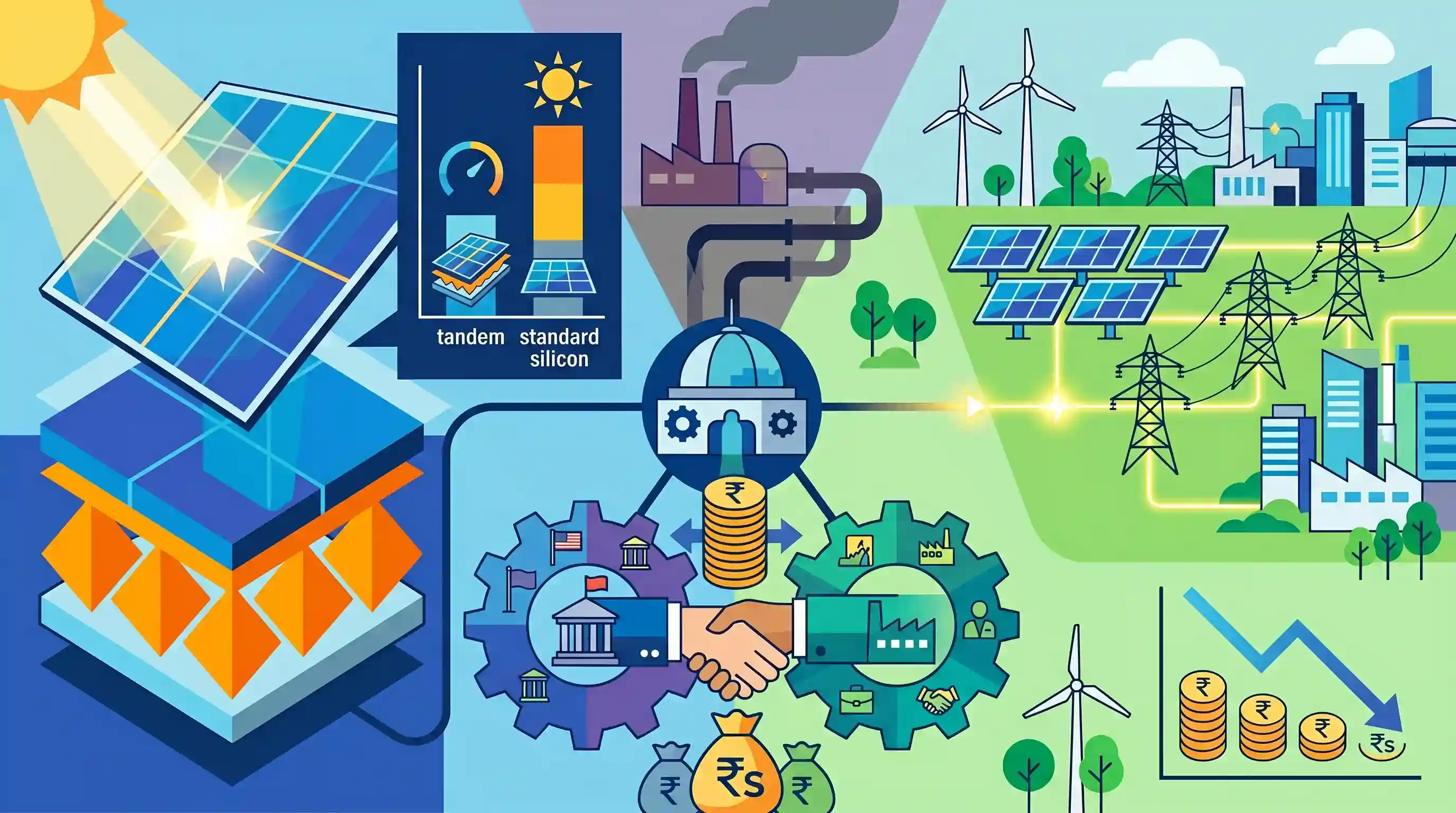
Researchers at IIT-Bombay have unveiled a breakthrough in renewable energy technology by developing a high-efficiency 2-terminal tandem solar cell that combines perovskite and silicon. This hybrid technology layers semi-transparent perovskite solar cells over traditional silicon bases, achieving a power conversion efficiency of nearly 30%—a substantial improvement over the 20% efficiency of standard silicon cells. To support the commercialisation of this game-changing technology, the Union Ministry of New and Renewable Energy announced an Rs 83 crore funding grant for the National Centre for Photovoltaic Research & Education (NCPRE) at IIT-Bombay, which will be executed through a Public-Private Partnership (PPP) model. The commercial scaling of this innovation promises to drastically reduce the cost of solar power to roughly Re 1 per unit, fundamentally supporting India's transition to clean energy.
Key Points
- Researchers at IIT-Bombay have developed a new 2-terminal tandem solar cell that pairs perovskite and silicon materials.
- By layering a semi-transparent perovskite solar cell over a conventional silicon cell, the technology achieves around 30% power conversion efficiency, up from the standard 20%.
- The Ministry of New and Renewable Energy announced Rs 83 crore in funding for the fourth phase of the NCPRE to scale up the innovation using a Public-Private Partnership (PPP) model.
- This advancement is expected to significantly reduce solar power costs, potentially lowering it from Rs 2.5-4 per unit to around Re 1 per unit.
Important Terms
Perovskite-Silicon Tandem Solar Cell

A high-efficiency hybrid solar cell that layers light-sensitive perovskite minerals over a silicon base to capture a broader spectrum of sunlight than traditional single-material cells.
UPSC context
GS Paper 3 (Science & Technology); critical for understanding next-generation renewable energy and indigenization of technology.
Ministry of New and Renewable Energy (MNRE)
India's nodal ministry for formulating policies and schemes to promote renewable energy sources, aiming to achieve 500 GW of non-fossil fuel capacity by 2030.
UPSC context
GS Paper 3 (Infrastructure/Energy); essential for understanding government institutional frameworks and climate commitments.
National Centre for Photovoltaic Research & Education (NCPRE)
A premier research hub established at IIT Bombay in 2010 with MNRE funding to provide R&D and educational support for India’s solar energy targets.
UPSC context
GS Paper 3 (S&T/Institutions); tests knowledge of domestic research infrastructure supporting the National Solar Mission.
Power Conversion Efficiency (PCE)
A ratio measuring the percentage of solar energy from sunlight that a solar cell converts into usable electrical power.
UPSC context
GS Paper 3 (S&T); a fundamental metric used to evaluate the commercial and technical viability of solar technologies.
Public-Private Partnership (PPP) in R&D
A collaborative funding and execution model where government grants (like MNRE’s ₹83 crore) support private startups or entities to scale lab research into commercial manufacturing.
UPSC context
GS Paper 3 (Economic Development/Investment Models); relevant for questions on bridging the 'lab-to-market' gap in innovation.
Prelims Trap
"Perovskite solar cells are non-toxic, highly durable, and completely stable under humid environmental conditions."
While highly efficient and cheaper to produce, perovskite cells face major hurdles precisely because they degrade rapidly in moisture and contain toxic lead components.
Static Concepts Connected
What distinguishes Perovskite Solar Cells (PSCs) from traditional Silicon cells?
- Material Composition: PSCs utilize metal halide compounds with a specific crystal structure, unlike conventional crystalline silicon bases.
- Spectral Tuning: Perovskites can be chemically tuned to absorb varied light wavelengths, making them ideal for layering over silicon in tandem cells to capture more of the solar spectrum.
- Key Vulnerabilities: Despite high efficiency, current PSCs suffer from rapid structural degradation in humid environments and often contain toxic lead.
How is India structurally tackling its reliance on imported solar modules?
- Tariff Barriers: Imposition of Basic Customs Duty (BCD) at 40% on solar modules and 25% on solar cells to make imported products uncompetitive.
- ALMM Mandate: The Approved List of Models and Manufacturers (ALMM) acts as a non-tariff barrier, restricting government-backed projects to domestically manufactured modules.
- PLI Scheme: Financial incentives through the Production Linked Incentive (PLI) scheme for gigawatt-scale domestic manufacturing of high-efficiency solar PV modules.
Cross-Topic Patterns
Advanced PV tech + Import Substitution
Indigenous tandem cell R&D directly complements the ALMM mandate and PLI scheme, creating a complete lab-to-market pipeline that reduces reliance on Chinese silicon ingots and wafers.
Perovskite cells + E-waste Management Rules
The use of lead in highly efficient perovskite cells poses future e-waste recycling challenges, directly intersecting with the Extended Producer Responsibility (EPR) mandates for solar panels.

Expect a 2026 Prelims statement-based question comparing Perovskite vs Silicon cells, specifically targeting efficiency and lead toxicity.
Linked PYQs · 5
Linked PYQs · 5
- 2014PrelimsGS1
With reference to technologies for solar power production, consider the following statements: 1. 'Photovoltaics' is a technology that generates electricity by direct conversion of light into electricity, while 'Solar Thermal' is a technology that utilizes the Sun's rays to generate heat which is further used in electricity generation process. 2. Photovoltaics generates Alternating Current (AC), while Solar Thermal generates Direct Current (DC). 3. India has manufacturing base for Solar Thermal technology, but not for Photovoltaics. Which of the statements given above is/are correct?
- 2020MainsGS3
Describe the benefits of deriving electric energy from sunlight in contrast to the conventional energy generation. What are the initiatives offered by our Government for this purpose?
- 2022MainsGS3
Do you think India will meet 50 percent of its energy needs from renewable energy by 2030 ? Justify your answer. How will the shift of subsidies from fossil fuels to renewables help achieve the above objective ? Explain.
- 2022MainsGS3
Why is Public Private Partnership (PPP) required in infrastructural projects ? Examine the role of PPP model in the redevelopment of Railway Stations in India.
- 2018MainsGS3
“Access to affordable, reliable, sustainable and modern energy is the sine qua non to achieve Sustainable Development Goals (SDGs).” Comment on the progress made in India in this regard.
