Delhi Slum Rehabilitation Policy Finalized for Urban Housing
Source:The Hindu ↗
Why It Matters
Highlights shifts in urban planning and welfare administration, providing a clear example of state intervention leveraging the PPP model to address affordable housing and slum rehabilitation. It serves as a modern case study for GS2 (welfare mechanisms) and GS3 (infrastructure and PPP).
Summary
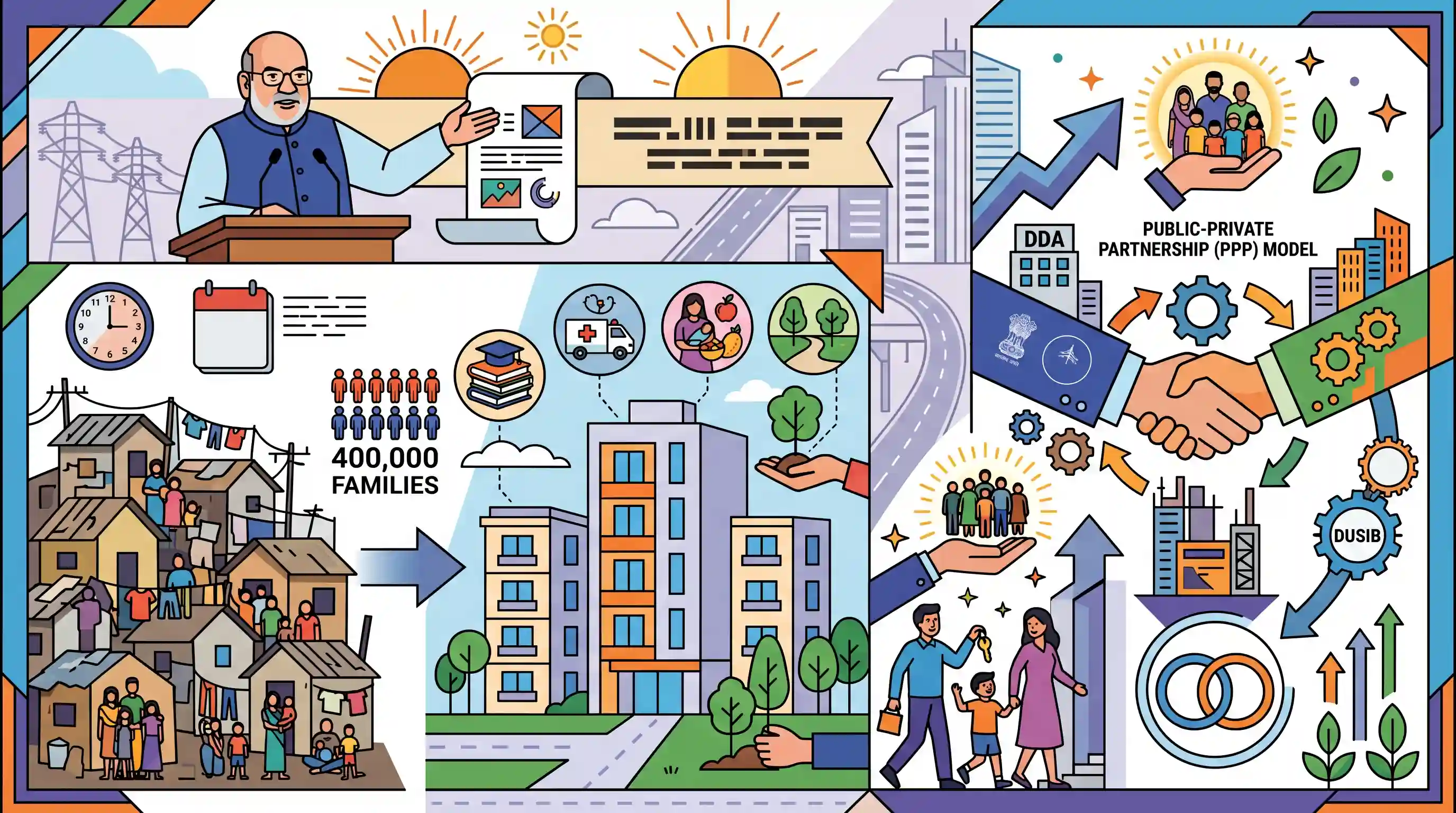
Home Minister Amit Shah announced the finalization of the Delhi Slum and JJ Cluster Rehabilitation and Relocation Policy, 2026, aimed at providing housing for roughly four lakh families. The policy replaces its 2015 predecessor, advancing the eligibility cut-off date to January 1, 2025, to include more recent residents. Implemented via a Public-Private Partnership (PPP) model by bodies such as the DDA and DUSIB, the initiative emphasizes "Antyodaya and Garib Kalyan." It promises multi-story housing blocks outfitted with crucial community infrastructure like schools, anganwadis, and healthcare facilities.
Key Points
- The newly finalized Delhi Slum and JJ Cluster Rehabilitation and Relocation Policy, 2026 replaces the 2015 framework to benefit over four lakh families.
- The eligibility cut-off date has been extended from January 1, 2015, to January 1, 2025, broadening the scope of beneficiaries.
- Projects will be executed using a Public-Private Partnership (PPP) model, overseen by agencies like the DDA and DUSIB.
- The rehabilitated colonies will feature integrated community infrastructure, including educational institutions, health centres, anganwadi centres, and parks.
Important Terms
Delhi Slum and JJ Cluster Rehabilitation and Relocation Policy, 2026

A 2026 housing framework aiming to provide permanent homes to four lakh families in Delhi's informal settlements through Public-Private Partnerships, with an eligibility cut-off date of January 1, 2025.
UPSC context
GS Paper I & II: Urbanization, housing, and government interventions for vulnerable sections.
Antyodaya
A philosophy meaning "upliftment of the last person," popularized by Pandit Deendayal Upadhyaya, focusing on ensuring that development benefits reach the most marginalized and poorest individuals first.
UPSC context
GS Paper II: Social Justice and inclusive growth philosophies; foundational for welfare scheme design.
Garib Kalyan
A governance theme meaning "welfare of the poor," central to various Indian government schemes aimed at providing food security, financial assistance, and basic amenities to economically weaker sections.
UPSC context
GS Paper II: Government policies and interventions for poverty alleviation and social welfare.
Delhi Development Authority (DDA)
A statutory body established under the Delhi Development Act, 1957, responsible for the planned development, land management, and construction of public housing in the National Capital Territory.
UPSC context
GS Paper II: Statutory bodies and urban governance; tests understanding of planning authorities.
Delhi Urban Shelter Improvement Board (DUSIB)
A statutory board under the Delhi Government (est. 2010) specifically tasked with improving the quality of life for slum and Jhuggi-Jhopri (JJ) dwellers through resettlement and civic amenities.
UPSC context
GS Paper II: Urban governance and welfare; tests knowledge of specialized state-level development agencies.
Prelims Trap
"The Delhi Slum Rehabilitation Policy is entirely administered by the Government of NCT of Delhi."
Delhi's 'Land' falls under the Union Government. Thus, DDA (a central body) plays a primary role alongside DUSIB, making it a dual-governance initiative rather than a purely state-run scheme.
Static Concepts Connected
What are the unique administrative exclusions for the Delhi Legislative Assembly?
- Article 239AA: Under the 69th Amendment, the Delhi Assembly can legislate on State/Concurrent list subjects EXCEPT Public Order, Police, and Land.
- DDA's Jurisdiction: Because 'Land' is an excluded subject, the Delhi Development Authority (DDA) operates under the Union Ministry of Housing and Urban Affairs.
How is a 'Slum' officially defined in the Indian context?
- Census of India: Defines a slum as a compact area of at least 300 population (or 60-70 households) of poorly built congested tenements with inadequate infrastructure.
- Slum Areas Act 1956: Defines slums as areas where buildings are unfit for human habitation due to dilapidation, overcrowding, or faulty design/streets.
Cross-Topic Patterns
Slum rehab vs. Asymmetric Federalism
Urban planning in Delhi often sparks federal friction because 'Land' falls under the Union Government (DDA), while civic amenities and shelter improvement often fall under state bodies (DUSIB).
PPP models in Social Infrastructure
PPPs are moving beyond hard infrastructure (highways) to social infrastructure (affordable housing, slum rehab), often requiring tools like Viability Gap Funding (VGF) to make projects commercially attractive.

Expect a GS2 Mains question on urban slum proliferation intertwined with the unique administrative bottlenecks (Article 239AA) of the NCT.
Linked PYQs · 5
Linked PYQs · 5
- 2016MainsGS1
With a brief background of quality of urban life in India, introduce the objectives and strategy of the 'Smart City Programme'.
- 2019MainsGS2
Performance of welfare schemes that are implemented for vulnerable sections is not so effective due to absence of their awareness and active involvement at all stages of policy process. Discuss.
- 2023MainsGS2
“Development and welfare schemes for the vulnerable, by its nature, are discriminatory in approach.” Do you agree? Give reasons for your answer.
- 2022MainsGS3
Why is Public Private Partnership (PPP) required in infrastructural projects ? Examine the role of PPP model in the redevelopment of Railway Stations in India.
- 2013MainsGS3
Adoption of PPP model for infrastructure development of the country has not been free of criticism. Critically discuss pros and cons of the model.
