New SAF Battalion and Tribal Police Units Planned in Khandwa
Source:free-press-journal ↗
Why It Matters
The formation of special police companies for Baiga, Bharia, and Sahariya tribes aligns with welfare measures for PVTGs, a highly recurring topic in MPPSC Prelims. It also highlights state administrative efforts regarding industrial security and police reforms.
Summary
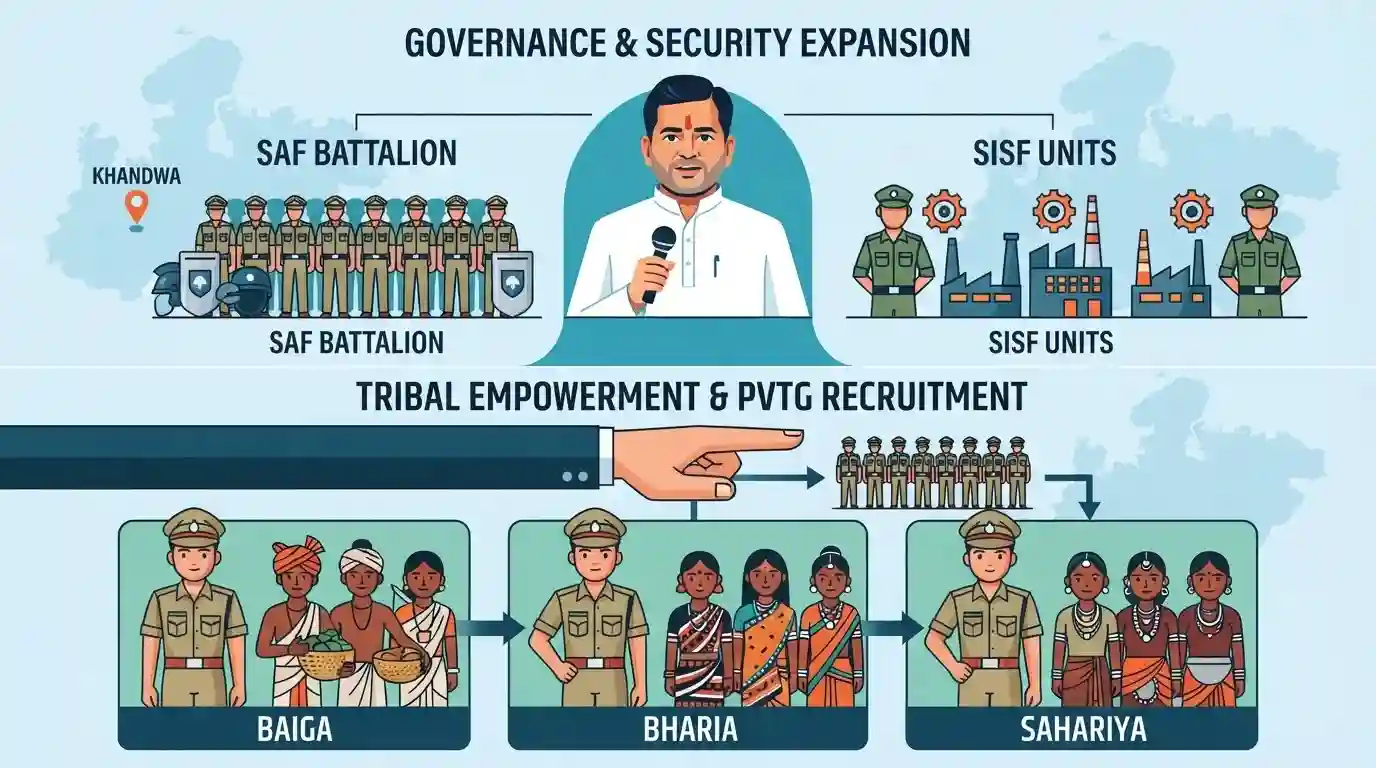
Chief Minister Mohan Yadav has announced a series of strategic expansions for the Madhya Pradesh Police, including the establishment of a new Special Armed Force (SAF) battalion in Khandwa and three State Industrial Security Force (SISF) units. In a significant move for tribal empowerment, special police companies will be created to recruit youths from the state's Particularly Vulnerable Tribal Groups (PVTGs)—the Baiga, Bharia, and Sahariya tribes. The initiative aims to enhance state security while integrating marginalized communities into the mainstream workforce.
Key Points
- A new Special Armed Force (SAF) battalion will be established in Khandwa district.
- Three State Industrial Security Force (SISF) units are being constituted in Madhya Pradesh.
- Special police companies will be formed exclusively for youths from the Baiga, Bharia, and Sahariya tribes, which are categorized as Particularly Vulnerable Tribal Groups (PVTGs).
- The government is undertaking large-scale police promotions and new recruitments, including for police bands and forensic science laboratories (FSL), to strengthen state security.
Important Terms
Particularly Vulnerable Tribal Groups (PVTGs)

The most marginalized tribal communities in India, characterized by severe socio-economic disadvantages, stagnant populations, low literacy, and pre-agricultural technology. India officially recognizes 75 such groups.
UPSC context
GS Paper 2 (Social Justice). Crucial for evaluating targeted tribal welfare schemes, demographic vulnerabilities, and affirmative action policies.
State Industrial Security Force (SISF)
A specialized armed police unit in Madhya Pradesh modeled after the CISF. It provides dedicated security to industrial areas, banks, and critical private and government infrastructure on a payment basis.
UPSC context
GS Paper 3 (Internal Security). Highlights state-level capacity building to protect economic assets and critical infrastructure from physical threats.
Special Armed Force (SAF)
The armed paramilitary wing of the Madhya Pradesh Police, established under a 1968 Act. It serves as a reserve force deployed for riot control, anti-Naxal operations, disaster management, and election security.
UPSC context
GS Paper 3 (Internal Security). Relevant for understanding the role of state-level armed forces in maintaining law and order.
Baiga Tribe
A Particularly Vulnerable Tribal Group (PVTG) predominantly inhabiting the Dindori, Mandla, and Balaghat districts of Madhya Pradesh, recognized for their animistic beliefs and profound traditional connection to forest ecosystems.
UPSC context
GS Paper 1 (Culture/Geography) & Prelims. Frequently tested in questions matching specific tribes with their geographic locations and cultural practices.
Bharia Tribe
A Particularly Vulnerable Tribal Group (PVTG) native to Madhya Pradesh. They are historically isolated and primarily reside in the remote, geographically unique Patalkot Valley of the Chhindwara district.
UPSC context
GS Paper 1 (Geography). Highly relevant for Prelims questions mapping isolated tribal groups to their specific ecological habitations.
Sahariya Tribe
A Particularly Vulnerable Tribal Group (PVTG) concentrated in the northern districts of Madhya Pradesh, including Sheopur and Shivpuri. They are currently targeted for special police recruitment to boost empowerment.
UPSC context
GS Paper 2 (Vulnerable Sections). Illustrates the intersection of tribal marginalization and state-led affirmative action through targeted employment drives.
Prelims Trap
"Due to its vast tribal demographic, Madhya Pradesh hosts the highest number of Particularly Vulnerable Tribal Groups (PVTGs) in India."
While Madhya Pradesh has a massive tribal population, Odisha has the highest number of recognized PVTGs (13). MP has only three: Baiga, Bharia, and Sahariya.
Static Concepts Connected
What are the four official criteria for declaring a community as a PVTG?
- Technology: Pre-agricultural level of technology.
- Population: A stagnant or declining population over successive censuses.
- Literacy: Extremely low level of literacy compared to other tribal groups.
- Economy: A subsistence level of economy or severe economic backwardness.
How do the new criminal laws mandate the expansion of state forensic infrastructure?
- BNSS Mandate: The Bharatiya Nagarik Suraksha Sanhita (BNSS) makes forensic evidence collection mandatory for offenses punishable by 7 years or more.
- State Capacity Burden: This statutory requirement forces state governments to rapidly upgrade Forensic Science Laboratories (FSLs) and hire specialized personnel to avoid trial delays.
Cross-Topic Patterns
Tribal Recruitment & LWE Mitigation
Raising special police companies from PVTGs acts as a soft-power internal security strategy, draining potential recruit pools for Left-Wing Extremism (LWE) by offering state employment and mainstream integration.
Decentralizing Critical Infra Security
States raising their own SISFs reflects a shift towards localized protection of industrial assets, easing the deployment burden on Central Armed Police Forces (CAPFs) while managing "Public Order" (a State List subject).

Expect a Prelims multi-statement question mapping specific PVTGs (Baiga, Sahariya) to states, alongside Dhebar Commission criteria.
Linked PYQs · 1
Linked PYQs · 1
- 2025MPPSC_PRELIMSGS1
Which one of the following is not one of the Particularly Vulnerable Tribal Group (PVTG) of Madhya Pradesh?
