Balancing AI Regulation and Free Speech in India
Source:Indian Express ↗
Why It Matters
The regulation of AI and deepfakes sits at the critical intersection of technology (GS3) and fundamental rights (GS2). UPSC frequently tests the balance between national security/public order and the freedom of speech, especially regarding new digital frameworks and intermediary guidelines.
Summary
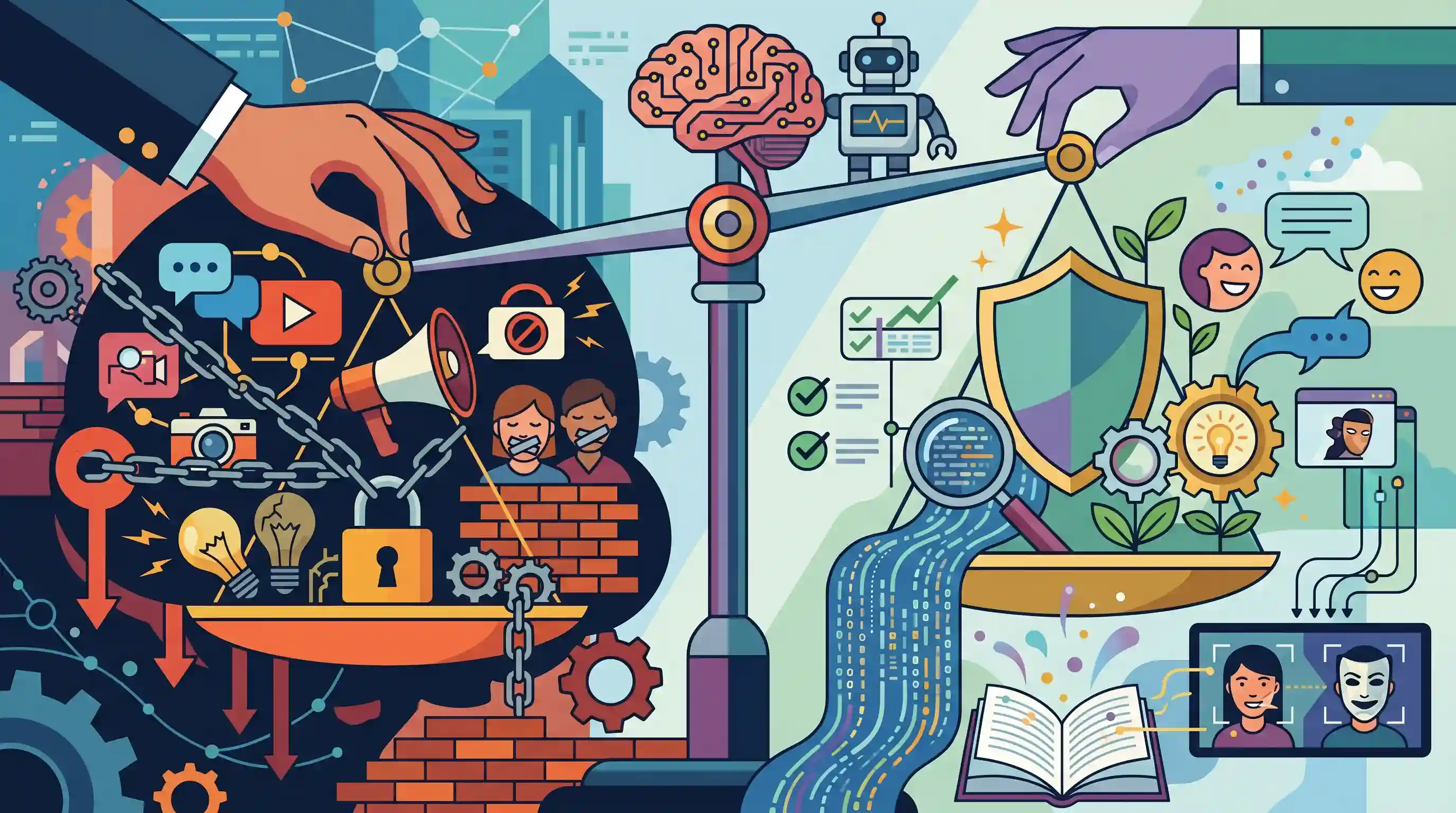
The article examines India's evolving regulatory approach towards AI-generated content, particularly the recent guidelines aimed at curbing deepfakes and misinformation. It highlights the delicate balance the government must maintain between 'calibration'—ensuring AI models are safe, reliable, and accountable—and 'censorship,' where overly stringent rules or intermediary liabilities could stifle digital innovation and infringe upon the fundamental right to freedom of speech and expression.
Key Points
- India is updating its regulatory framework to tackle the challenges of AI-generated content, focusing on curbing deepfakes, misinformation, and algorithmic bias.
- The core debate lies in distinguishing between necessary 'calibration' (ensuring AI safety, accountability, and user protection) and 'censorship' (over-regulation that restricts free speech).
- Placing heavy compliance burdens and threatening the 'safe harbour' protection of digital intermediaries can lead platforms to preemptively over-moderate content, causing a chilling effect on Article 19(1)(a).
- Effective AI regulation requires narrowly tailored definitions of harm rather than vague advisories, balancing digital innovation with the protection of electoral integrity and citizens' privacy.
Important Terms
Information Technology Act, 2000

The primary law in India governing electronic commerce, cybercrimes, and digital signatures. It provides the legal framework for Section 79 (Safe Harbour) and Section 69A (content blocking).
UPSC context
GS Paper 2/3: Essential for topics on cyber law, internal security, and digital sovereignty.
IT (Intermediary Guidelines and Digital Media Ethics Code) Rules, 2021
Subordinate legislation mandating due diligence for social media and OTT platforms. 2026 amendments specifically regulate AI-generated content through mandatory labelling and accelerated takedown timelines (2-3 hours).
UPSC context
GS Paper 2: Tests knowledge of statutory governance, platform accountability, and media ethics.
Safe Harbour Protection
Legal immunity under Section 79 of the IT Act shielding intermediaries from liability for third-party content. Protection is conditional on 'due diligence' and prompt action against unlawful content.
UPSC context
GS Paper 2: Critical for debates on Article 19 (Free Speech) vs. online safety and censorship.
Synthetically Generated Information (SGI)
A legal term under the IT Rules 2026 for AI-generated or algorithmically altered content (deepfakes). It requires prominent watermarks and metadata to prevent public deception.
UPSC context
GS Paper 3: Focuses on AI ethics, misinformation, and the technological challenges of digital regulation.
Ministry of Electronics and Information Technology (MeitY)
The nodal central ministry responsible for digital governance, electronics policy, and the IT Act's implementation. It spearheads the IndiaAI Mission and issues advisories on AI safety.
UPSC context
GS Paper 2: Key for understanding the executive's role in shaping India's tech ecosystem.
Intermediary Liability
The principle holding digital platforms accountable for user uploads. Current trends shift platforms from 'passive conduits' to active gatekeepers, especially concerning AI-driven harms.
UPSC context
GS Paper 2/3: Explores the legal balance between corporate responsibility and individual rights.
Prelims Trap
"Section 79 of the IT Act provides absolute immunity to digital platforms from third-party content liability."
Safe harbour is not absolute. Platforms lose this protection if they fail to observe due diligence or ignore lawful takedown orders from courts or government agencies.
Static Concepts Connected
What is the 'Safe Harbour' principle under Section 79 of the IT Act?
- Conditional Immunity: Exempts digital intermediaries (like social media platforms) from legal liability for hosting third-party user content.
- Due Diligence: Protection applies only if platforms observe mandated due diligence and act merely as a conduit for information.
- Shreya Singhal Ruling: Clarified that platforms must remove content only upon receiving a specific court order or government directive, preventing arbitrary private censorship.
How do Generative Adversarial Networks (GANs) create deepfakes?
- Dual AI Architecture: Consists of two neural networks—a 'generator' and a 'discriminator'—competing against each other to produce highly realistic synthetic media.
- The Generator: Creates synthetic audio, images, or video mimicking real data with the goal of deceiving the discriminator.
- The Discriminator: Evaluates the synthetic media against real data to detect forgeries, iteratively forcing the generator to improve its output until undetectable.
Cross-Topic Patterns
Article 19(1)(a) + Over-moderation
The 'chilling effect' on free speech mirrors the pre-2015 debate over Section 66A of the IT Act, where vaguely worded regulations caused platforms to preemptively censor digital content.
Electoral Integrity + Deepfakes
Combating AI-generated misinformation during campaigns merges GS2 (Elections) with GS3 (Cybersecurity). Deepfakes challenge the ECI's Model Code of Conduct by bypassing traditional ad-transparency mechanisms.

Expect a multi-statement Prelims question in 2026 linking GANs (Science) with the conditional nature of Section 79 Safe Harbour (Polity).
Linked PYQs · 4
Linked PYQs · 4
- 2023MainsGS3
Introduce the concept of Artificial Intelligence (AI). How does Al help clinical diagnosis? Do you perceive any threat to privacy of the individual in the use of Al in healthcare?
- 2024MainsGS3
Social media and encrypting messaging services pose a serious security challenge. What measures have been adopted at various levels to address the security implications of social media? Also suggest any other remedies to address the problem.
- 2014MainsGS2
What do you understand by the concept "freedom of speech and expression"? Does it cover hate speech also ? Why do the films in India stand on a slightly different plane from other forms of expression ? Discuss.
- 2020PrelimsGS1
With the present state of development, Artificial Intelligence can effectively do which of the following? 1. Bring down electricity consumption in industrial units 2. Create meaningful short stories and songs 3. Disease diagnosis 4. Text-to-Speech Conversion 5. Wireless transmission of electrical energy Select the correct answer using the code given below:
