Allied and Healthcare Professions Registration Framework in India
Source:The Hindu ↗
Why It Matters
Critical for understanding regulatory reforms in India's healthcare human resources and health service delivery systems.
Summary
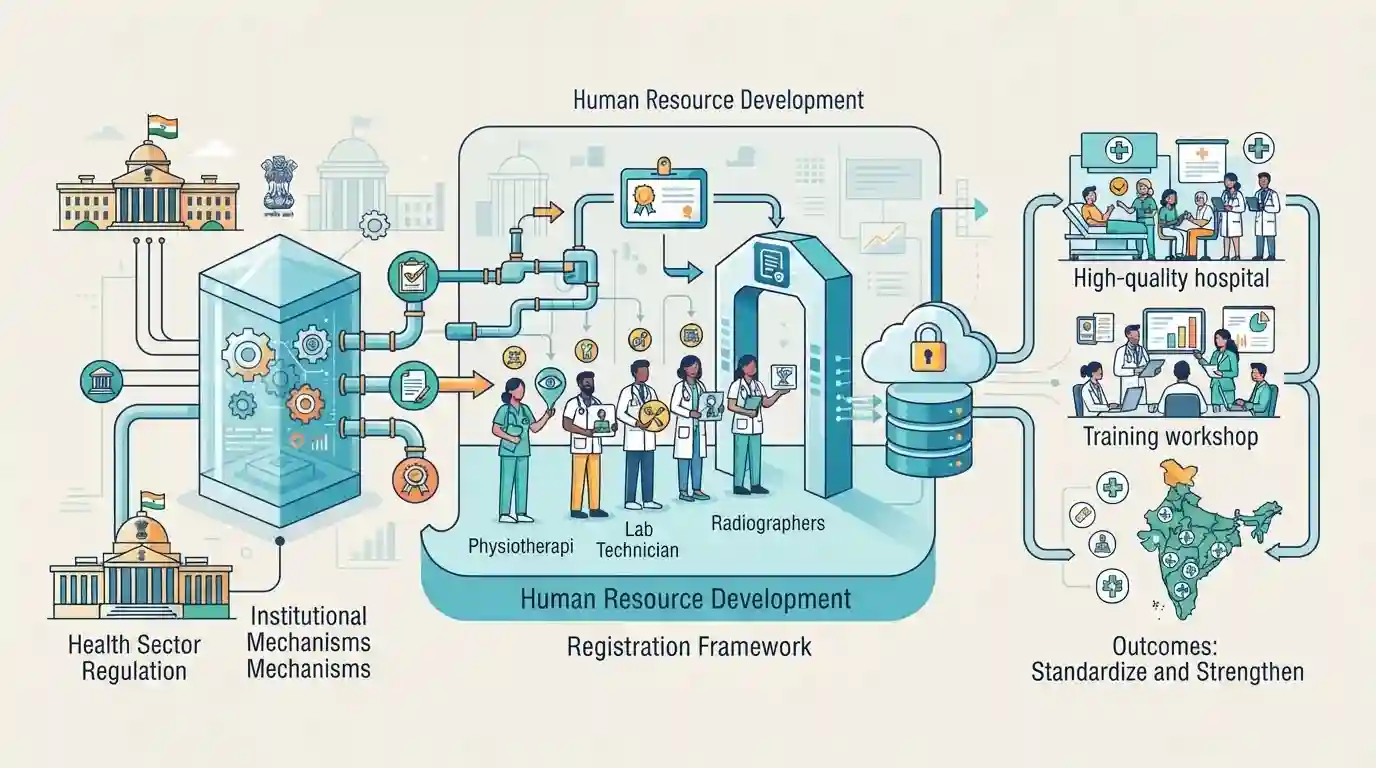
A new registration framework has been proposed in India to regulate, standardize, and strengthen allied and healthcare professions, addressing human resource challenges in the health sector.
Key Points
- A new uniform registration framework has been proposed to streamline and regulate allied and healthcare professionals across India.
- The framework aims to improve standardization, quality assurance, and mobility of healthcare workforce.
- It addresses systemic gaps in the regulation of paramedical and allied health services under the National Commission framework.
Important Terms
National Commission for Allied and Healthcare Professions Act

An Act enacted in 2021 to provide for regulation and maintenance of standards of education and services by allied and healthcare professionals in India.
UPSC context
Relevant for GS Paper II (Health, Governance, Human Resources). Tests knowledge of statutory bodies and regulatory reforms in the health sector.
National Commission for Allied and Healthcare Professions
A statutory body established under the 2021 Act to frame policies, standardize education, regulate professional conduct, and maintain central and state registers of allied and healthcare professionals.
UPSC context
Important for GS Paper II under institutional mechanisms and regulatory governance in public health.
Ministry of Health and Family Welfare
The central government ministry responsible for formulating health policies, implementing national health programs, and administering legislation related to medical education and healthcare professions in India.
UPSC context
Relevant for GS Paper II (Governance and Welfare Schemes). Tests understanding of key central ministries steering public health initiatives.
Prelims Trap
state councils retain exclusive, final authority over allied and healthcare professional licensing independent of central commission frameworks.
Aspirants often assume state medical councils retain exclusive licensing power over allied health professionals, ignoring that the NCAHP Act empowers a central statutory commission to maintain a unified national register.
Static Concepts Connected
What are the key statutory mandates of the National Commission for Allied and Healthcare Professions (NCAHP) Act, 2021?
- Central Commission: Statutory Body: Establishes NCAHP to regulate and standardize education and services of allied and healthcare professionals in India.
- National Register: Unified Register: Maintains a Central Register and State Registers for professional transparency and digital credential verification.
- Defined Categories: Professional Categories: Covers distinct professional categories including physiotherapists, nutritionists, medical lab technologists, and optometrists.
Cross-Topic Patterns
Allied Health Regulation & NMC Reform
The NCAHP Act mirrors the National Medical Commission (NMC) Act 2019, shifting governance from fragmented state councils to a unified national statutory body for allied health professionals.
Digital Health Infrastructure & ABDM Synergy
Digital registration portals for allied health practitioners connect with Ayushman Bharat Digital Mission (ABDM), building a unified national registry for healthcare workforce mapping.

NCAHP Act provisions, state-centre statutory jurisdiction, and digital registries for healthcare workforce likely to feature in Prelims.
Linked PYQs · 2
Linked PYQs · 2
- 2024MainsGS2
In a crucial domain like the public healthcare system the Indian State should play a vital role to contain the adverse impact of marketisation of the system. Suggest some measures through which the State can enhance the reach of public healthcare at the grassroots level.
- 2023MainsGS2
The crucial aspect of development process has been the inadequate attention paid to Human Resource Development in India. Suggest measures that can address this inadequacy.
