UN Global Plastics Treaty Draft and Production Cap Controversies
Source:The Hindu ↗
हे का महत्त्वाचे आहे
The global plastics treaty is a landmark multilateral environmental agreement currently under negotiation. Understanding the conflicting interests (e.g., oil-producing vs. vulnerable nations) and the shift from production caps to waste management helps aspirants address Mains questions on environmental diplomacy, climate negotiations, and the socio-economic impacts of pollution.
सारांश
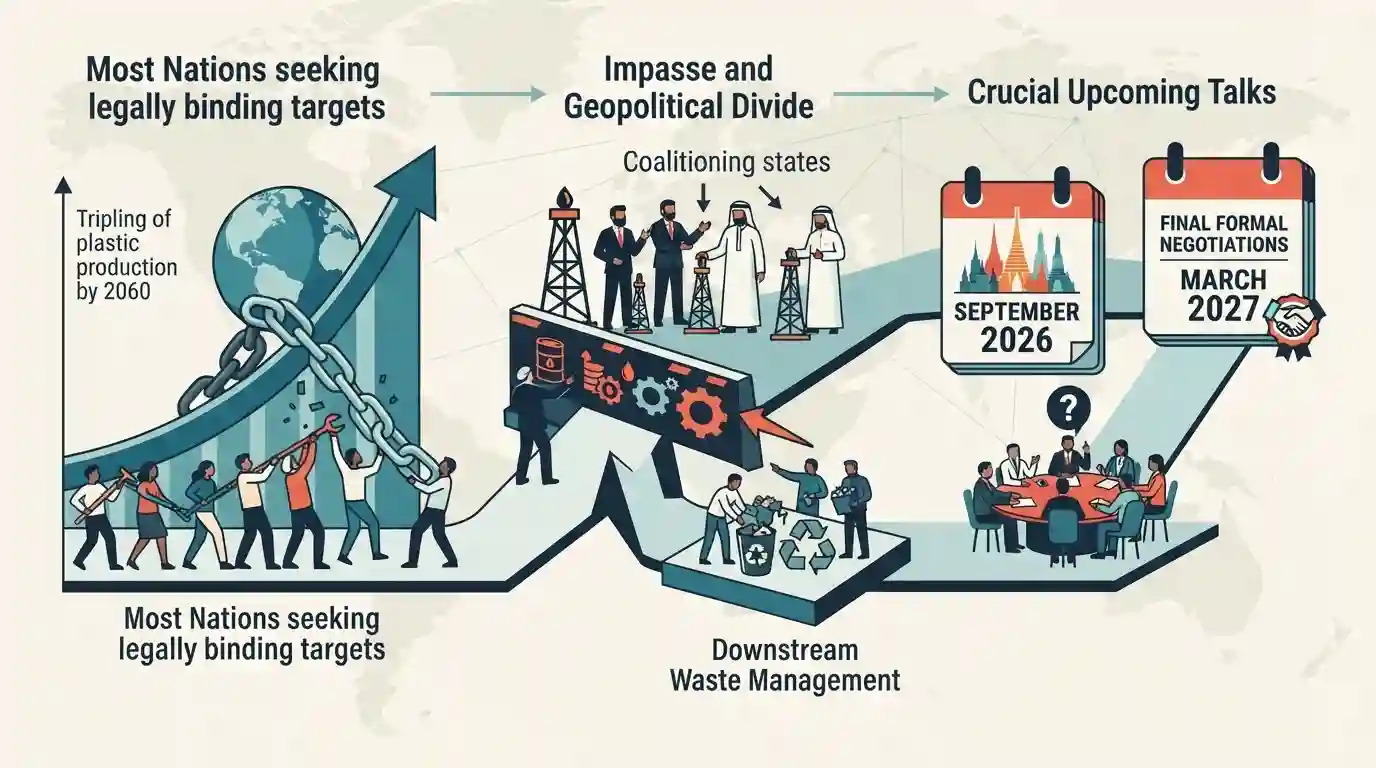
The drafting of a UN global plastics treaty faces hurdles as a new informal reference document is criticized by environmental experts for being significantly weakened. While most nations seek legally binding targets to cap plastic production—which is expected to triple by 2060—a coalition of oil-producing states, including Saudi Arabia and Russia, is actively blocking these efforts, advocating instead for a focus solely on downstream waste management. The impasse reflects the deep geopolitical divides in environmental governance, even as plastic pollution exacts a massive toll on global health and the economy. Resumed talks in Bangkok (September 2026) and final formal negotiations (March 2027) will be crucial in determining the treaty's efficacy.
मुख्य मुद्दे
- A newly released informal reference document for the UN global plastics treaty has been criticized by scientists and environmental groups for lacking ambition.
- Previous negotiations collapsed in August 2025 due to resistance from a bloc of oil-producing nations (including Saudi Arabia, Kuwait, and Russia) who prefer focusing on waste management rather than capping production.
- Global plastic production is projected to triple by 2060, prompting a majority of countries to demand legally binding production caps.
- A Lancet study highlights the immense economic burden of plastic pollution, estimating health-related costs at $1.5 trillion annually.
- Informal talks will resume in Bangkok in September 2026, leading up to the formal UN Environment Programme negotiations scheduled for March 2027.
महत्त्वाच्या संज्ञा
Global Plastics Treaty

A proposed UN-backed, legally binding international agreement aiming to eliminate plastic pollution. Negotiations are currently deadlocked over whether to cap plastic production globally or focus strictly on downstream waste management.
UPSC context
GS3 (Environment). Tests knowledge of international environmental treaties, pollution control, and geopolitical friction between conservation and fossil-fuel interests.
UN Environment Programme (UNEP)
The UN’s primary environmental authority, established in 1972. It coordinates global responses to climate change, biodiversity loss, and pollution, while facilitating major multilateral environmental agreements and providing scientific policy guidance.
UPSC context
GS2 (International Organizations) & GS3 (Environment). Essential for questions on global environmental governance, climate diplomacy, and institutional frameworks.
Center for International Environmental Law (CIEL)
A non-profit organization using international law to protect the environment and human rights. It plays a key civil-society role in treaty negotiations, regularly analyzing policy drafts and exposing corporate lobbying.
UPSC context
GS3 (Environment) & GS2 (NGOs). Highlights the role of civil society organizations in shaping and providing accountability within global environmental governance.
पूर्वपरीक्षा सापळा
The proposed Global Plastics Treaty's mandate is restricted strictly to regulating marine plastic pollution and end-of-life recycling.
UNEA Resolution 5/14 explicitly mandates an instrument addressing the full lifecycle of plastic, spanning upstream petrochemical extraction and design, not just marine environments or waste.
संबंधित स्थिर संकल्पना
What is the United Nations Environment Assembly (UNEA)?
- Governing Authority: Created in 2012 at Rio+20, it is the world’s highest-level decision-making body on environmental issues.
- Membership: It features universal membership comprising all 193 UN Member States, meeting biennially in Nairobi, Kenya.
- Key Mandate: It delivers leadership, catalyzes intergovernmental action, and negotiated the mandate for the Global Plastics Treaty.
What is the 'Lifecycle Approach' in environmental governance?
- Scope Shift: Moves regulation upstream from 'end-of-pipe' waste disposal to raw material extraction, chemical design, and production phases.
- Circular Economy Link: Aims to eliminate waste by design, keeping resources in use for as long as possible through restoration.
आंतर-विषय नमुने
Petro-geopolitics and climate negotiation parallels
Divergent petro-state interests stalling upstream plastic production caps mirror the geopolitical deadlocks over fossil fuel phase-outs observed in UNFCCC COPs.
Microplastics and public health externalities
Chemical additives in plastics act as endocrine disruptors, transforming ecological pollution into a multi-trillion-dollar global public health and human capital challenge.

UNEA's mandate for a legally binding plastic treaty versus voluntary recycling regimes likely to be framed as a core 2026 GS3/Prelims theme.
संबंधित PYQ · 3
संबंधित PYQ · 3
- 2024PrelimsGS1
Consider the following statements : Statement-I: Many chewing gums found in the market are considered a source of environmental pollution. Statement-II : Many chewing gums contain plastic as gum base. Which one of the following is correct in respect of the above statements?
- 2025PrelimsGS1
Consider the following: I. Cigarette butts II. Eyeglass lenses III. Car tyres How many of them contain plastic?
- 2022MainsGS2
‘Clean energy is the order of the day.’ Describe briefly India's changing policy towards climate change in various international fora in the context of geopolitics.
