State Level Resource Adequacy Committee Formed to Assess Power Demand
Source:firstindia ↗
Why It Matters
Questions on specific state-level committees, their mandates, and energy sector administration are highly relevant for the RPSC RAS Prelims, focusing on Rajasthan's economic and infrastructural development.
Summary
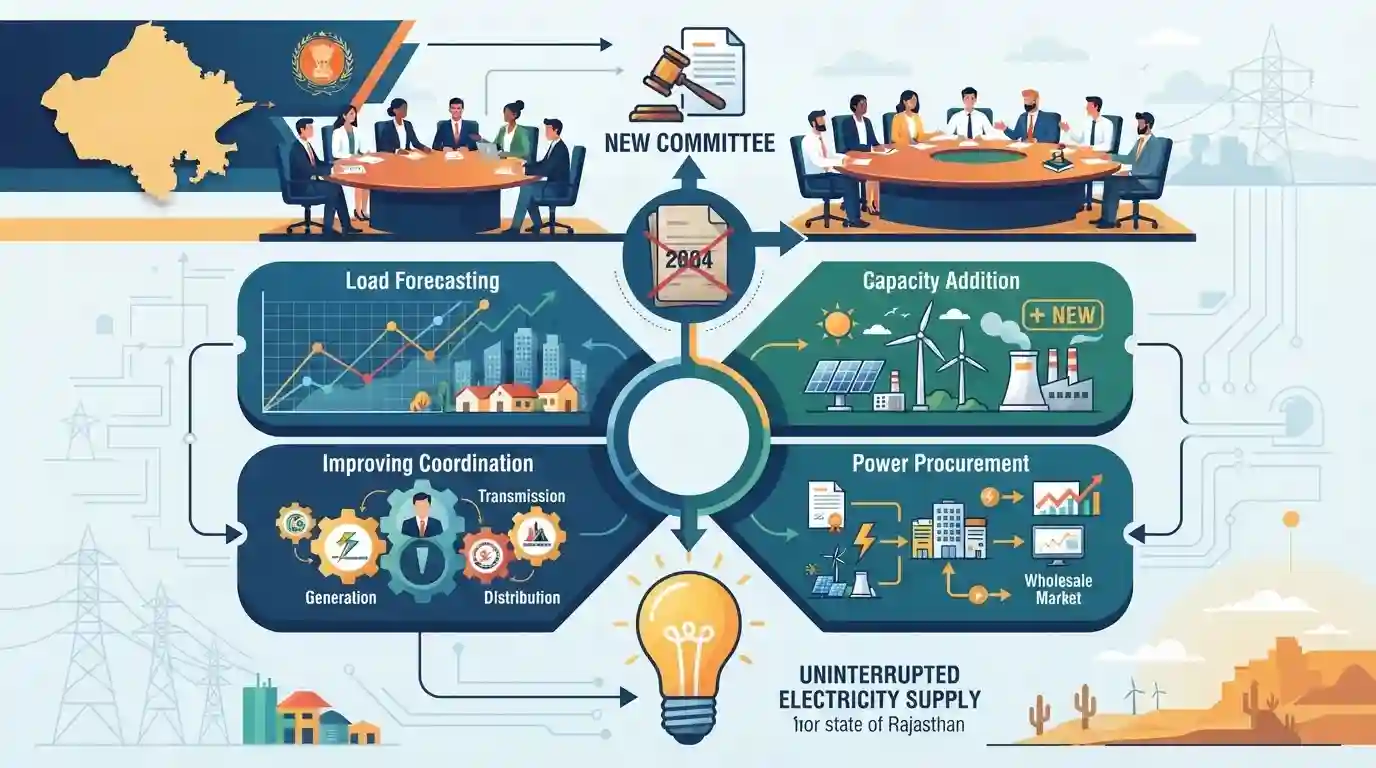
The Energy Department of Rajasthan has constituted a new high-level panel named the 'State Level Resource Adequacy Committee' to comprehensively assess the state's future power demands. Headed by the Chairman of RVPNL, the committee replaces the older Energy Assessment Committee from 2004. Formed in compliance with the RERC Framework for Resource Adequacy Regulations, 2026, the panel will focus on load forecasting, capacity addition, power procurement, and improving coordination across Rajasthan's state-owned power generation, transmission, and distribution companies to ensure an uninterrupted electricity supply.
Key Points
- The Rajasthan Energy Department has formed the State Level Resource Adequacy Committee to assess and plan for the state's future electricity demands.
- This newly constituted high-level committee replaces the existing Energy Assessment Committee, which was formed in 2004.
- The panel is headed by the Chairman of the Rajasthan Rajya Vidyut Prasaran Nigam Limited (RVPNL) and includes senior officials from state power utilities.
- The committee will operate under the guidelines of the RERC Framework for Resource Adequacy Regulations, 2026.
- Its mandate includes long-term power generation planning, demand forecasting, and ensuring coordination among generation, transmission, and distribution bodies for uninterrupted power supply.
Important Terms
State Level Resource Adequacy Committee

A high-level panel established in 2026 by Rajasthan's Energy Department to assess future power demand, replace the 2004 Energy Assessment Committee, and coordinate state-owned power generation, transmission, and distribution companies.
UPSC context
GS Paper III (Infrastructure, Energy Security) — tests planning mechanisms for grid reliability and institutional coordination in state-level power sectors.
RERC Framework for Resource Adequacy Regulations 2026
Regulatory guidelines established by the Rajasthan Electricity Regulatory Commission to systematically forecast demand, optimize procurement, and maintain a minimum 10% reserve margin to ensure grid stability and climate-resilient power supply.
UPSC context
GS Paper III (Infrastructure, Energy) — tests regulatory reforms for power procurement, demand forecasting, and integrating renewable energy into state grids.
Rajasthan Electricity Regulatory Commission (RERC)
The statutory state-level regulator responsible for regulating the power sector in Rajasthan, determining electricity tariffs, facilitating transmission and distribution, and enforcing resource planning guidelines.
UPSC context
GS Paper III (Energy, Infrastructure regulation) — tests the institutional role of state electricity regulatory commissions in sector reforms.
Rajasthan Urja Vikas and IT Services Limited (RUVITL)
A Rajasthan state undertaking responsible for power procurement and purchase cost optimization on behalf of state distribution companies, transitioning to data-driven and AI-enabled energy portfolio management.
UPSC context
GS Paper III (Infrastructure, Energy, IT application) — tests state-level power procurement structures and technology adoption for modern grid operations.
Rajasthan Rajya Vidyut Prasaran Nigam Limited (RVPNL)
The state-owned power transmission utility of Rajasthan, responsible for constructing, maintaining, and operating the high-voltage transmission network to ensure bulk power supply across the state.
UPSC context
GS Paper III (Infrastructure, Power Sector) — tests the function of public sector transmission utilities in state grid infrastructure management.
State Load Despatch Centre (SLDC)
The apex state-level body responsible for real-time monitoring, dispatching, and integrated operations of the state's power grid to ensure daily supply-demand balance and grid stability.
UPSC context
GS Paper III (Infrastructure, Grid Security) — tests understanding of real-time electricity grid management, load dispatch, and federal energy operations.
Prelims Trap
Resource Adequacy planning and Planning Reserve Margins (PRM) are determined solely by the Central Electricity Authority (CEA) via a uniform, nationally standardized formula.
Under the Electricity (Amendment) Rules 2022, while the central CEA issues guidelines, individual State Electricity Regulatory Commissions (SERCs) enact state-specific regulations that customize capacity credits based on local, seasonal, and peak-hour dynamics.
Static Concepts Connected
What is Resource Adequacy Planning (RAP) in India's power sector?
- Core Objective: Ensures utilities secure sufficient generation capacity to meet projected peak demand plus a safety margin under extreme conditions.
- Regulatory Framework: Anchored in Rule 16 of the Electricity (Amendment) Rules, 2022, which mandates operationalizing RAP through the Central Electricity Authority (CEA) guidelines.
- Key Metrics: Relies on mathematical risk indices such as Loss of Load Probability (LOLP) and Normalized Energy Not Served (NENS) to quantify grid failure risks.
How are regulatory jurisdictions divided under the Electricity Act, 2003?
- CEA Role: Formulates technical standards, grid safety codes, and drafts the National Electricity Plan.
- CERC Jurisdiction: Regulates interstate transmission tariffs, central generation companies, and resolves interstate disputes.
- SERC Jurisdiction: Determines retail tariffs, licenses intra-state distribution companies (DISCOMs), and enforces state-level resource adequacy.
Cross-Topic Patterns
Renewable Integration & Grid Stability
As India scales up variable solar and wind power, resource adequacy planning bridges seasonal intermittency with battery storage to prevent grid instability.
Cooperative Federalism in Infrastructure
Power is a Concurrent List subject (Entry 38). State-level execution of central CEA guidelines showcases the regulatory federalism shaping India's energy security.

Grid reliability metrics (LOLP, NENS) under the Electricity Amendment Rules likely to feature in GS-3 infrastructure/energy questions.
Linked PYQs · 3
Linked PYQs · 3
- 2023RPSC_PRELIMSGS1
Which agency has been given the responsibility of implementing the PM-KUSUM scheme (Component A) in Rajasthan, which involves the establishment of solar power plants with a capacity of 0.5 MW to 2 MW?
- 2024RPSC_PRELIMSGS1
Which of the following has been formed in place of Chief Minister's Rajasthan Economic Transformation Advisory Council (CMRETAC)?
- 2021RPSC_PRELIMSGS1
What is the proposed percentage of plan expenditure of total expenditure on electricity in the 2021-22 Rajasthan Budget?
