Pension Fund Regulatory Changes on Withdrawal Norms
Source:Indian Express ↗
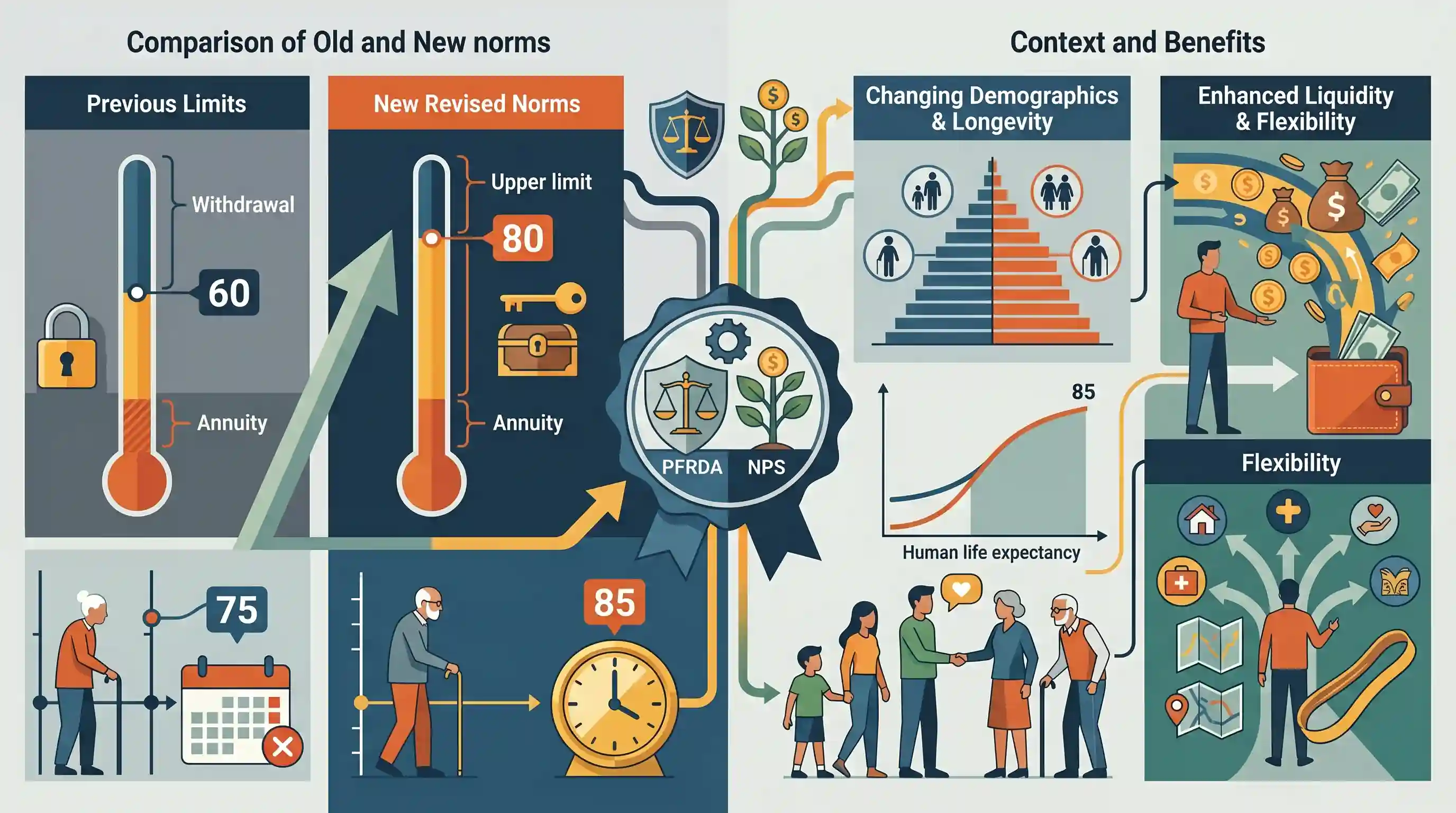
Why It Matters
Understanding pension reforms is critical for GS3 (Economy) and GS2 (Social Justice), as the NPS forms the backbone of India's formal sector social security framework. Changes in withdrawal limits and exit age reflect macroeconomic adaptations to rising life expectancy and the need for post-retirement financial independence.
Summary
The Pension Fund Regulatory and Development Authority (PFRDA) has notified revised norms for the National Pension System (NPS), granting non-government subscribers the option to withdraw up to 80% of their retirement corpus as a lump sum, up from the previous 60%. Additionally, the maximum age for exit and deferred withdrawal has been raised to 85 years. These reforms are designed to offer enhanced liquidity and flexibility in retirement planning, catering to changing demographic trends and longer life expectancies.
Key Points
- PFRDA has revised the National Pension System (NPS) rules for non-government subscribers, increasing the lump sum withdrawal limit to 80% of the corpus upon normal exit, leaving 20% for annuity purchase.
- The maximum exit age from the NPS has been extended to 85 years, allowing subscribers to remain invested and grow their corpus for a longer period.
- If the accumulated pension wealth is equal to or less than ₹5 lakh, subscribers can now withdraw the entire amount as a lump sum without buying an annuity.
- These regulatory changes aim to provide private-sector subscribers with greater flexibility, liquidity, and control over their retirement planning amidst rising life expectancy.
Important Terms
National Pension System (NPS)

A voluntary, market-linked, defined contribution retirement savings scheme in India. It enables subscribers to build a corpus through regular contributions, providing both a lump sum and a regular pension upon retirement.
UPSC context
GS II (Social Justice) & GS III (Economy); tests knowledge of social security frameworks and fiscal management of retirement benefits.
Pension Fund Regulatory and Development Authority (PFRDA)
The statutory regulatory body, established under the PFRDA Act 2013, responsible for overseeing, promoting, and regulating the National Pension System and other non-statutory pension schemes in India.
UPSC context
GS II (Statutory Bodies); focuses on the governance and regulatory architecture of India's financial and social security sectors.
Defined Contribution Scheme
A pension plan where the final retirement benefit is determined by total contributions and market-linked investment returns, shifting investment risk from the employer to the subscriber.
UPSC context
GS III (Economy); crucial for comparing NPS with Defined Benefit schemes like the Old Pension Scheme (OPS).
Annuity
A financial product that converts a lump sum into a guaranteed series of periodic payments for life. In NPS, a mandatory portion of the corpus must be used to purchase an annuity.
UPSC context
GS III (Economy); relates to retirement planning tools and the trade-off between liquidity and long-term financial security.
Systematic Lump Sum Withdrawal (SLW)
A flexible withdrawal facility allowing NPS subscribers to receive their lump sum portion in periodic installments (monthly, quarterly, etc.) rather than as a single payout upon exit.
UPSC context
GS III (Economy); reflects modernization of financial products to improve liquidity and manage market volatility for retirees.
Prelims Trap
The new rule allows all NPS subscribers, including government employees, to withdraw 80% of their corpus as a lump sum.
The 80% lump sum and 85-year exit age revisions explicitly apply ONLY to non-government (private sector/citizen) subscribers. Government employees have a separate regulatory structure.
Static Concepts Connected
What is the core structure and regulation of the National Pension System (NPS)?
- Tier Structure: Divided into Tier-I (restricted withdrawal, mandatory for retirement) and Tier-II (voluntary, easily withdrawable savings account).
- Regulation: Governed by PFRDA, a statutory regulatory body established by Parliament, functioning under the Ministry of Finance.
- Tax Benefits: Eligible for tax deductions up to Rs 1.5 lakh under 80C, plus an exclusive additional deduction of Rs 50,000 under Section 80CCD(1B).
How does NPS fundamentally differ from the Old Pension Scheme (OPS)?
- Defined Contribution: NPS pension amounts depend entirely on market-linked returns generated by the accumulated corpus of joint employee-employer contributions.
- Defined Benefit: OPS guarantees a fixed payout (typically 50% of the last drawn salary) funded directly by the exchequer, creating massive unfunded liabilities.
Cross-Topic Patterns
Demographics & the Silver Economy
Raising the exit age to 85 reflects India's rising life expectancy, connecting to GS1 demographics and GS2 social justice policy planning for the 'Silver Economy'.
Govt vs Private sector pension divide
These non-govt NPS tweaks arrive alongside the new Unified Pension Scheme (UPS) for govt employees, highlighting diverging policy tracks for public vs private retirement nets.

Expect a Prelims question mixing PFRDA’s statutory status with specific NPS non-govt limits and the newly proposed Unified Pension Scheme.
Linked PYQs · 2
Linked PYQs · 2
- 2017PrelimsGS1
Who among the following can join the National Pension System (NPS)?
- 2024MainsGS1
What is the concept of a 'demographic winter'? Is the world moving towards such a situation? Elaborate.
