Naval modernization and maritime strategic readiness priorities
Source:The Hindu ↗
Why It Matters
The appointment and strategic priorities of the new Navy Chief underscore India's focus on maritime security and defense modernization, crucial topics for GS-3. Understanding the Navy's role in safeguarding economic interests and adapting to complex regional security environments is highly relevant for internal security and international relations.
Summary
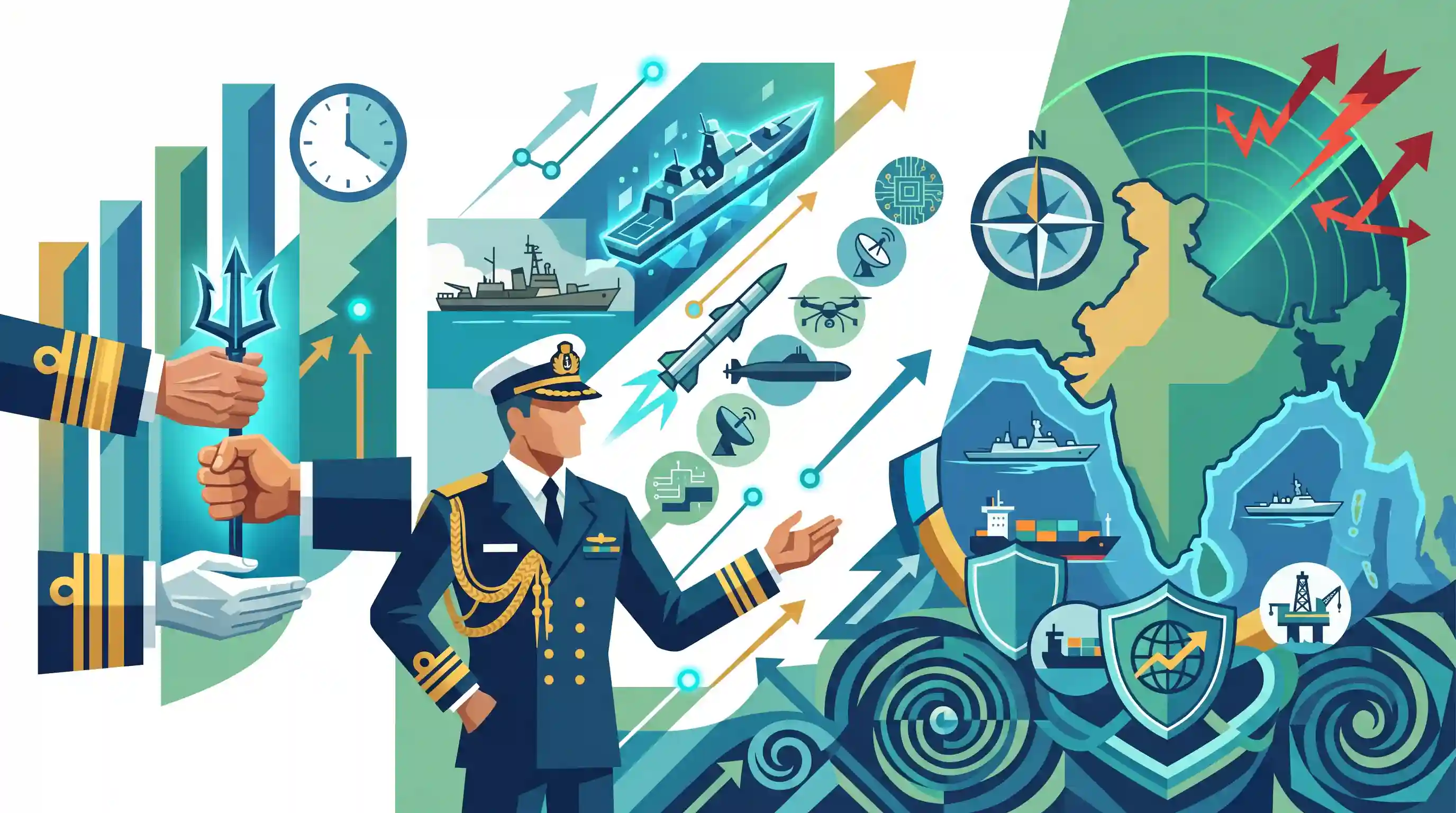
Admiral Krishna Swaminathan has taken charge as the 27th Chief of the Naval Staff of the Indian Navy, succeeding Admiral Dinesh Kumar Tripathi. In his assumption address, he emphasized the importance of sustaining the Navy's growth momentum through modernization, capability enhancement, and the induction of niche technologies. Admiral Swaminathan reaffirmed the Navy's vigilance in protecting India's national and economic interests within an increasingly complex and unpredictable regional security environment.
Key Points
- Admiral Krishna Swaminathan assumed charge as the 27th Chief of the Naval Staff of the Indian Navy, succeeding Admiral Dinesh Kumar Tripathi.
- His key priorities include maintaining operational readiness, combat effectiveness, and capability enhancement.
- He emphasized the acceleration of inducting niche and emerging technologies to strengthen the Navy's operational capabilities.
- The Navy is committed to protecting India's national and economic interests amidst a complex, unpredictable, and uncertain regional security environment.
- Admiral Swaminathan brings extensive experience, having previously commanded the aircraft carrier INS Vikramaditya and served as Vice Chief of the Naval Staff.
Important Terms
Chief of the Naval Staff (CNS)

The professional head and highest-ranking four-star officer of the Indian Navy, responsible for operational readiness, training, and administration. The office is statutory under the Navy Act, 1957.
UPSC context
GS Paper 3: Security Architecture. Relevant for understanding India's defense leadership and statutory military governance.
Maritime Security
The protection of sea-based interests, including territorial waters, Exclusive Economic Zones (EEZ), and Sea Lines of Communication (SLOCs), from threats like piracy, terrorism, and illegal trafficking.
UPSC context
GS Paper 3: Internal Security. Tests ability to analyze non-traditional maritime threats and India's 26/11-inspired coastal security framework.
Defence Modernisation
The process of upgrading military hardware, infrastructure, and doctrine to handle contemporary warfare, focusing on shifting from legacy systems to advanced, indigenous technological platforms.
UPSC context
GS Paper 3: Security. Tests knowledge of Revolution in Military Affairs (RMA) and capability enhancement in the armed forces.
Indigenisation
The capability to design, develop, and manufacture defense equipment within India, aiming to reduce dependence on foreign imports and achieve strategic self-reliance (Atmanirbhar Bharat).
UPSC context
GS Paper 3: Security/Economy. Critical for questions on defense procurement policies (DAP 2020) and reducing the fiscal burden of imports.
Indian Ocean Region (IOR)
A critical geopolitical space connecting Asia, Africa, and Australia, carrying 80% of global seaborne oil trade and central to India's 'SAGAR' vision.
UPSC context
GS Paper 2: International Relations. Tests understanding of India's role as a 'net security provider' and the 'String of Pearls' challenge.
Niche Technologies
Emerging, cutting-edge technologies—such as Artificial Intelligence (AI), quantum computing, drone swarms, and space-based communication—that provide a significant tactical or strategic advantage in modern warfare.
UPSC context
GS Paper 3: Science & Tech/Security. Focuses on disruptive military advancements and the SPRINT initiative for naval indigenisation.
Prelims Trap
INS Vikramaditya is India's first indigenously built aircraft carrier.
INS Vikramaditya is a modified Kiev-class vessel acquired from Russia. INS Vikrant is India's first indigenously designed and built aircraft carrier.
Static Concepts Connected
What are the key differences between India's operational aircraft carriers?
- INS Vikramaditya: Acquired from Russia (formerly Admiral Gorshkov), it is a modified Kiev-class carrier using a STOBAR (Short Take-Off But Arrested Recovery) system.
- INS Vikrant: India's first indigenously designed and built aircraft carrier (IAC-1), built at Cochin Shipyard, also utilizing the STOBAR configuration.
What are the major frameworks driving niche technology induction in the Navy?
- NIIO: Naval Innovation and Indigenisation Organisation (NIIO) fosters innovation by bringing together academia, industry, and military end-users.
- Swavlamban Initiative: The Navy's annual seminar and roadmap aimed at actively inducting new indigenous technologies (like unmanned vessels), aligning with the Atmanirbhar Bharat vision.
Cross-Topic Patterns
Defense Indigenization + Emerging Tech (Swavlamban)
The Navy's push for AI and autonomous drone swarms is heavily driven by the NIIO's 'Swavlamban' initiative, bridging traditional defense procurement with domestic deep-tech startups.
SLOC Protection + Indo-Pacific Security
The "complex regional environment" directly ties to protecting Sea Lanes of Communication (SLOCs) amid disruptions like Red Sea drone attacks and Chinese naval expansion in the Indian Ocean Region.

Expect a multi-statement prelims question linking indigenous defense platforms (INS Vikrant) with emerging naval tech (drone swarms/AI).
Linked PYQs · 2
Linked PYQs · 2
- 2022MainsGS3
What are the maritime security challenges in India ? Discuss the organisational, technical and procedural initiatives taken to improve the maritime security.
- 2025MainsGS3
Why is maritime security vital to protect India's sea trade? Discuss maritime and coastal security challenges and the way forward.
