Computational Modeling of Locust Swarm Intelligence and Behavior
Source:The Hindu ↗
Why It Matters
Advancements in modeling complex animal behaviors provide critical technological interventions for managing biological disasters like locust swarms, which directly threaten food security and agricultural livelihoods.
Summary
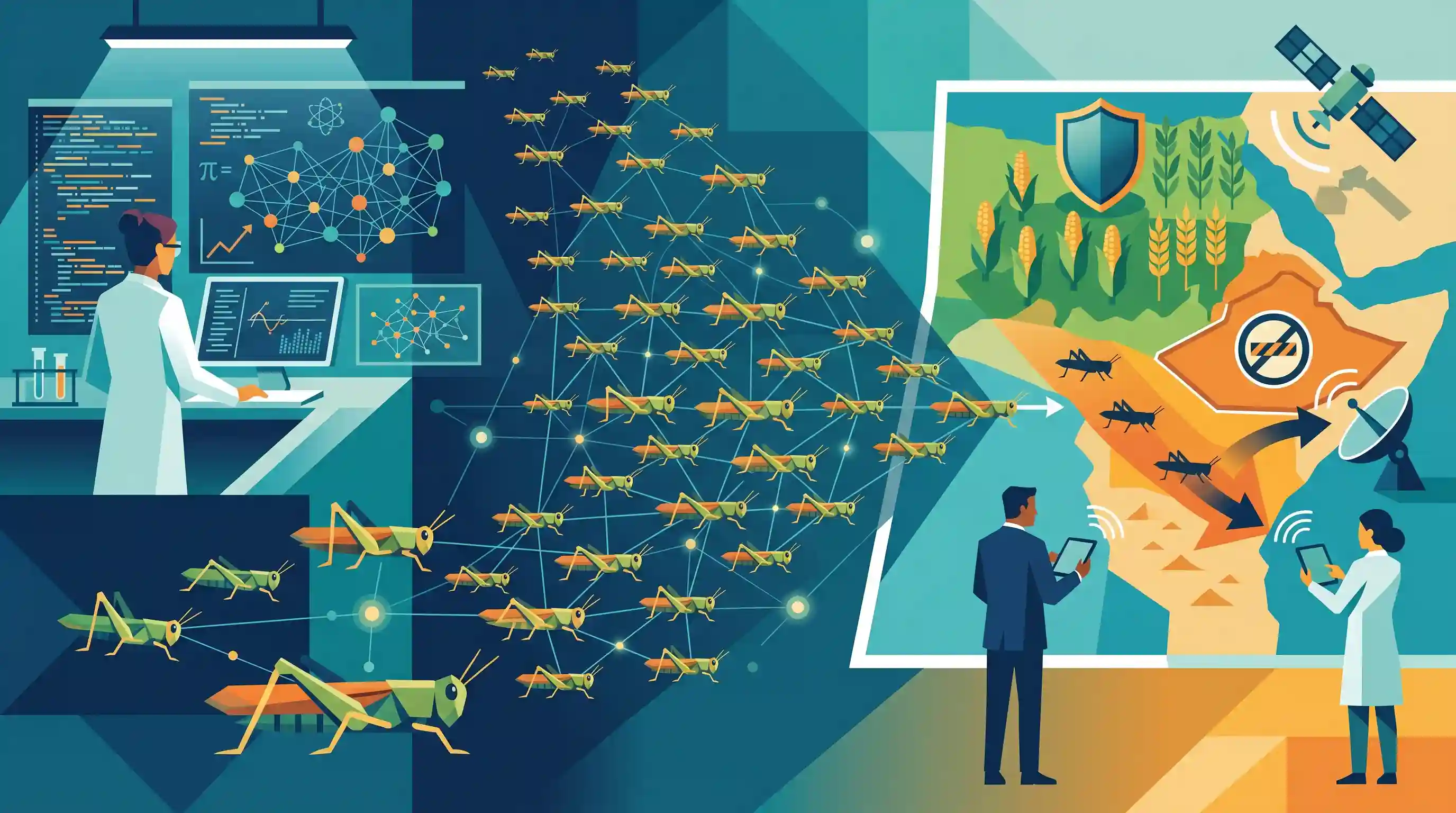
A new computational model has shed light on the collective behavior of locusts, discovering that they make complex decisions while moving in deadly swarms. Instead of merely reacting blindly to their immediate neighbors, individual locusts process information dynamically, leading to the highly organized and destructive nature of the swarm. Understanding these complex interaction rules and swarm dynamics is a major breakthrough in biological modeling. For policymakers and agricultural scientists, this offers a powerful tool to better predict the paths of locust outbreaks, enabling timely interventions to protect crops, ensure food security, and mitigate biological disasters.
Key Points
- A novel model has revealed that individual locusts within massive swarms are capable of making complex decisions rather than acting purely on simple local reflexes.
- This complex individual decision-making contributes to the highly organized, cohesive, and deadly nature of locust swarms.
- Desert locust swarms pose a massive threat to global food security, causing severe agricultural damage across continents like Africa and Asia.
- Decoding the 'swarm intelligence' and collective behavior of locusts provides crucial data for predictive modeling.
- Better predictive tools can enable early-warning systems and targeted interventions to prevent widespread crop destruction and support agricultural disaster management.
Important Terms
Desert Locust

A highly destructive migratory pest (Schistocerca gregaria) capable of transforming from a solitary insect into a gregarious, swarm-forming phase that devours vast amounts of vegetation and crops.
UPSC context
GS III (Agriculture/Environment); tests understanding of trans-boundary pests, their biological behavior, and impact on rural livelihoods and food security.
Locust Warning Organization (LWO)
A specialized agency under India's Ministry of Agriculture responsible for monitoring, forecasting, and controlling desert locust outbreaks, primarily in the desert regions of Rajasthan and Gujarat.
UPSC context
GS III (Disaster Management); tests knowledge of institutional frameworks for managing agricultural emergencies and specialized pest control.
Pradhan Mantri Fasal Bima Yojana (PMFBY)
A centrally sponsored crop insurance scheme providing financial support to farmers against non-preventable natural risks, including pest attacks like locusts, with capped premiums for Kharif and Rabi crops.
UPSC context
GS III (Agriculture); tests awareness of government risk-mitigation schemes and financial safety nets for the farming community.
Biological Disaster
A disaster category involving the mass spread of pathogens or pests (like locust plagues) that cause widespread damage to health, crops, or the environment.
UPSC context
GS III (Disaster Management); tests the ability to classify and manage diverse natural threats under NDMA guidelines.
Food Security
The assurance that all people have physical and economic access to sufficient, safe, and nutritious food, often threatened by large-scale crop failures during pest outbreaks.
UPSC context
GS II (Social Justice) and GS III (Agriculture); tests understanding of the National Food Security Act and agricultural stability.
Scheduled Desert Area (SDA)
An area of approximately 2 lakh square kilometers in Rajasthan and Gujarat designated for intensive surveillance and control operations to prevent trans-boundary locust invasions.
UPSC context
GS III (Geography/Agriculture); tests awareness of region-specific vulnerabilities and geographical focus of national pest control programs.
Prelims Trap
Locust attacks are classified as agricultural disasters and are primarily monitored by the NDMA.
Locust attacks are officially classified as "Biological Disasters," and the nodal monitoring agency is the Locust Warning Organisation under the Ministry of Agriculture, not NDMA.
Static Concepts Connected
What is 'Swarm Intelligence' in Artificial Intelligence?
- Nature-inspired AI: It is an AI paradigm that mimics the decentralized, self-organized collective behavior of natural systems, such as locust swarms, ant colonies, or bird flocks.
- Defense Applications: It powers modern defense technologies, such as coordinated drone swarms, famously utilized in concepts like India's Combat Air Teaming System (CATS).
How do climate phenomena trigger desert locust outbreaks?
- Positive IOD: A strong positive Indian Ocean Dipole (IOD) causes unseasonal, heavy rainfall and cyclonic activity in East Africa and the Arabian Peninsula.
- Breeding Triggers: This rainfall creates moist sandy soils and sudden vegetation growth, providing the perfect breeding grounds that trigger solitary locusts to turn into gregarious swarms.
Cross-Topic Patterns
Biomimicry in AI and Defense Tech
Biological phenomena like locust swarming are directly inspiring new AI paradigms, forming the basis for advanced military drone swarm technology and decentralized computing.
Climate Anomalies and Biological Disasters
Oceanic phenomena like the Indian Ocean Dipole (IOD) don't just affect Indian monsoons; they directly catalyze transboundary biological disasters by creating ideal breeding grounds for pests.

Expect a multi-statement question linking 'Swarm Intelligence' AI defense applications (drone swarms) to biological behaviors of locusts.
Linked PYQs · 3
Linked PYQs · 3
- 2023PrelimsGS1
Which of the following organisms perform waggle dance for others of their kin to indicate the direction and the distance to a source of their food?
- 2024PrelimsGS1
The organisms “Cicada, Froghopper and Pond skater" are:
- 2016MainsGS3
Given the vulnerability of Indian agriculture to vagaries of nature, discuss the need for crop insurance and bring out the salient features of the Pradhan Mantri Fasal Bima Yojana (PMFBY).
