Supreme Court Review of Waqf Amendment Act and Judicial Precedent
Source:The Hindu ↗
Why It Matters
The issue highlights the tension between legislative amendments and established judicial precedents. It touches upon critical constitutional aspects like Article 26 (freedom to manage religious affairs), the nature of religious endowments, and the scope of judicial review when a statute's core objectives are allegedly nullified.
Summary
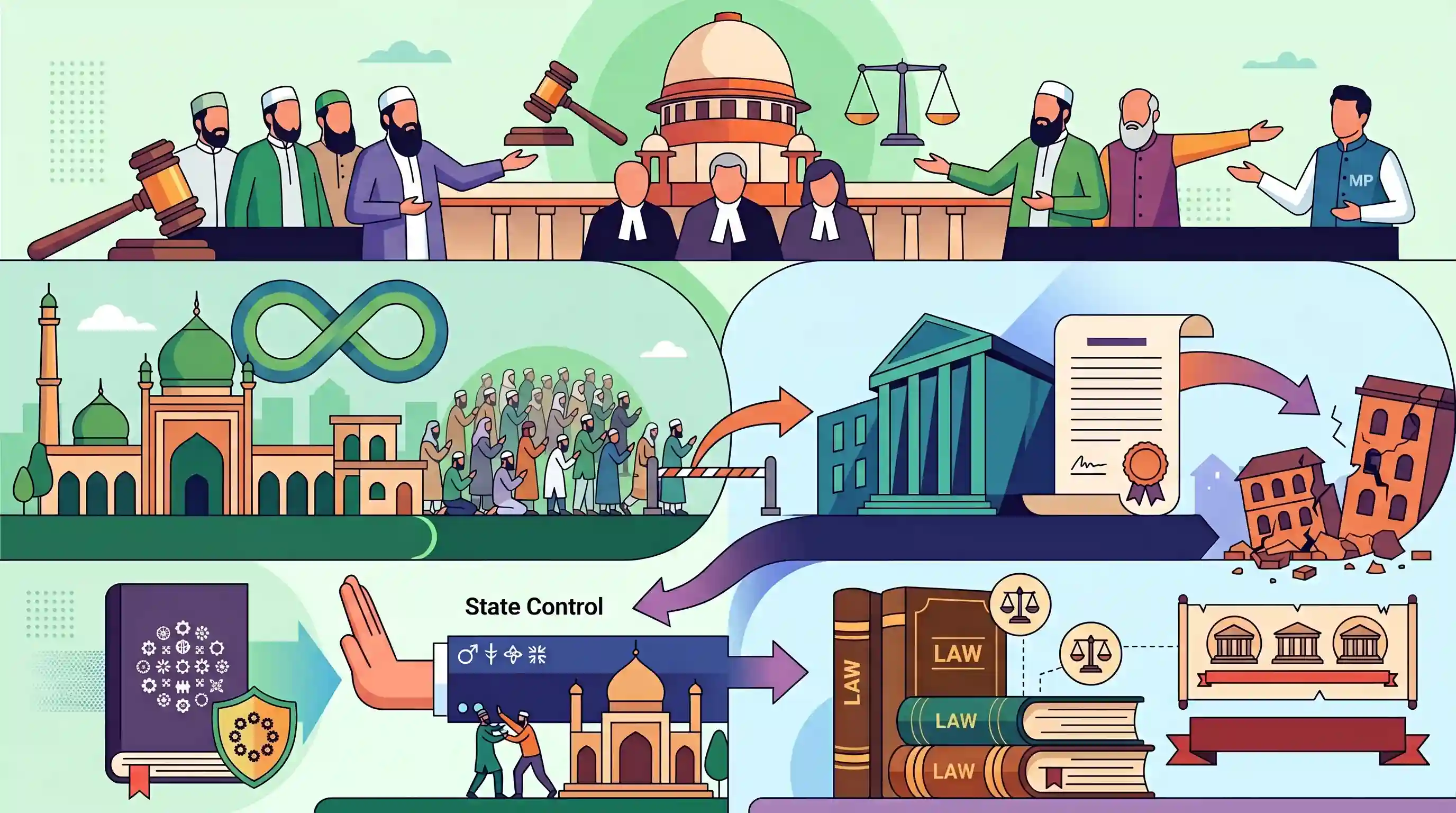
The Supreme Court is hearing petitions challenging the Waqf (Amendment) Act, 2025, with petitioners arguing it breaches the established legal doctrine of 'once a Waqf, always a Waqf'. The amendments remove the traditional concept of 'Waqf by User'—which previously recognized long-term religious or pious use of property as sufficient for Waqf status—and mandate formal deeds of dedication. Petitioners, including Islamic organizations and MPs, contend that this will endanger centuries-old properties lacking formal documentation. They argue the law violates Article 26 of the Constitution by expanding state control over religious endowments and runs contrary to several historical Supreme Court judgments that protect the administrative rights of religious denominations over their properties.
Key Points
- Petitions in the Supreme Court argue the Waqf (Amendment) Act, 2025 violates the 'once a Waqf, always a Waqf' principle, potentially jeopardizing centuries-old minority community properties.
- The new legislation eliminates the concept of 'Waqf by User'—recognized previously by the Supreme Court in the 2019 Ramjanmabhoomi judgment—making formal deeds of dedication mandatory.
- Petitioners assert that expanding state control over Waqf assets violates Article 26 of the Constitution, which guarantees religious denominations the right to manage their own affairs.
- The challenge cites earlier rulings like Ratilal Panachand Gandhi v. State of Bombay (1954), which established that transferring control of religious property to secular authorities infringes on religious and property rights.
- The Ulema argues the deletion of 'Waqf by User' will unleash a flood of applications challenging ancient Waqfs that lack formal deeds, risking their conversion to private or government properties.
Important Terms
Waqf (Amendment) Act, 2025

Legislation reforming the 1995 Act, mandating non-Muslim board members, transferring survey powers to Collectors, and requiring formal deeds for property registration.
UPSC context
GS Paper II (Governance); tests understanding of statutory reforms, minority rights, and executive versus religious body powers.
Article 26 of the Constitution
A Fundamental Right guaranteeing religious denominations the freedom to manage their own affairs, own/acquire property, and administer it according to law.
UPSC context
GS Paper II (Polity); central to debates on state interference in religious endowments and minority autonomy.
Once a Waqf, always a Waqf
A legal doctrine holding that once a property is dedicated for pious, religious, or charitable purposes, its Waqf status is permanent and irrevocable.
UPSC context
GS Paper II (Judiciary); tests knowledge of landmark judicial interpretations and the principle of perpetuity in religious law.
Waqf by User
Property recognized as a religious endowment based on long-term, uninterrupted public use (e.g., graveyards, mosques) without needing formal written documentation or deeds.
UPSC context
GS Paper II (Social Justice/Polity); key point of contention regarding land registration and historical religious practices.
Waqf Tribunal
A quasi-judicial body established to resolve disputes over Waqf properties, whose composition was traditionally required to include an expert in Muslim law.
UPSC context
GS Paper II (Quasi-judicial bodies); relevant for questions on dispute resolution mechanisms and judicial review (appeals).
Waqf Boards
Statutory bodies responsible for the management, regulation, and protection of religious endowments (Auqaf) within a state or union territory.
UPSC context
GS Paper II (Statutory Bodies); focuses on administrative accountability, representation, and the role of the Ministry of Minority Affairs.
Prelims Trap
"Article 26 grants religious denominations absolute immunity from State regulation in administering their properties."
Article 26(d) guarantees property administration only "in accordance with law." The State CAN regulate secular aspects (like audits), provided it doesn't usurp core control.
Static Concepts Connected
What specific protections does Article 26 offer to religious denominations?
- Establish Institutions: Right to establish and maintain institutions for religious and charitable purposes.
- Manage Affairs: Right to manage its own affairs specifically in matters of religion.
- Property Administration: Right to acquire, own, and administer movable and immovable property, strictly "in accordance with law."
Why is executive adjudication of property disputes constitutionally problematic?
- Separation of Powers: Adjudicating complex property titles is a core judicial function. Shifting it to executive officers (like District Collectors) violates Article 50.
- Judicial Independence: Transferring judicial powers to executive authorities without equivalent specialized judicial oversight undermines judicial independence, a basic feature of the Constitution.
Cross-Topic Patterns
Article 26 + Statutory Regulation of Trusts
UPSC often tests the fine line between the State's right to regulate the 'secular administration' of religious trusts and the unconstitutional takeover of denominations, building on the Ratilal and Shirur Mutt cases.
Separation of Powers + Executive Adjudication
The SC staying provisions that empower District Collectors to adjudicate Waqf property disputes mirrors past syllabus themes on executive overreach and the violation of Separation of Powers (e.g., National Tax Tribunal Act).

A 2026 Prelims multi-statement MCQ is highly likely to test the 'in accordance with law' caveat of Article 26 alongside 'Waqf by User'.
Linked PYQs · 5
Linked PYQs · 5
- 2024MainsGS2
Public charitable trusts have the potential to make India's development more inclusive as they relate to certain vital public issues. Comment.
- 2018MainsGS2
Whether National Commission for Scheduled Castes (NCSC) can enforce the implementation of constitutional reservation for the Scheduled Castes in the religious minority institutions? Examine.
- 2021PrelimsGS1
What is the position of the Right to Property in India?
- 2023PrelimsGS1
In essence, what does 'Due Process of Law' mean?
- 2016MainsGS2
What was held in the Coelho case? In this context, can you say that judicial review is of key importance amongst the basic features of the Constitution?
