New Labour Codes and Regulatory Reforms in Indian Economy
Source:Indian Express ↗
Why It Matters
Understanding labour reforms is crucial for analyzing India's economic growth strategies, industrial policy, and employment generation. The transition to the new labour codes directly addresses structural bottlenecks in the Indian economy, making it a highly probable topic for Mains GS3 questions on economic reforms, employment, and the gig economy.
Summary
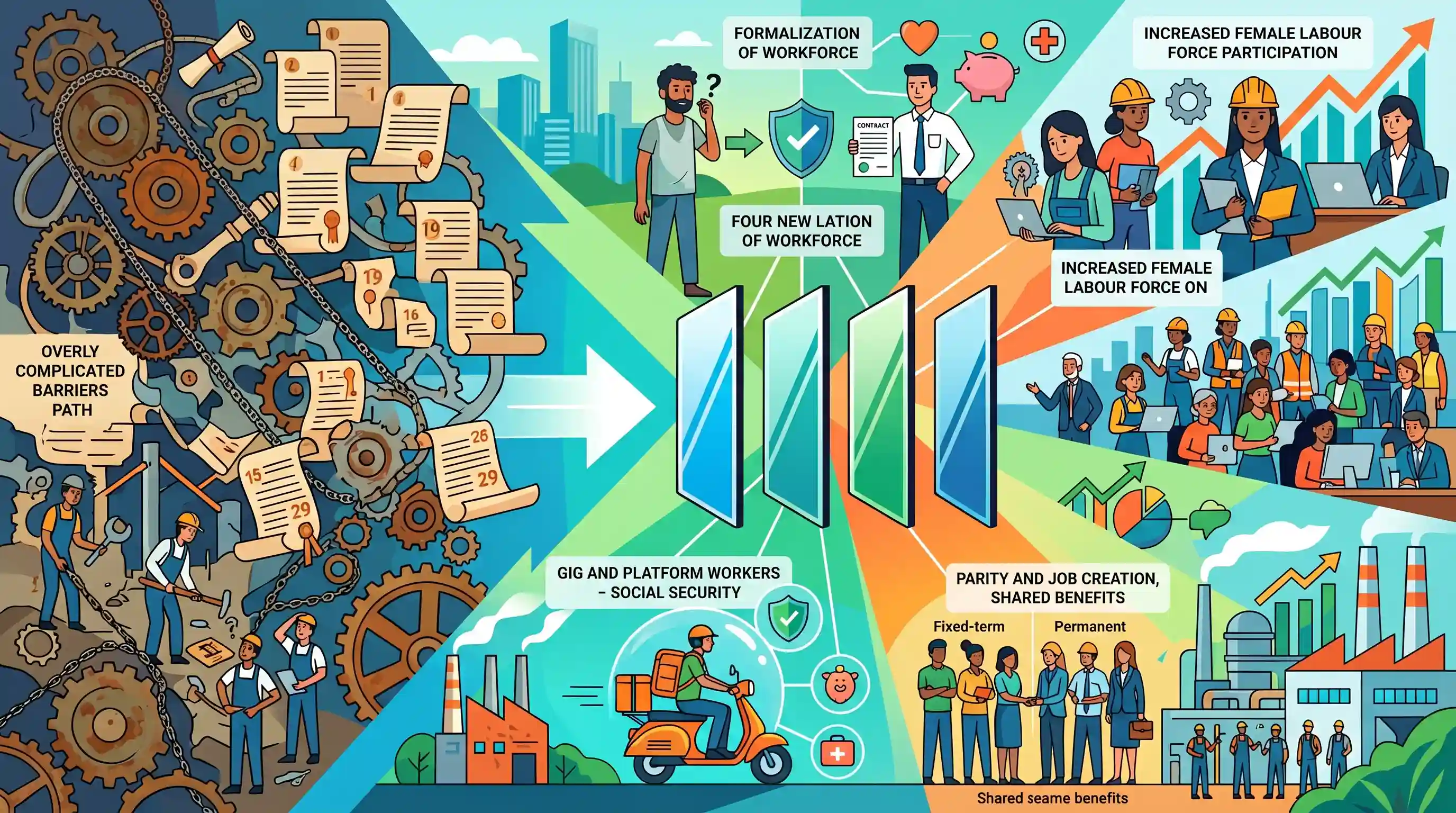
The NDA government is set to simplify India's regulatory framework by replacing 29 existing labour laws with four new labour codes. These reforms are designed to ease compliance burdens, encourage the formalization of the workforce, and increase female labour force participation. Crucially, the codes extend social security to gig and platform workers and aim for parity between fixed-term and permanent employees. Historically, a complex regulatory maze has stifled the growth of large firms in labour-intensive sectors, leaving most workers in low-productivity, informal jobs. By rationalizing these laws and pursuing broader deregulation, the government seeks to counteract the growing capital intensity in manufacturing, stimulate job creation, and leverage India's labour-abundant demography.
Key Points
- Four new labour codes are set to replace 29 existing, complex labour laws to simplify India's regulatory framework.
- The reforms aim to ease the compliance burden, encourage formalization of the workforce, and boost female labour force participation.
- The new codes will widen the social security net to include gig and platform workers, while bringing fixed-term employees on parity with permanent workers.
- Historically, stringent labour regulations have deterred the growth of large-scale firms in labour-intensive sectors, trapping the majority of the workforce in low-productivity informal jobs.
- These labour reforms, alongside broader deregulation, are essential to counteract the rising capital intensity in production and maximize job creation in India's labour-abundant economy.
Important Terms
Four Labour Codes

Four unified laws—Wages, Industrial Relations, Social Security, and OSHWC—replacing 29 fragmented central labour laws to simplify regulations and improve worker welfare.
UPSC context
GS Paper III: Indian Economy and Employment; significant for questions on structural reforms and labor market flexibility.
Compliance 3.0
A technology-driven, proactive regulatory framework in India aiming for seamless, paperless compliance to reduce the "regulatory maze" and improve Ease of Doing Business.
UPSC context
GS Paper II & III: Governance and Economy; tests understanding of ease of doing business and digital governance.
Gig Economy
A labor market characterized by short-term contracts or freelance work, as opposed to permanent jobs, often involving platform-based services.
UPSC context
GS Paper III: Employment and Growth; critical for discussing new employment models and social security gaps.
Formalization of Workforce
The process of transitioning workers from informal, unregulated arrangements to regulated contracts with legal protections and social security benefits.
UPSC context
GS Paper III: Inclusive Growth; focuses on labor productivity and the expansion of the tax base.
Code on Social Security, 2020
A specific code consolidating laws on maternity benefits, gratuity, and insurance, extending social security to gig, platform, and unorganized workers.
UPSC context
GS Paper II & III: Social Justice and Economy; tests knowledge of welfare schemes for vulnerable workers.
Fixed-term Employment
A contract-based employment for a specific duration, providing workers with the same benefits as permanent employees for the period they work.
UPSC context
GS Paper III: Industrial Policy; relevant for discussions on labor market flexibility vs. job security.
Prelims Trap
The four new Labour Codes consolidate and replace all Central and State labour laws to create a uniform national framework.
Labour is a Concurrent List subject. The codes subsume 29 Central laws, but state governments must still frame and notify their own rules for implementation. They do not overwrite state laws automatically.
Static Concepts Connected
What are the four new Labour Codes replacing the 29 Central laws?
- Code on Wages: Mandates a National Floor Wage and universalizes minimum wages and timely payment for all workers, regardless of the sector.
- Industrial Relations Code: Raises the retrenchment threshold from 100 to 300 workers without prior government permission and grants parity to fixed-term employees.
- Social Security Code: Legally defines gig/platform workers for the first time and mandates aggregators to contribute to a dedicated social security fund.
- OSH Code: Consolidates regulations regarding workplace safety, health, and working conditions, specifically targeting factories, mines, and hazardous industries.
What are the constitutional provisions governing labour laws in India?
- Concurrent List: Entries 22, 23, and 24 of the Concurrent List (Schedule VII) deal with trade unions, social security, and labour welfare, allowing both Centre and States to legislate.
- DPSP: Articles 39, 41, 42, and 43 direct the State to secure decent working conditions, living wages, maternity relief, and the right to work.
Cross-Topic Patterns
Firm Dwarfism & Regulatory Cholesterol
Historic Economic Survey concepts link strict labour compliance thresholds to 'dwarfism,' where MSMEs stay small to avoid regulatory cholesterol, pushing capital-intensive manufacturing over labour-intensive job creation.
Gig Economy & Urban Vulnerability
Formalizing gig workers through the Social Security Code bridges GS2 social justice themes with the tech-driven service sector, addressing urban vulnerabilities highlighted during the pandemic.
FLFP & Statutory Parity
Parity for fixed-term workers and expanded social security directly intersect with GS1 (Society) and GS3 (Economy) themes on reversing India's historically stagnant Female Labour Force Participation (FLFP).

Expect a 2026 multi-statement Prelims Q linking the Social Security Code's exact definition of 'gig workers' with Concurrent List powers.
Linked PYQs · 3
Linked PYQs · 3
- 2024MainsGS3
Discuss the merits and demerits of the four 'Labour Codes' in the context of labour market reforms in India. What has been the progress so far in this regard?
- 2022MainsGS3
Economic growth in the recent past has been led by increase in labour productivity." Explain this statement. Suggest the growth pattern that will lead to creation of more jobs without compromising labour productivity.
- 2023MainsGS3
Faster economic growth requires increased share of the manufacturing sector in GDP, particularly of MSMEs. Comment on the present policies of the Government in this regard.
