Significance of implementing the four new labour codes in India
Source:Indian Express ↗
Why It Matters
Labour reforms are a fundamental aspect of India's economic development and employment generation strategy. The four labour codes are a direct syllabus topic in GS-3 and have already appeared in the 2024 Mains. Understanding the historical context of informalization and capital intensity is crucial for structuring Mains answers on economic growth and industrial policy.
Summary
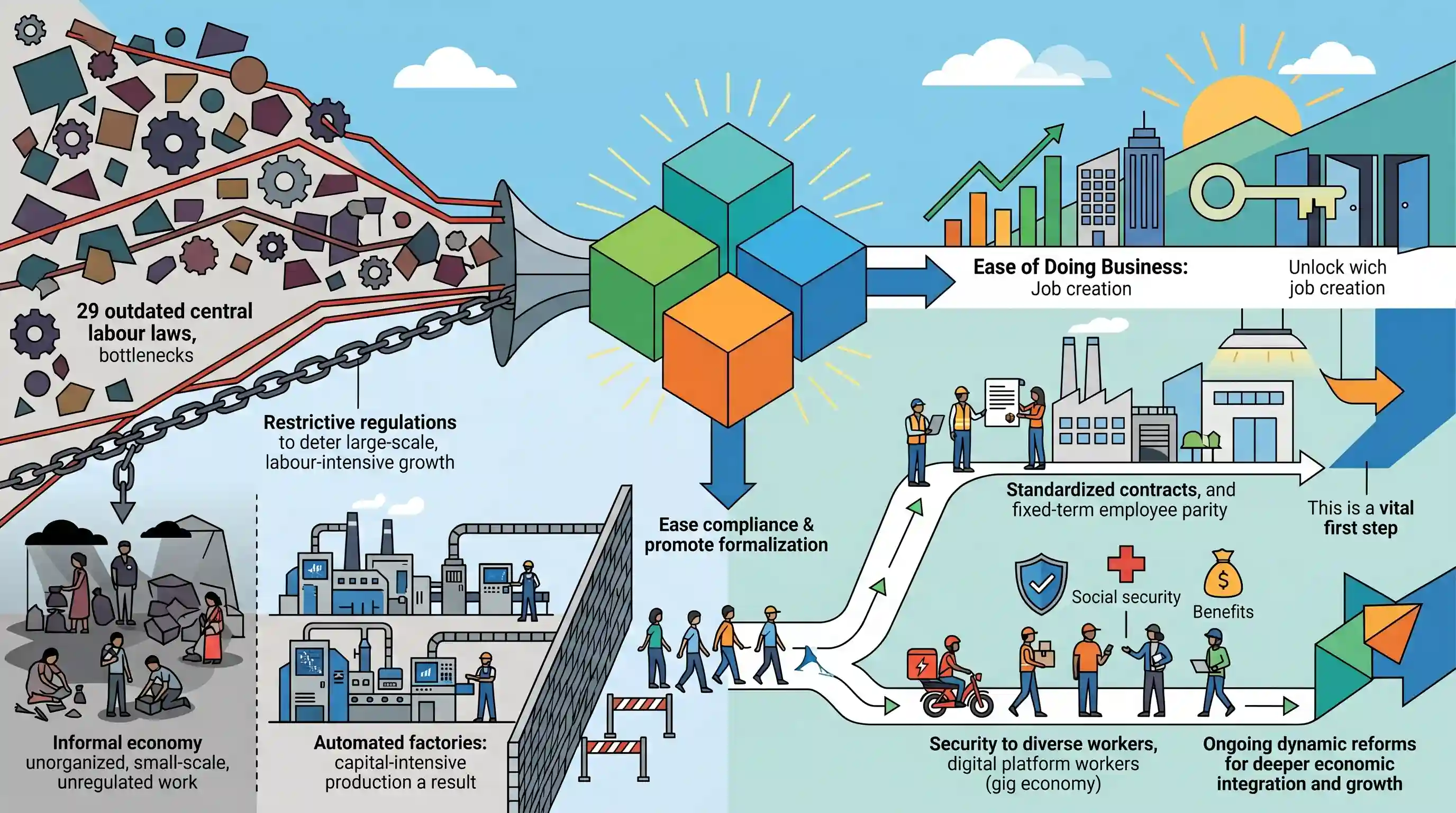
The article welcomes the impending implementation of four new labour codes designed to replace 29 central labour laws, addressing long-standing structural bottlenecks in India's employment landscape. Historically, stringent labour regulations deterred the growth of large-scale enterprises in labour-intensive sectors, fostering a massive informal economy and inadvertently driving capital-intensive production in a labour-surplus nation. The new codes promise to ease compliance burdens, incentivize formalization, provide parity for fixed-term employees, and extend social security to emerging vulnerable segments like gig and platform workers. The author emphasizes that while these codes are a vital first step, further continuous reforms are required to untangle India's extensive regulatory maze to genuinely improve the ease of doing business and boost job creation.
Key Points
- The Centre plans to notify four new labour codes, subsuming 29 existing central labour laws, a crucial step toward structural economic reform.
- Stringent historical labour regulations imposed heavy compliance costs, restricted firm size in labour-intensive sectors, and expanded the informal economy.
- Regulatory rigidities inadvertently led to increased capital intensity in Indian manufacturing despite the country being labour-abundant.
- The new codes aim to simplify compliance, encourage formalisation, and extend social security benefits to gig and platform workers.
- Implementing the codes should be the beginning of a broader initiative to dismantle India's complex regulatory maze and improve the ease of doing business.
Important Terms
Labour Codes (India)

A legislative reform consolidating 29 central laws into four streamlined codes: Wages, Industrial Relations, Social Security, and Occupational Safety to simplify compliance and boost growth.
UPSC context
GS Paper III (Economy/Employment); tests understanding of structural reforms to the labour market and balancing worker welfare with industry flexibility.
Code on Social Security, 2020
A unified law that integrates nine previous social security acts to extend benefits like pensions and insurance to all workers, including the unorganized and gig sectors.
UPSC context
GS Paper II (Social Justice) and Paper III (Economy); critical for addressing the social safety net for India's diverse workforce.
Gig and Platform Workers
Workers operating outside traditional employer-employee relationships (gig) or through online platforms (platform), now legally recognized for social protection under the new labour codes.
UPSC context
GS Paper III (Employment); relevant for questions on the digital economy, precarious employment, and modernizing labour definitions.
Fixed-Term Employment (FTE)
A direct contractual hiring model for a specific duration that grants employees the same wages and statutory benefits as permanent staff, aiming to reduce middleman-driven contract labour.
UPSC context
GS Paper III (Employment); tests the concept of hiring flexibility and its impact on formalizing jobs in labour-intensive sectors.
Informal Economy
Economic activities and enterprises that are not registered or regulated, where workers typically lack formal contracts, job security, and statutory social security benefits.
UPSC context
GS Paper III (Indian Economy); essential for analyzing economic productivity, dualism, and the transition toward a formalized, tax-compliant workforce.
Code on Wages, 2019
Legislation consolidating four wage-related acts to establish a national floor wage and ensure universal minimum wage protection for all employees across India.
UPSC context
GS Paper III (Employment/Economy); focuses on wage parity, poverty alleviation, and the standardization of income definitions.
Prelims Trap
"Digital aggregators must contribute a flat 5 percent of their annual turnover to the gig worker social security fund."
The mandate is actually 1% to 2% of annual turnover, and this amount is strictly capped at 5% of the total wages paid to the platform workers.
Static Concepts Connected
How did historic labour laws induce "capital intensity" in a labour-surplus India?
- Compliance Thresholds: Strict regulations kicked in at 10-100 employees, causing firms to stay artificially small (dwarfism) to evade burdensome compliance and labour inspections.
- Mechanization Bias: To scale up production without triggering rigid retrenchment laws (like the Industrial Disputes Act), large manufacturing firms heavily automated instead of hiring low-skilled workers.
How do the new Labour Codes alter the status of Fixed-Term Employment (FTE)?
- Statutory Parity: FTEs are now legally entitled to receive the exact same statutory benefits, wages, and working conditions as permanent workers for the same work.
- Pro-rata Gratuity: The eligibility period for receiving gratuity has been reduced from five continuous years of service to just one year for fixed-term workers.
Cross-Topic Patterns
Platform work & Urban Demographic Dividend
The Social Security Code's statutory recognition of gig workers ties directly to GS1/GS2 themes of urbanization and the changing nature of informal urban employment driven by India's digital economy.
Concurrent List & Cooperative Federalism
Labour falls under the Concurrent List. The multi-year delay in implementing these codes stems from the requirement that States must frame and notify their own rules, highlighting challenges in cooperative federalism.

Expect a multi-statement prelims question contrasting gig worker aggregator contributions vs fixed-term employee gratuity limits.
Linked PYQs · 3
Linked PYQs · 3
- 2024MainsGS3
Discuss the merits and demerits of the four 'Labour Codes' in the context of labour market reforms in India. What has been the progress so far in this regard?
- 2016MainsGS3
How globalization has led to the reduction of employment in the formal sector of the Indian economy? Is increased informalization detrimental to the development of the country?
- 2022MainsGS3
Economic growth in the recent past has been led by increase in labour productivity." Explain this statement. Suggest the growth pattern that will lead to creation of more jobs without compromising labour productivity.
