Impact of Employment Legislation on Rural Gender and Social Equality
Source:Indian Express ↗
Why It Matters
Evaluates the social impact of employment legislation on rural demographics, emphasizing the intersection of economic policy and social justice. This is crucial for analyzing how changes in welfare scheme designs can inadvertently harm vulnerable sections like rural women and marginalized castes.
Summary
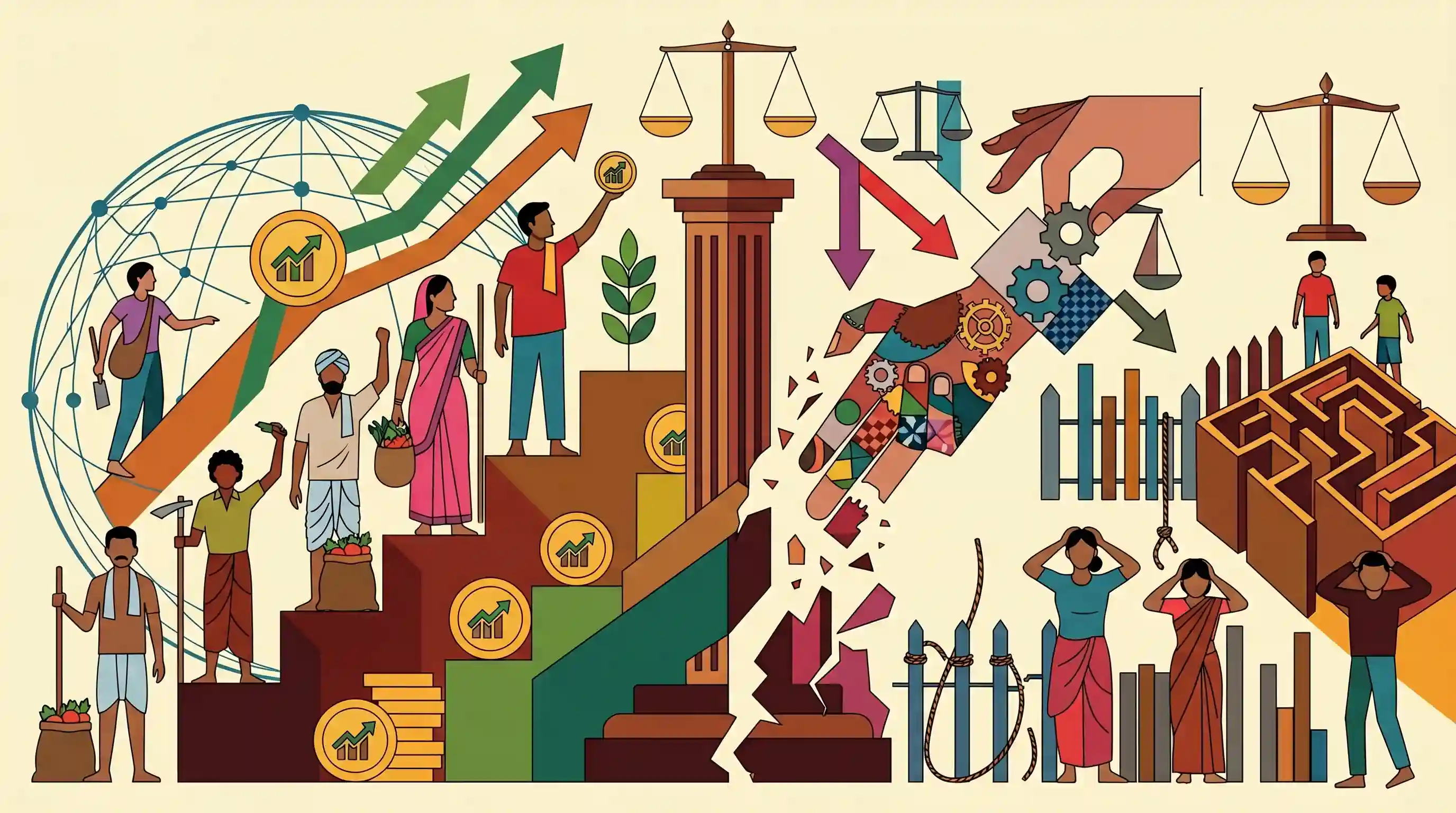
The article critiques a newly introduced or proposed jobs law for jeopardizing the progress made in rural equality, particularly concerning gender and caste equity. Historically, rights-based employment programs like MGNREGA played a pivotal role in narrowing the rural wage gap, empowering women, and uplifting marginalized communities by guaranteeing equal pay and accessible work. The author argues that replacing or altering this framework with the new law threatens to dismantle these hard-won gains. By potentially diluting the universal employment guarantee, altering wage structures, or introducing exclusionary criteria, the new policy risks reducing the bargaining power of rural workers, deepening structural inequalities, and reversing the socio-economic empowerment of vulnerable rural demographic groups.
Key Points
- The newly proposed or enacted employment legislation threatens to reverse the social parity and equality achieved in rural areas over the last two decades.
- Historical rights-based schemes like MGNREGA acted as powerful equalizers by enforcing statutory wage parity, which structurally improved rural gender equality and boosted female workforce participation.
- The new policy approach risks diluting the universal employment guarantee, potentially leading to a resurgence of the gender wage gap and decreasing the bargaining power of marginalized communities.
- Alterations to funding, wage-setting mechanisms, or the introduction of exclusionary criteria in the new jobs law could marginalize the vulnerable rural populations who have heavily relied on guaranteed work.
Important Terms
MGNREGA (Mahatma Gandhi National Rural Employment Guarantee Act)

The 2005 social security law guaranteeing 100 days of unskilled manual work to rural households. It pioneered demand-driven, rights-based welfare in India, significantly reducing poverty and the gender wage gap.
UPSC context
GS-II (Welfare Schemes), GS-III (Employment/Poverty). Tests understanding of social safety nets and legal entitlements.
VB-G RAM G Act (Viksit Bharat Gramin Rozgar and Management Guarantee)
A 2025 legislation replacing MGNREGA. It increases the employment guarantee to 125 days but is critiqued for transitioning from a demand-driven model to a supply-constrained "normative allocation" system.
UPSC context
GS-II (Governance & Social Justice). Critical for analyzing policy shifts in rural employment and administrative reforms.
Demand-Driven Employment
A policy architecture where the state is legally obligated to provide employment whenever a worker applies for it. Failure to provide work within 15 days typically triggers unemployment allowance.
UPSC context
GS-III (Economics). Core concept in labor economics and social security; differentiates rights from discretionary schemes.
Rights-Based Framework
A governance model where benefits are legal entitlements (rights) rather than discretionary charity. It allows citizens to approach courts or authorities to enforce the delivery of services or work.
UPSC context
GS-II (Social Justice). Key for discussing the evolution of Indian welfare and citizen-state relations.
Ministry of Rural Development (MoRD)
The nodal central agency in India responsible for formulating and implementing policies for rural poverty alleviation, infrastructure, and employment (including MGNREGA and its successors).
UPSC context
GS-II (Government Policies). Essential for identifying the administrative authority behind rural developmental interventions.
Gram Panchayats
Village-level constitutional bodies that serve as the primary implementing agency for rural employment schemes. They are responsible for planning works, registering households, and issuing job cards.
UPSC context
GS-II (Local Governance). Tests knowledge of decentralization and the bottom-up implementation of welfare policies.
Normative Allocation
A fund-sharing mechanism under the VB-G RAM G Act where the Centre allocates resources to states based on predetermined standards or caps, rather than responding to actual ground-level demand.
UPSC context
GS-II (Federalism). Relates to Centre-State financial relations and the fiscal autonomy of states in social spending.
Prelims Trap
MGNREGA is a targeted scheme providing guaranteed employment exclusively to identified Below Poverty Line (BPL) families.
MGNREGA is universal, not BPL-targeted. It relies on 'self-targeting'—meaning anyone willing to do minimum-wage manual labor can demand work, automatically filtering for those in need.
Static Concepts Connected
How does the Constitution and law frame the 'Right to Work' in India?
- DPSP (Article 41): The Right to Work is primarily enshrined as a Directive Principle of State Policy under Article 41, meaning it is not natively justifiable in courts.
- Statutory Right: Laws like MGNREGA convert this DPSP into a justifiable statutory legal right, allowing citizens to demand work and claim unemployment allowance if work is not provided within 15 days.
What are the statutory roles of Gram Panchayats in rural employment guarantees?
- Planning & Priority: The Gram Sabha is legally mandated to recommend works and determine the order of priority for projects to be taken up in the village.
- Implementation: Gram Panchayats are statutorily responsible for executing at least 50% of the works in terms of cost, ensuring fiscal and operational decentralization.
- Social Audit: The Gram Sabha conducts mandatory social audits of all projects, enforcing grassroots accountability over wage payments and material quality.
Cross-Topic Patterns
Feminization of agriculture and wage parity
MGNREGA's statutory wage parity sets a floor for rural wages. This links GS1 (Women's Issues) with GS3 (Agriculture), specifically contrasting statutory parity with the persistent gender wage gap in the open market.
Rights-based vs. Allocation-based Welfare
The policy transition from legally enforceable rights (like MGNREGA, NFSA) to budget-constrained, centrally-allocated welfare schemes reflects a fundamental shift in governance architecture and decentralization.

Expect a 2026 GS2 question evaluating the shift from rights-based statutory guarantees to allocation-based welfare in rural employment.
Linked PYQs · 4
Linked PYQs · 4
- 2022MainsGS2
Besides the welfare schemes, India needs deft management of inflation and unemployment to serve the poor and the underprivileged sections of the society. Discuss.
- 2023MainsGS2
“Development and welfare schemes for the vulnerable, by its nature, are discriminatory in approach.” Do you agree? Give reasons for your answer.
- 2019MainsGS2
Performance of welfare schemes that are implemented for vulnerable sections is not so effective due to absence of their awareness and active involvement at all stages of policy process. Discuss.
- 2021MainsGS2
Can the vicious cycle of gender inequality, poverty and malnutrition be broken through microfinancing of women SHGs? Explain with examples.
