Labour Reforms and Expansion of Social Security
Source:Indian Express ↗
Why It Matters
Labour market reforms are a core component of GS-3 (Indian Economy). The transition from multiple complex labour laws to four simplified Labour Codes directly impacts employment generation, industrial relations, and social justice. Understanding the balance between employer flexibility and social security for workers is critical for Mains answers.
Summary
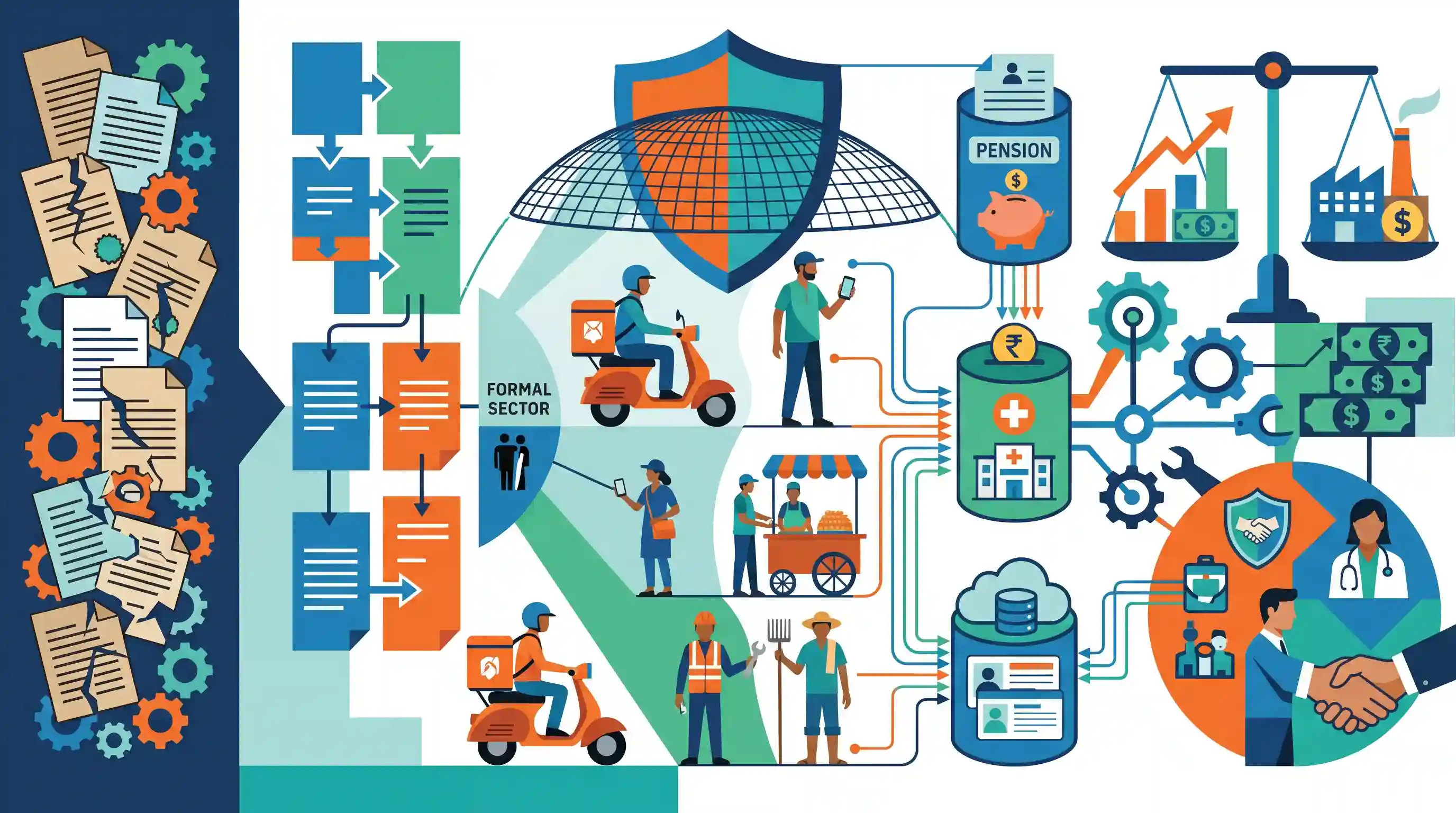
The article argues that India's new labour codes, particularly the provisions surrounding social security, do not represent a rollback of workers' rights but are a necessary structural reform. By consolidating archaic laws, the new framework seeks to balance the ease of doing business with the changing realities of the modern job market. A major focus is expanding the social safety net to include unorganised, gig, and platform workers, integrating them into formal mechanisms like EPFO, ESIC, and the e-Shram database. The reforms aim to provide a more flexible yet secure employment environment, addressing criticisms of dilution by highlighting the extension of core protections.
Key Points
- The new labour codes are intended to rationalise and consolidate outdated labour laws, rather than diminish the rights of workers.
- The Code on Social Security specifically aims to extend social protection to previously uncovered segments, including gig workers, platform workers, and the unorganised sector.
- Critics often argue that the codes dilute job security to favour employers, but the reforms actually attempt to balance ease of doing business with a universal social safety net.
- Formalising the workforce through centralized databases like the e-Shram portal is a crucial step towards ensuring targeted delivery of welfare and social protection.
Important Terms
Labour Codes

A legislative framework consolidating 29 central labour laws into four unified codes (Wages, Social Security, Industrial Relations, and Occupational Safety) to simplify compliance and formalise the workforce.
UPSC context
GS Paper III: Industrial growth; tests understanding of legislative rationalisation and its impact on formalising the Indian economy.
Code on Social Security, 2020
A reform merging nine social security laws to extend benefits like insurance and pensions to organised, unorganised, gig, and platform workers for the first time.
UPSC context
GS Paper II/III: Social justice; essential for discussing social safety nets for the modern, tech-enabled workforce.
e-Shram portal
The National Database of Unorganised Workers (NDUW) seeded with Aadhaar, used to register informal workers and facilitate the delivery of social security benefits through a Universal Account Number.
UPSC context
GS Paper II: Governance; tests knowledge of digital initiatives for welfare delivery and documentation of the informal sector.
Gig Economy
A labour market dominated by short-term contracts or freelance work, often facilitated by digital platforms (aggregators) rather than permanent, traditional employer-employee relationships.
UPSC context
GS Paper III: Indian Economy; relevant for questions on employment trends, inclusive growth, and the platform-based workforce.
Code on Wages, 2019
Legislation that universalises the right to minimum wages and timely payment, introducing a statutory 'floor wage' to ensure a basic living standard across all Indian states.
UPSC context
GS Paper III: Economic development; focuses on wage parity, the floor wage concept, and universalising labour rights.
Prelims Trap
"The Code on Social Security, 2020, legally confers formal 'employee' status upon gig and platform workers."
Gig and platform workers are explicitly defined OUTSIDE the traditional employer-employee relationship. They receive targeted social security, not full statutory employee status or standard PF matching.
Static Concepts Connected
How is 'Labour' classified under the 7th Schedule of the Indian Constitution?
- Concurrent Subject: Labour falls under the Concurrent List (List III) of the 7th Schedule.
- Legislative Jurisdiction: Both Parliament and State legislatures can enact laws. This shared jurisdiction is why states must frame their own rules to implement the central Labour Codes.
- DPSP Linkage: Article 43 directs the State to secure a living wage and decent standard of life for all workers, framing the constitutional basis for these codes.
What are the foundational differences between EPFO and ESIC mandates?
- EPFO Mandate: Manages provident fund and pensions; typically mandatory for establishments with 20 or more employees.
- ESIC Mandate: Provides health insurance and medical care; generally for establishments with 10+ employees.
- Hazardous Exemption: Under the new Code, ESIC coverage is now mandatory for establishments engaged in hazardous occupations, regardless of the total employee headcount.
Cross-Topic Patterns
Gig economy, urbanization & SDG 8
The gig economy heavily absorbs distress rural-urban migration. Formalizing this workforce is critical to managing India's demographic dividend and aligning with SDG 8 (Decent Work), despite stagnant traditional manufacturing job creation.
DPI driving targeted welfare delivery
Linking e-Shram with Aadhaar-seeded UANs extends the JAM trinity's utility. It showcases India's Digital Public Infrastructure (DPI) transitioning from pure cash-transfer DBTs to complex, targeted statutory social security mechanisms.

Expect a Prelims 2026 multi-statement Q distinguishing gig worker welfare funding (1-2% aggregator turnover) from traditional EPFO setups.
Linked PYQs · 3
Linked PYQs · 3
- 2024MainsGS3
Discuss the merits and demerits of the four 'Labour Codes' in the context of labour market reforms in India. What has been the progress so far in this regard?
- 2022MainsGS3
Economic growth in the recent past has been led by increase in labour productivity." Explain this statement. Suggest the growth pattern that will lead to creation of more jobs without compromising labour productivity.
- 2022MainsGS2
Besides the welfare schemes, India needs deft management of inflation and unemployment to serve the poor and the underprivileged sections of the society. Discuss.
