Consumer Price Index base year revision and monetary policy
Source:Indian Express ↗
Why It Matters
Accurate measurement of inflation is a foundational element of macroeconomic management. The update of the CPI base year and item weightages directly impacts the RBI's inflation targeting framework, which in turn dictates benchmark interest rates and overall economic liquidity.
Summary
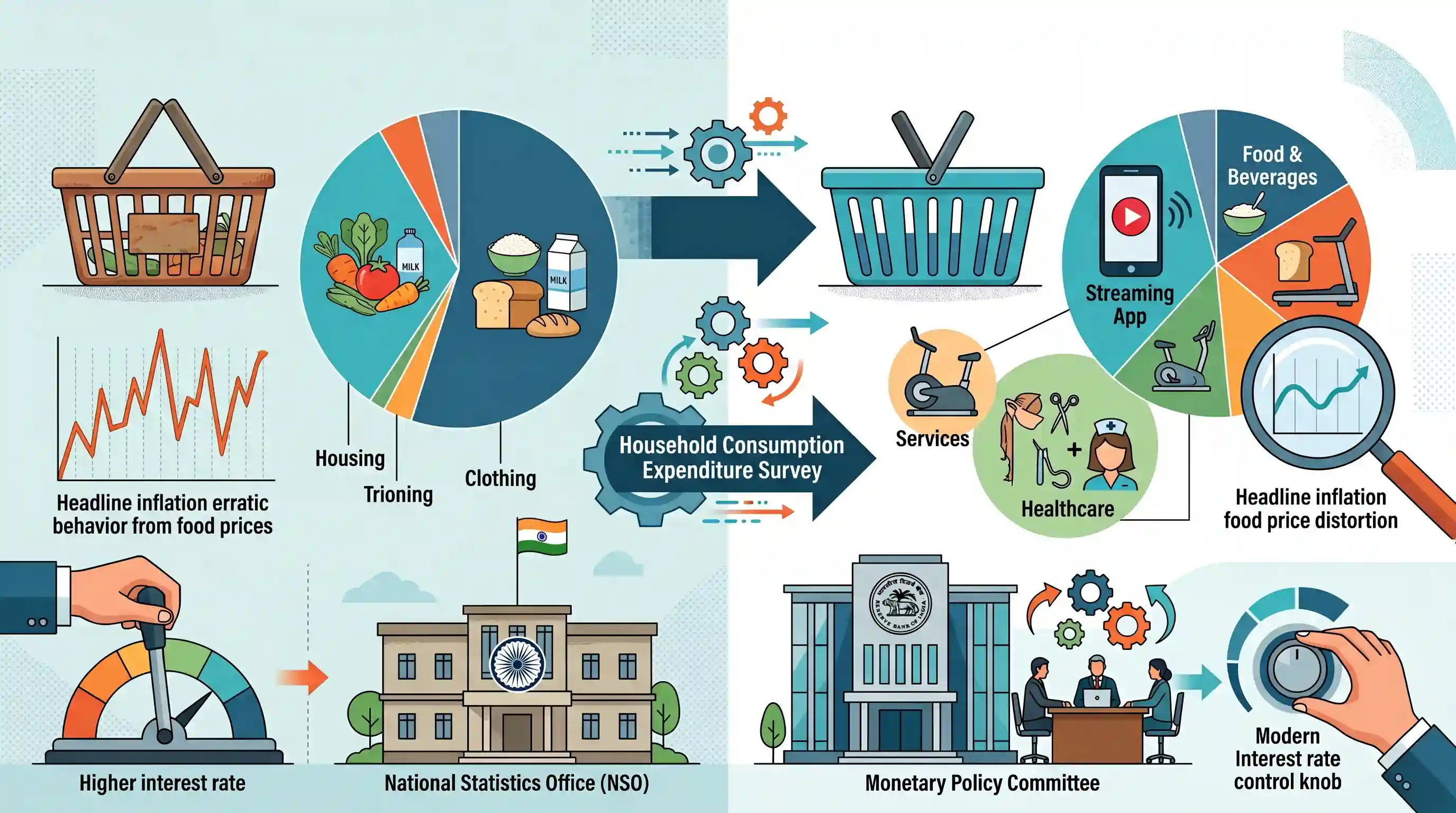
The National Statistics Office (NSO) has introduced a new series for the Consumer Price Index (CPI) by updating the base year from 2012 to 2024. Relying on the Household Consumption Expenditure Survey 2023-24, the updated CPI basket significantly reduces the weightage of food and beverages from 45.86% to 36.75%, while increasing the share of housing and services. The basket now also includes modern expenditures like online streaming and exercise equipment. This recalibration brings inflation measurement closer to current reality. For the Reserve Bank of India's Monetary Policy Committee, the lowered food weight reduces the distortion of volatile food prices on headline inflation, potentially providing more room for monetary policy easing and interest rate adjustments.
Key Points
- The National Statistics Office has updated the base year for the Consumer Price Index (CPI) from 2012 to 2024.
- Reflecting data from the Household Consumption Expenditure Survey 2023-24, the weightage of food and beverages in the CPI basket has dropped from 45.86% to 36.75%.
- The revised basket assigns a higher weight to housing, services (like medical care and transport), and non-food items.
- New items reflecting modern consumption patterns, such as online media streaming, babysitters, and rural housing, have been added to the CPI basket.
- Under the new series, retail inflation for January came in at 2.75%, which is well below the RBI's 4% target.
- The reduced weight of volatile food prices will give the Monetary Policy Committee a clearer view of core inflation, improving the effectiveness of monetary policy formulation.
Important Terms
Consumer Price Index (CPI)

A retail inflation index measuring price changes in a basket of goods and services. India recently updated its base year to 2024 to reflect modern consumption patterns.
UPSC context
GS-III Economy: Primary measure for inflation targeting and determining real-time cost-of-living shifts.
Household Consumption Expenditure Survey (HCES)
A large-scale NSO survey tracking household spending on food and non-food items. Its data is used to recalibrate CPI weights and assess poverty levels.
UPSC context
GS-III Economy: Crucial for understanding structural shifts in the economy and revising macroeconomic indicators.
Monetary Policy Committee (MPC)
A statutory six-member body (3 RBI, 3 Government) that sets the policy repo rate. It aims to maintain headline inflation at 4% within a 2-6% band.
UPSC context
GS-III Economy: Tested for its composition, legal mandate under the RBI Act, and role in price stability.
Headline Inflation
The total inflation figure in an economy, including volatile items like food and fuel. It is the official target for India's monetary policy.
UPSC context
GS-III Economy: Vital for distinguishing between temporary supply shocks and persistent price trends.
National Statistics Office (NSO)
India's nodal statistical agency under MoSPI, formed in 2019 by merging the CSO and NSSO. It compiles GDP, CPI, and industrial production data.
UPSC context
GS-II/III: Important for governance and the institutional framework of India’s economic data collection.
Base Year
The benchmark period (currently 2024 for CPI) used to compare economic data over time. Periodic updates prevent data distortion from outdated consumption habits.
UPSC context
GS-III Economy: Tests conceptual clarity on the 'base effect' and statistical accuracy in economic measurement.
Prelims Trap
"Food and beverages constitute more than 40% of the revised Consumer Price Index (CPI) basket weight."
Under the new 2024 base year, the weight of food and beverages has dropped significantly from 45.86% to 36.75%. It is no longer above 40%.
Static Concepts Connected
How does CPI differ from WPI in inflation measurement?
- Authority: CPI is compiled by the NSO (MoSPI), whereas WPI is published by the Office of Economic Adviser (Ministry of Commerce and Industry).
- Basket scope: WPI excludes services and assigns maximum weight to manufactured goods. CPI includes services like housing, education, and medical care.
- Policy target: The RBI uses headline CPI as the nominal anchor for its Flexible Inflation Targeting framework, not WPI.
What is the mandate and composition of the Monetary Policy Committee (MPC)?
- Mandate: Instituted under the RBI Act, 1934 to maintain price stability while keeping in mind the objective of growth (target: 4% CPI inflation, ±2% band).
- Composition: A 6-member body comprising 3 RBI officials (including the Governor as ex-officio chair) and 3 external experts appointed by the Central Government.
- Decision making: Decisions are binding and taken by majority vote. The RBI Governor does not have a veto, but has a casting vote in a tie.
Cross-Topic Patterns
Welfare schemes altering economic metrics
The reduction in CPI food weight is partly driven by free foodgrain schemes like PMGKAY structurally altering household out-of-pocket expenditure, forcing a recalibration of national macro-metrics.
Digital economy in macro-metrics
Adding online streaming and e-commerce price scraping to the 2024 basket reflects the formalization of India's digital consumption, linking GS-3 macroeconomics with digital public infrastructure.

Expect a 2026 Prelims question testing the sub-40% food weight in the new 2024 CPI basket alongside traditional WPI/CPI comparisons.
Linked PYQs · 4
Linked PYQs · 4
- 2020PrelimsGS1
Consider the following statements: 1. The weightage of food in Consumer Price Index (CPI) is higher than that in Wholesale Price Index (WPI). 2. The WPI does not capture changes in the prices of services, which CPI does. 3. Reserve Bank of India has now adopted WPI as its key measure of inflation and to decide on changing the key policy rates. Which of the statements given above is/are correct?
- 2022PrelimsGS1
In India, which one of the following is responsible for maintaining price stability by controlling inflation?
- 2017PrelimsGS1
Which of the following statements is/are correct regarding the Monetary Policy Committee (MPC)? 1. It decides the RBI's benchmark interest rates. 2. It is a 12-member body including the Governor of RBI and is reconstituted every year. 3. It functions under the chairmanship of the Union Finance Minister. Select the correct answer using the code given below:
- 2024MainsGS3
What are the causes of persistent high food inflation in India? Comment on the effectiveness of the monetary policy of the RBI to control this type of inflation.
