Himachal Pradesh drafts new industrial policy with cheap power tariffs
Source:propnewstime ↗
Why It Matters
This article highlights critical state-level facts such as specific infrastructure projects (IT park at Kandaghat, geothermal energy in Kinnaur), exact cost-sharing ratios (50% for Chandigarh-Baddi railway), and legal-political claims (7.19% share in Chandigarh), which are high-yield areas for state-specific questions in HPAS Prelims.
Summary
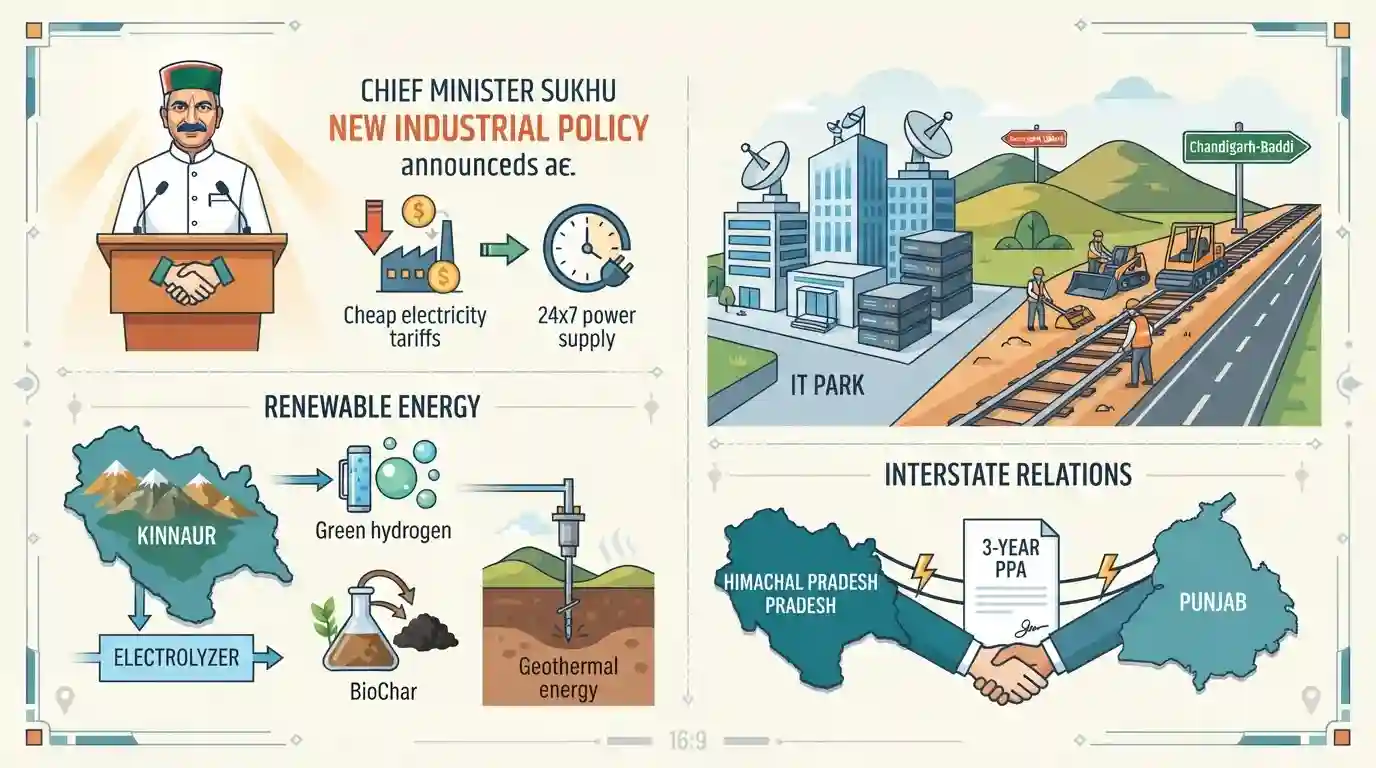
Himachal Pradesh Chief Minister Sukhvinder Singh Sukhu announced the drafting of a new industrial policy featuring cheap electricity tariffs and 24x7 power supply to attract investors. Key highlights include the state's push towards green hydrogen, BioChar, and geothermal energy in Kinnaur, a 3-year Power Purchase Agreement with Punjab, an IT park in Kandaghat (Solan), and 50% cost-sharing for the Chandigarh-Baddi railway line project.
Key Points
- Himachal Pradesh is preparing to launch a new industrial policy that features reduced electricity tariffs to attract fresh investments and support industries.
- HP aims to emerge as a green hydrogen production hub and is expanding renewable energy initiatives, including establishing BioChar plants for biomass utilization and commissioning a geothermal energy project in Kinnaur district.
- As a power-surplus state, HP is signing a 3-year Power Purchase Agreement (PPA) with Punjab to supply electricity.
- To boost the IT sector and technology-led investments, the state is developing data storage infrastructure and setting up an IT park at Kandaghat in Solan district.
- For the Chandigarh-Baddi railway line project, the HP government will bear 50% of the cost of land acquisition and construction, aimed at completion within three years to improve connectivity for the Baddi-Nalagarh manufacturing cluster.
- The state is also actively pursuing discussions with the Centre regarding its 7.19% share in Chandigarh.
Important Terms
New Industrial Policy of Himachal Pradesh

A forthcoming state policy offering comprehensive incentives, reduced electricity tariffs, land rebates, and tax reimbursements to attract investment and foster sustainable industrial growth.
UPSC context
Relevant for GS 3 (Economic Development). Highlights state-level ease of doing business and competitive governance to attract investment.
Power Purchase Agreement (PPA)
A legal contract between an electricity generator and a buyer. In this context, power-surplus Himachal Pradesh is signing a three-year PPA to supply electricity to Punjab.
UPSC context
Core to GS 3 (Infrastructure - Energy). Tests understanding of energy markets, DISCOMs, and inter-state energy cooperation.
Chandigarh-Baddi Railway Line Project
A vital infrastructure project connecting Chandigarh to Himachal\'s Baddi-Nalagarh industrial belt, featuring a 50-50 cost-sharing model for land acquisition and construction between the state and Centre.
UPSC context
Important for GS 3 (Infrastructure). Illustrates center-state cost-sharing models and the need for last-mile industrial connectivity.
Green Hydrogen
Hydrogen fuel produced via electrolysis powered by renewable energy. Himachal Pradesh is leveraging its clean energy surplus to position itself as a national production hub.
UPSC context
Critical for GS 3 (Environment/Energy). Key to India\'s National Green Hydrogen Mission and long-term industrial decarbonization targets.
Geothermal Energy
Renewable energy generated from the earth\'s internal heat. Himachal Pradesh is diversifying its clean energy portfolio with a recently commissioned geothermal project in Kinnaur district.
UPSC context
Relevant for GS 1 (Geography) and GS 3 (Renewable Energy). Tests awareness of non-conventional energy resource distribution in India.
Prelims Trap
Himachal Pradesh's territorial and resource claims over Chandigarh originate from the States Reorganisation Act of 1956.
The claim actually stems from the Punjab Reorganisation Act of 1966, which carved out Haryana and reorganized hilly territories, not the 1956 Act.
Static Concepts Connected
What are the prominent geothermal energy hotspots in India?
- Himalayan Province: Includes Puga Valley (Ladakh), Manikaran, and Kinnaur (Himachal Pradesh), leveraging the tectonically active Himalayan belt.
- Central India: Tattapani in Chhattisgarh, situated along the geologically active Son-Narmada-Tapi (SONATA) fault zone.
- Western India: Cambay Graben (Gujarat) and several hot springs located along the West Coast in Maharashtra.
Why is the pharmaceutical manufacturing sector considered a 'footloose' industry?
- Raw Material Independence: It does not rely on heavy, weight-losing raw materials; Active Pharmaceutical Ingredients (APIs) are easily transported.
- Policy Driven: Industrial location heavily depends on state incentives, tax holidays, and cheap uninterrupted power (e.g., Baddi, HP).
- Logistics and Skills: Success relies more on proximity to transport networks, cold-chain logistics, and access to skilled labor.
Cross-Topic Patterns
Biochar and circular economy agriculture
HP's push for Biochar links biomass management to soil health, reflecting a growing UPSC theme of integrating circular economy models with climate-resilient farming.
Post-Independence reorganisation legacy
HP's ongoing 7.19% claim in Chandigarh highlights the unresolved territorial and asset-sharing anomalies stemming from the post-independence 1966 Punjab Reorganisation Act.

Expect a Prelims match-the-following on Geothermal sites (Kinnaur, Puga, Tattapani) or a multi-statement question on Biochar applications.
Linked PYQs · 2
Linked PYQs · 2
- 2017HPAS_PRELIMSGS1
Renewable source of energy is :
- 2016HPAS_PRELIMSGS1
At which place in Bilaspur District of H.P. a woman Industrial Training Institute (I.T.I.) has been made functional during 2015-16 ?
