Himachal Pradesh plans new industrial policy focusing on green energy
Source:business-aajkal ↗
Why It Matters
The article highlights the strategic use of state-level industrial policies and resource advantages (clean power) to attract private investment. It underscores India's broader push towards sustainable industrial growth and green hydrogen, relevant for questions on state-driven economic development and renewable energy transitions.
Summary
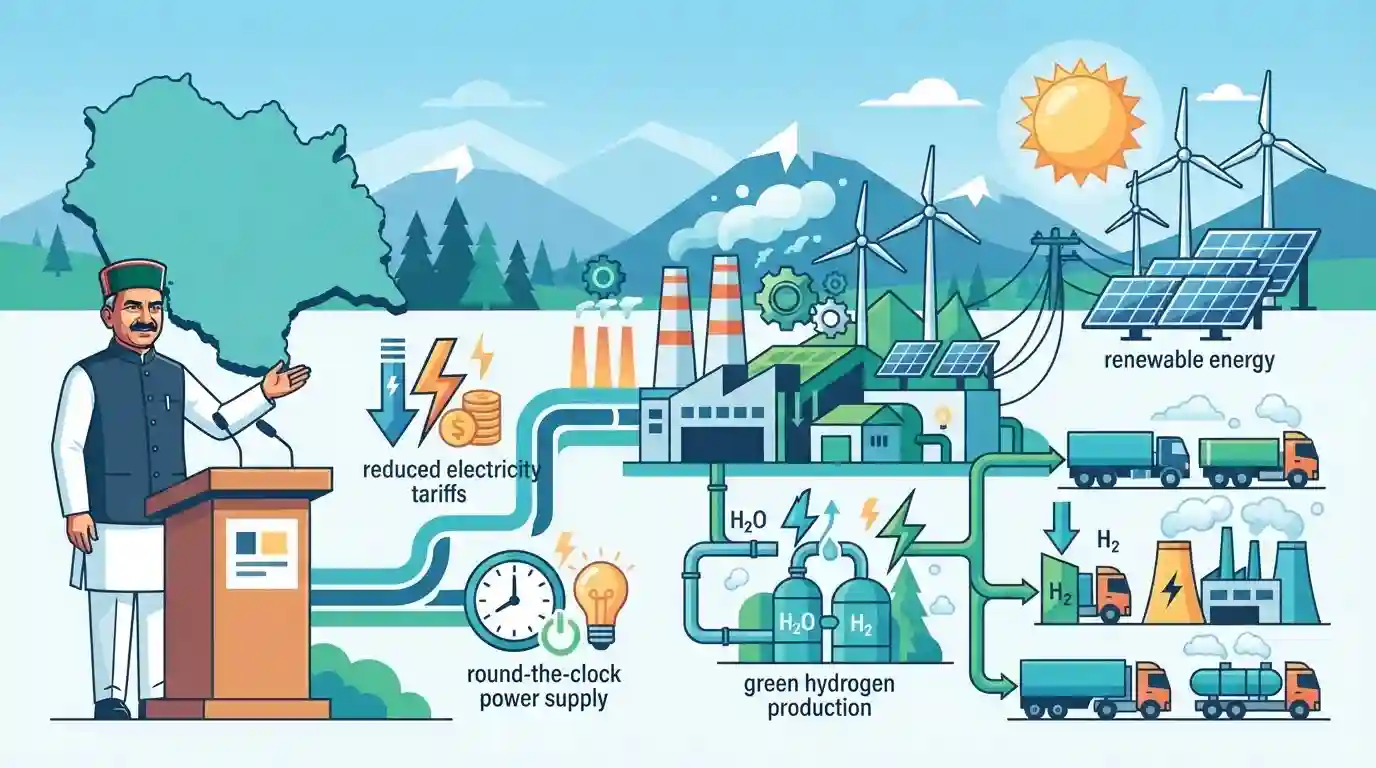
Himachal Pradesh Chief Minister Sukhvinder Singh Sukhu announced an upcoming industrial policy aimed at attracting investment by offering reduced electricity tariffs and round-the-clock power supply to industries. Speaking at the TiE Chandigarh AGM, he emphasized the state's potential to emerge as a national leader in green hydrogen production, underscoring the government's commitment to sustainable industrial growth and clean energy.
Key Points
- Himachal Pradesh is preparing a new industrial policy that features reduced electricity tariffs to attract greater investment.
- The state government guarantees round-the-clock power supply to industries.
- Chief Minister Sukhvinder Singh Sukhu announced the policy at the Chandigarh Leadership Conclave and TiE AGM.
- Himachal Pradesh aims to become a national leader in green hydrogen production, focusing on sustainable industrial growth and clean energy.
Important Terms
New Industrial Policy (Himachal Pradesh)

An upcoming regulatory framework by Himachal Pradesh to attract business investments by offering reduced electricity tariffs, uninterrupted power supply, and infrastructure support for IT and green energy sectors.
UPSC context
Relates to GS-2 (State Policies) and GS-3 (Industrial Growth). Illustrates sub-national strategies to improve ease of doing business and investment.
TiE (The Indus Entrepreneurs)
A global non-profit network founded in Silicon Valley in 1992. It fosters entrepreneurial ecosystems worldwide through a core five-pillar approach encompassing mentoring, networking, education, funding, and incubation.
UPSC context
Relevant for GS-3 (Economy & Startups). Demonstrates the role of global diaspora and non-profit networks in driving startup ecosystems.
Green Hydrogen
Hydrogen fuel produced via the electrolysis of water using entirely renewable energy sources (like solar or wind), ensuring zero carbon emissions during the entire production process.
UPSC context
Crucial for GS-3 (Environment & Energy). Tests knowledge of India's National Green Hydrogen Mission, clean energy transition, and decarbonization targets.
Chandigarh Leadership Conclave
A regional business and entrepreneurial summit serving as a collaborative platform for industry leaders, startups, and policymakers to discuss regional investments, industrial policies, and economic growth.
UPSC context
Fits GS-3 (Economic Development & Investment Models). Exemplifies public-private networking platforms essential for regional industrial development.
Prelims Trap
Green hydrogen is produced from natural gas or coal, provided carbon capture and storage (CCS) technology is utilized.
This describes Blue Hydrogen. Green Hydrogen is generated strictly through the electrolysis of water using renewable electricity, producing zero carbon emissions.
Static Concepts Connected
How are the different types of hydrogen classified by their production methods?
- Grey Hydrogen: Produced from natural gas or coal via steam methane reforming; carbon emissions are released directly into the atmosphere.
- Blue Hydrogen: Produced from fossil fuels similar to grey hydrogen, but the resulting carbon emissions are captured and stored (CCS).
- Green Hydrogen: Produced by splitting water via electrolysis using 100% renewable energy (solar, wind), resulting in zero carbon emissions.
How is 'Industry' categorized under the 7th Schedule of the Constitution?
- State List: Entry 24 places 'Industries' generally under the jurisdiction of State governments, empowering them to frame independent state-specific industrial policies.
- Union List: Entry 52 empowers Parliament to control specific industries declared by law to be expedient in the public interest, superseding state control.
Cross-Topic Patterns
Competitive Federalism + Climate Goals
States are moving beyond standard tax breaks, using cheap renewable power and green hydrogen hubs to compete for global investments, merging GS2 federalism with GS3 decarbonization.
Green Hydrogen + Hard-to-abate Sectors
State guarantees for 24/7 cheap electricity directly address massive electrolyzer operational costs, enabling the decarbonization of heavy industries like steel and fertilizers necessary for Net Zero targets.

Competitive federalism driving Net Zero: States competing via cheap power for green hydrogen hubs is a highly probable GS3 Mains theme.
Linked PYQs · 3
Linked PYQs · 3
- 2017HPAS_PRELIMSGS1
Renewable source of energy is :
- 2018HPAS_PRELIMSGS1
Which one is incorrect regarding sustainable development ?
- 2025HPAS_PRELIMSGS1
Match List I with List II : | List-I (Scheme) | List-II (Ministry) | |---|---| | (a) Atal Pension Yojana | (i) Ministry of Communications | | (b) Startup India Scheme | (ii) Ministry of Finance | | (c) Eco-NIWAS | (iii) Ministry of Commerce and Industry | | (d) BharatNet | (iv) Ministry of Power | Code: (a) (b) (c) (d)
