New industrial policy focusing on green manufacturing in Himachal
Source:hindustantimes ↗
Why It Matters
The shift towards green industrialization is a critical aspect of sustainable development in ecologically sensitive hill states like Himachal Pradesh. The state's strategy regarding employment generation, specialized corridors (defence), and private sector participation in infrastructure are directly relevant to the HPAS GS3 syllabus on state economy and industrial policies.
Summary
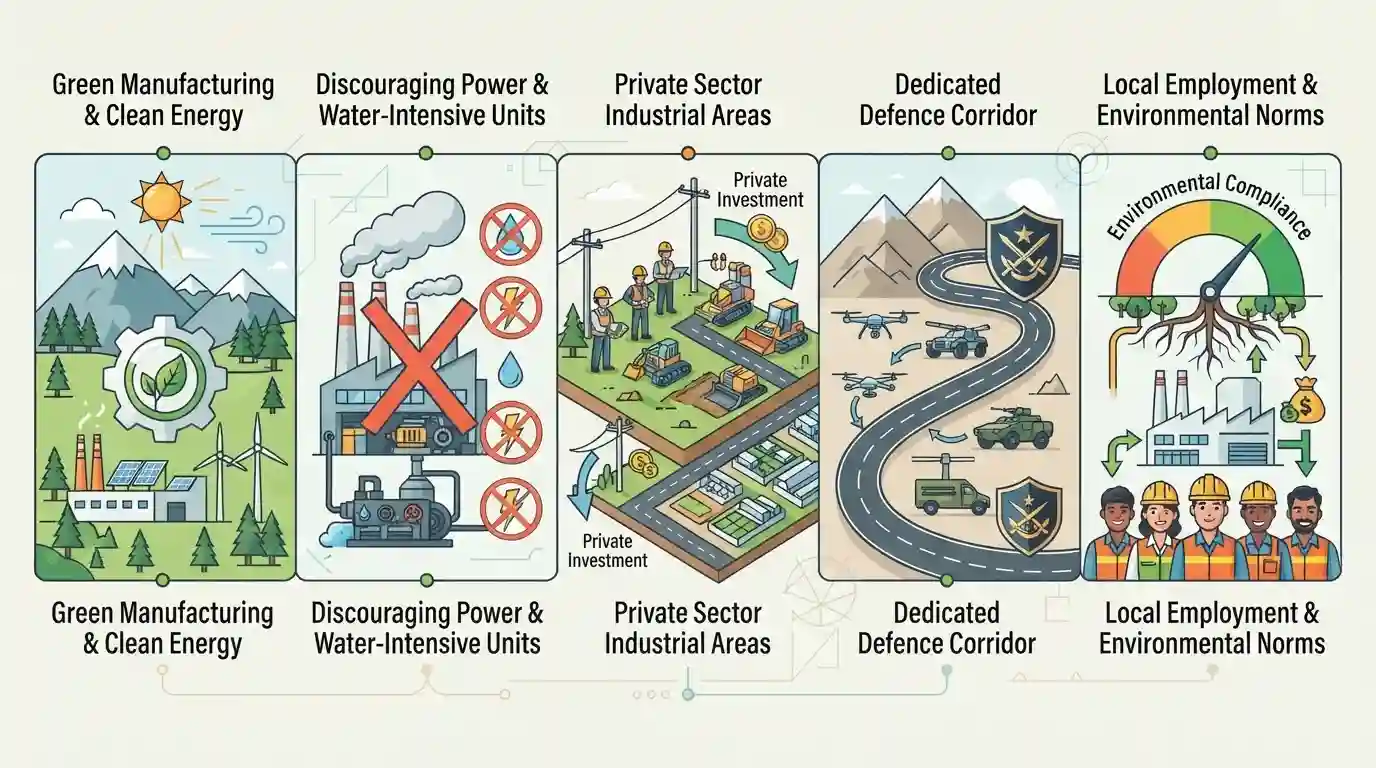
Himachal Pradesh is drafting a new industrial policy centered around green manufacturing and clean energy, explicitly discouraging power and water-intensive units like steel and ethanol. The policy will propose opening industrial area development to the private sector and establishing a dedicated defence corridor to attract specialized manufacturing. To boost local employment, the state is contemplating production-linked incentives tied to hiring locals, while ensuring strict adherence to environmental norms to protect the state's fragile ecology.
Key Points
- Himachal Pradesh's upcoming industrial policy emphasizes green manufacturing, clean energy, food processing, and local product-based industries.
- The policy explicitly discourages establishing high power and water-consuming industries, such as steel and ethanol units, due to pollution concerns.
- The state government plans to open industrial area development to the private sector, transitioning away from exclusive reliance on state agencies like HIMUDA and HPIDC.
- A dedicated defence corridor is proposed within the state to attract specialized defence manufacturing and bolster the industrial base.
- To maximize local job creation, the government is considering offering production-linked incentives tied directly to local employment generation.
Important Terms
New Industrial Policy of Himachal Pradesh

A state policy framework prioritizing green manufacturing, clean energy, private-sector-led industrial area development, and production-linked incentives, while actively discouraging power and water-intensive industries to preserve ecology.
UPSC context
GS Paper 3 (Industrial Policy/Sustainable Development), tests state-level initiatives balancing economic growth with ecological preservation.
State Level Single Window Clearance and Monitoring Authority
A statutory body chaired by the Chief Minister of Himachal Pradesh that provides time-bound, streamlined clearances and approvals for industrial investment proposals.
UPSC context
GS Paper 3 (Investment Models/Ease of Doing Business), tests regulatory reforms and administrative simplification for attracting investments.
HIMUDA
A statutory body established in 2004 tasked with developing housing, urban infrastructure, and industrial areas through public and private resource mobilization.
UPSC context
GS Paper 3 (Infrastructure) and GS Paper 2 (Statutory Bodies), tests institutional mechanisms for state-level urban planning and infrastructure development.
HPIDC
A state-owned corporation incorporated in 1966 that acts as the principal agency for promoting, developing, and financing small, medium, and large-scale industrial units.
UPSC context
GS Paper 3 (Industrial Infrastructure/Growth), tests the role of state-level public undertakings in fostering industrialization and regional growth.
Prelims Trap
Himachal Pradesh hosts one of India's official, centrally designated Defence Industrial Corridors under the 'Make in India' initiative.
Only two central DICs exist (UP and Tamil Nadu). Himachal Pradesh is merely proposing a state-level corridor in its new policy.
Static Concepts Connected
What is the difference between Strong and Weak Sustainability rules?
- Strong Sustainability: Asserts that natural capital is non-substitutable and must be preserved independently of man-made capital growth.
- Weak Sustainability: Assumes natural and physical capital are perfect substitutes; overall capital stock must remain constant or increase.
- Policy Implication: Strong sustainability guides bans on high-pollution industries like steel in ecologically fragile regions like the Western Himalayas.
How does the central Production Linked Incentive (PLI) scheme function?
- Incentive Basis: Rewards are calculated based on incremental sales over a baseline year, targeting 14 key manufacturing sectors.
- Primary Goal: Aims to scale up domestic manufacturing capacity, enhance exports, and integrate India into global value chains.
- State-level Shift: Unlike central PLI, some state-level variations are now trying to link fiscal incentives directly to local job creation.
Cross-Topic Patterns
Federal PLI Divergence
States modifying central industrial templates to enforce localized employment quotas highlights the growing friction between national economic scaling and regional job security.
Biofuels vs Fragile Ecosystems
High water footprint of first-generation ethanol production clashes directly with ecological preservation in Himalayan states, revealing critical cracks in uniform national clean energy mandates.

Questions in GS-3 will likely target the ecological trade-offs of biofuels and the limits of substitution in mountain ecosystems by 2026.
Linked PYQs · 4
Linked PYQs · 4
- 2018HPAS_PRELIMSGS1
Which one is incorrect regarding sustainable development ?
- 2025HPAS_PRELIMSGS1
Given below are two statements : Statement I : India is the second largest arms importer after Ukraine during 2020-24, as per the Stockholm International Peace Research Institute report. Statement II : India has developed two defence industrial corridors in Uttar Pradesh and Tamil Nadu to boost the defence manufacturing. In the light of the above statements, choose the most appropriate answer from the options given below :
- 2024HPAS_PRELIMSGS1
For the year 2022-23, match the Industry sub-sector in Himachal Pradesh with the percentage of workers employed in them : | List I (Industry Sub-sector) | List II (Percentage of workers employed) | |---|---| | (a) Mining and Quarrying | (i) 2 | | (b) Manufacturing | (ii) 41 | | (c) Electricity and Other Utilities | (iii) 50 | | (d) Construction | (iv) 7 | Choose the correct option : Code: (a) (b) (c) (d)
- 2025HPAS_PRELIMSGS1
According to PLFS 2023-24, share of secondary and tertiary sector in total employment in Himachal Pradesh respectively are :
