New Income Tax Regime Slabs and Direct Tax Compliance Reforms
Source:Indian Express ↗
Why It Matters
Understanding direct tax reforms is critical for the UPSC examination as it directly impacts fiscal policy, revenue mobilization, disposable income, and broader macroeconomic consumption trends. The transition from the old to the new tax regime showcases the government's shift toward simplified tax compliance with fewer deductions.
Summary
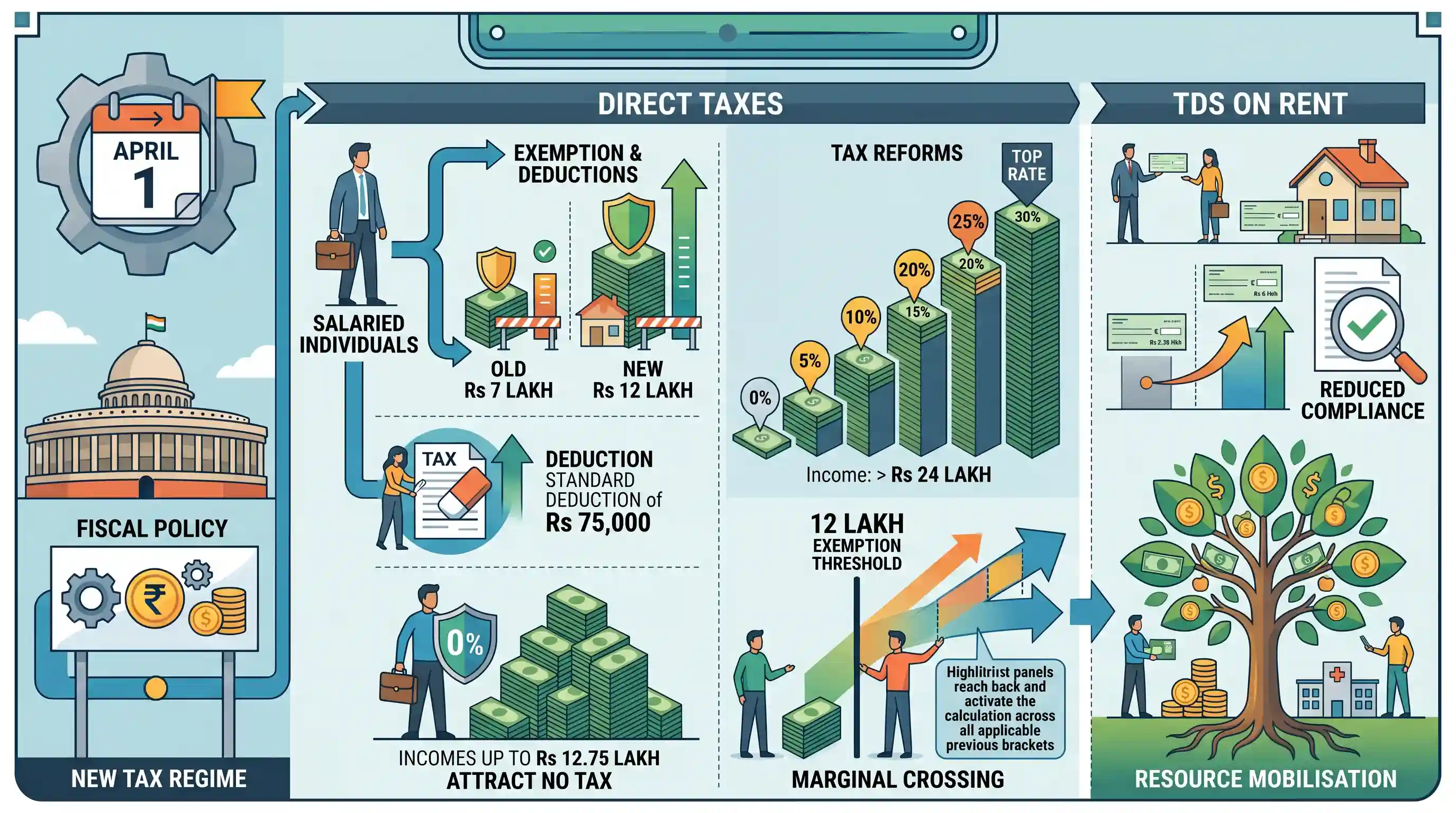
Beginning April 1, the new income tax slabs under the New Tax Regime (NTR) will come into effect, featuring a significantly higher exemption limit of Rs 12 lakh, up from Rs 7 lakh. Alongside an increased standard deduction of Rs 75,000 for salaried individuals, incomes up to Rs 12.75 lakh will attract no tax. The reformed tax brackets introduce a zero-tax threshold up to Rs 4 lakh, scaling to a 30% top rate for incomes exceeding Rs 24 lakh. A notable aspect of the new regime is that crossing the Rs 12 lakh exemption threshold triggers tax calculations across all applicable brackets, rather than taxing only the marginal excess. Additionally, the TDS threshold on rental income has been revised from Rs 2.40 lakh to Rs 6 lakh to reduce compliance burdens.
Key Points
- The Income Tax exemption limit under the New Tax Regime (NTR) has been raised to Rs 12 lakh from Rs 7 lakh, effective April 1.
- Salaried taxpayers can avail an increased standard deduction of Rs 75,000, making an income up to Rs 12.75 lakh completely tax-free.
- Tax rates are progressively scaled: Nil up to Rs 4 lakh, 5% for Rs 4-8 lakh, 10% for Rs 8-12 lakh, peaking at 30% for income above Rs 24 lakh.
- Taxpayers earning slightly above Rs 12 lakh lose the full exemption and will be taxed based on the prescribed slab rates.
- The TDS threshold on rental income has been increased from Rs 2.40 lakh to Rs 6 lakh to provide compliance relief.
Important Terms
New Tax Regime (NTR)

A simplified income tax structure with lower rates but minimal exemptions (e.g., 80C). It is now the default tax system for individuals and HUFs in India.
UPSC context
GS III (Indian Economy): Related to Government Budgeting, resource mobilization, and direct tax reforms for simplifying the tax structure.
Standard Deduction
A fixed amount (currently Rs 75,000 for NTR) deducted from gross salary before tax calculation, providing relief to salaried individuals without requiring proof of investment.
UPSC context
GS III (Indian Economy): Tests understanding of fiscal tools and components of direct taxation affecting disposable income.
Tax Deducted at Source (TDS)
A mechanism where the person responsible for making a payment (like rent or salary) deducts tax before paying the balance, ensuring early tax collection.
UPSC context
GS III (Indian Economy): Important for topics on resource mobilization and administrative measures to curb tax evasion.
Section 87A (Tax Rebate)
A provision under Section 87A that reduces tax liability to zero for individuals whose net taxable income falls below a specific threshold (effectively Rs 12 lakh).
UPSC context
Prelims/GS III: Specific technical provision used by the government to provide middle-class relief within the progressive tax system.
Income Tax Act, 1961
The primary law governing direct taxes in India. A comprehensive review and a "New Income Tax Bill" aim to simplify and replace the 1961 Act.
UPSC context
GS II (Governance) & GS III (Economy): Legal framework for taxation and recent legislative efforts toward structural reforms.
Fiscal Policy
The use of government spending and tax policies (like direct tax slab revisions) to influence macroeconomic conditions, including demand, inflation, and growth.
UPSC context
GS III (Indian Economy): Core concept regarding the government's role in economic stabilization and wealth redistribution.
Prelims Trap
The basic zero-tax slab under the New Tax Regime is set at Rs 12 lakh.
The zero-tax slab is only up to Rs 4 lakh. Incomes up to Rs 12 lakh become tax-free due to statutory rebates, meaning crossing Rs 12 lakh retroactively taxes the previous brackets.
Static Concepts Connected
What is 'Marginal Relief' in the Indian Income Tax system?
- Core Concept: A mechanism ensuring the additional income tax payable does not exceed the actual amount of additional income earned above a certain threshold.
- Anti-Cliff Application: It kicks in when crossing a rebate threshold (like Rs 12 lakh) suddenly triggers taxes on lower brackets, preventing an unfair 'cliff effect' on incremental earnings.
How does Tax Deducted at Source (TDS) function as a macroeconomic tool?
- Mechanism: Tax is deducted at the origin of income (salary, rent) before it reaches the payee, shifting compliance burden to the payer.
- Fiscal Benefit: It prevents tax evasion, expands the formal tax base, and ensures a steady, non-inflationary revenue stream for the government throughout the financial year.
Cross-Topic Patterns
Macro shift: Savings to Consumption
The New Tax Regime removes deductions for instruments like PPF or ELSS, marking a fiscal shift from incentivising forced household savings to boosting immediate disposable income and aggregate consumption.
Laffer Curve and Voluntary Compliance
Rationalising TDS thresholds (like rental income up to Rs 6 lakh) alongside lower personal tax rates aims to reduce litigation and encourage voluntary compliance, indirectly reflecting Laffer Curve principles.

Mains GS3 will likely link the New Tax Regime's 'no-exemption' model to India's macro shift from forced savings to consumption-led growth.
Linked PYQs · 2
Linked PYQs · 2
- 2019MainsGS3
Enumerate the indirect taxes which have been subsumed in the Goods and Services Tax (GST) in India. Also, comment on the revenue implications of the GST introduced in India since July 2017.
- 2025PrelimsGS1
Suppose the revenue expenditure is ₹ 80,000 crores and the revenue receipts of the Government are ₹60,000 crores. The Government budget also shows borrowings of ₹ 10,000 crores and interest payments of ₹ 6,000 crores. Which of the following statements are correct? I. Revenue deficit is ₹ 20,000 crores. II. Fiscal deficit is ₹ 10,000 crores. III. Primary deficit is ₹ 4,000 crores. Select the correct answer using the code given below.
