Structural Reforms and Compliance Changes in Direct Tax Rules
Source:Indian Express ↗
આ શા માટે મહત્વનું છે
Understanding changes in income tax structures is essential for analyzing fiscal policy, public finance management, disposable incomes, and the broader macroeconomic implications of direct tax reforms in India.
સારાંશ
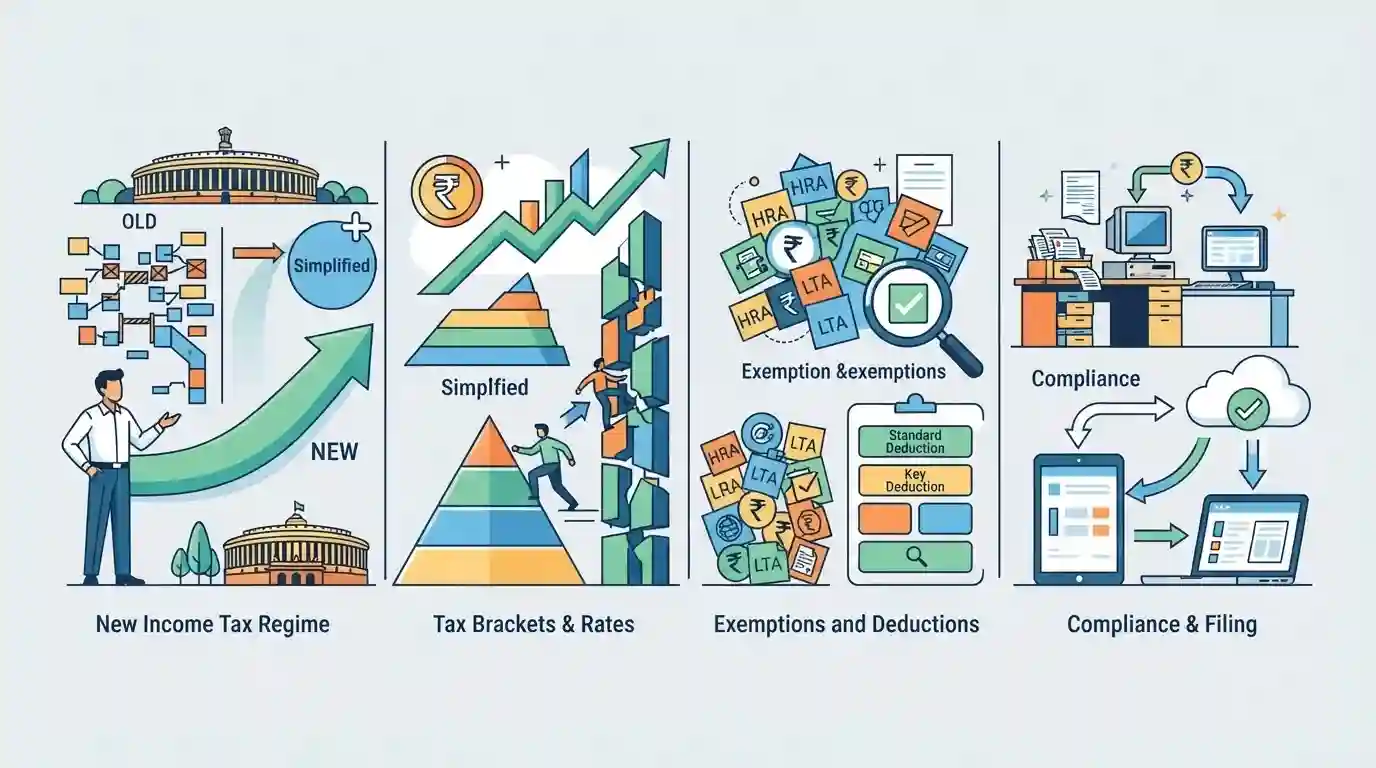
The article discusses the updated regulations and provisions under the new income tax rules, detailing changes affecting individual taxpayers, tax brackets, exemptions, and compliance procedures designed to promote tax simplification.
મુખ્ય મુદ્દા
- The article outlines the modifications and updates introduced under the new income tax rules, impacting tax slabs, deductions, and exemptions.
- Changes aim to streamline compliance, rationalize personal taxation, and encourage taxpayers to transition to the new tax regime.
- Direct tax reforms play a critical role in shaping disposable income, savings behavior, and overall economic demand in India.
મહત્વપૂર્ણ શબ્દો
Income Tax Act

The principal legislation governing income taxation in India, establishing rules for tax assessment, collection, exemptions, and compliance procedures across individuals and entities.
UPSC context
UPSC GS Paper III (Indian Economy - Mobilization of Resources & Government Budgeting). Important for understanding direct taxation frameworks and tax reforms.
Income Tax Department
The premier government agency under the Department of Revenue, Ministry of Finance, responsible for administering direct tax laws and revenue collection in India.
UPSC context
UPSC GS Paper III (Government Budgeting & Tax Administration). Tests knowledge of fiscal machinery, tax compliance, and administrative bodies like the CBDT.
Ministry of Finance
A vital ministry of the Union Government responsible for formulating the nation's economic, fiscal, financial, and taxation policies, including annual Union Budget preparations.
UPSC context
UPSC GS Paper II & III (Government Policies, Fiscal Policy, Public Finance). Essential for questions on budget-making and macroeconomic management.
પ્રિલિમ્સ ટ્રેપ
The new tax regime completely eliminates every single deduction and exemption available under the Income Tax Act without exception.
Aspirants often assume that shifting to the new tax regime means all deductions (like standard deduction) are permanently abolished, whereas the government frequently introduces specific allowances (like standard deduction) into the new regime.
સંલગ્ન સ્થિર ખ્યાલો
What are the key structural differences between the old and new income tax regimes in India?
- Exemptions & Deductions: The old regime offers numerous deductions and exemptions (e.g., Sec 80C, 80D, HRA) but has higher tax rates across slabs.
- Simplified Slabs: The new tax regime provides lower tax slab rates but eliminates most traditional deductions and exemptions to simplify compliance.
- Default Option: The new regime has been made the default option in recent budgets to nudge taxpayers away from complex deductions.
આંતર-વિષય પેટર્ન
Tax Regimes + Monetary Policy Transmission
Personal income tax slabs directly influence disposable income, altering household savings rates and shifting aggregate demand patterns tracked in monetary policy transmission.
Direct Tax Reforms + Tax-to-GDP Ratio
Tax simplification reforms seek to lower compliance burdens, directly correlating with improvements in India's Ease of Doing Business metrics and tax-to-GDP ratio trajectory.

Changes to tax regimes and exemptions are frequently tested via analytical statements on disposable income and savings behavior in Prelims.
સંલગ્ન PYQ · 4
સંલગ્ન PYQ · 4
- 2019MainsGS3
The public expenditure management is a challenge to the Government of India in the context of budget making during the post-liberalization period. Clarify it.
- 2024MainsGS3
Examine the pattern and trend of public expenditure on social services in the post-reforms period in India. To what extent this has been in consonance with achieving the objective of inclusive growth?
- 2021MainsGS3
Distinguish between Capital Budget and Revenue Budget. Explain the components of both these Budgets.
- 2025PrelimsGS1
Suppose the revenue expenditure is ₹ 80,000 crores and the revenue receipts of the Government are ₹60,000 crores. The Government budget also shows borrowings of ₹ 10,000 crores and interest payments of ₹ 6,000 crores. Which of the following statements are correct? I. Revenue deficit is ₹ 20,000 crores. II. Fiscal deficit is ₹ 10,000 crores. III. Primary deficit is ₹ 4,000 crores. Select the correct answer using the code given below.
