ग्लोबल साउथ जलवायु नेतृत्व और COP30 की प्राथमिकताएं
स्रोत:द हिंदू ↗
क्यों मायने रखता है
यह लेख जलवायु परिवर्तन की उभरती भू-राजनीति को समझने के लिए अत्यंत महत्वपूर्ण है। यह जलवायु वार्ताओं में विकसित राष्ट्रों (विशेष रूप से अमेरिका) और ग्लोबल साउथ (जैसे भारत और चीन) के बीच बदलती जिम्मेदारियों को रेखांकित करता है। यह जलवायु वित्त (climate finance), अनुकूलन (adaptation) और कार्बन मार्केट जैसे आवश्यक GS3 विषयों को कवर करता है, साथ ही अंतरराष्ट्रीय संस्थानों की प्रभावशीलता और बहुपक्षवाद (multilateralism) में संरचनात्मक सुधार की आवश्यकता जैसे GS2 विषयों को भी संबोधित करता है।
सारांश
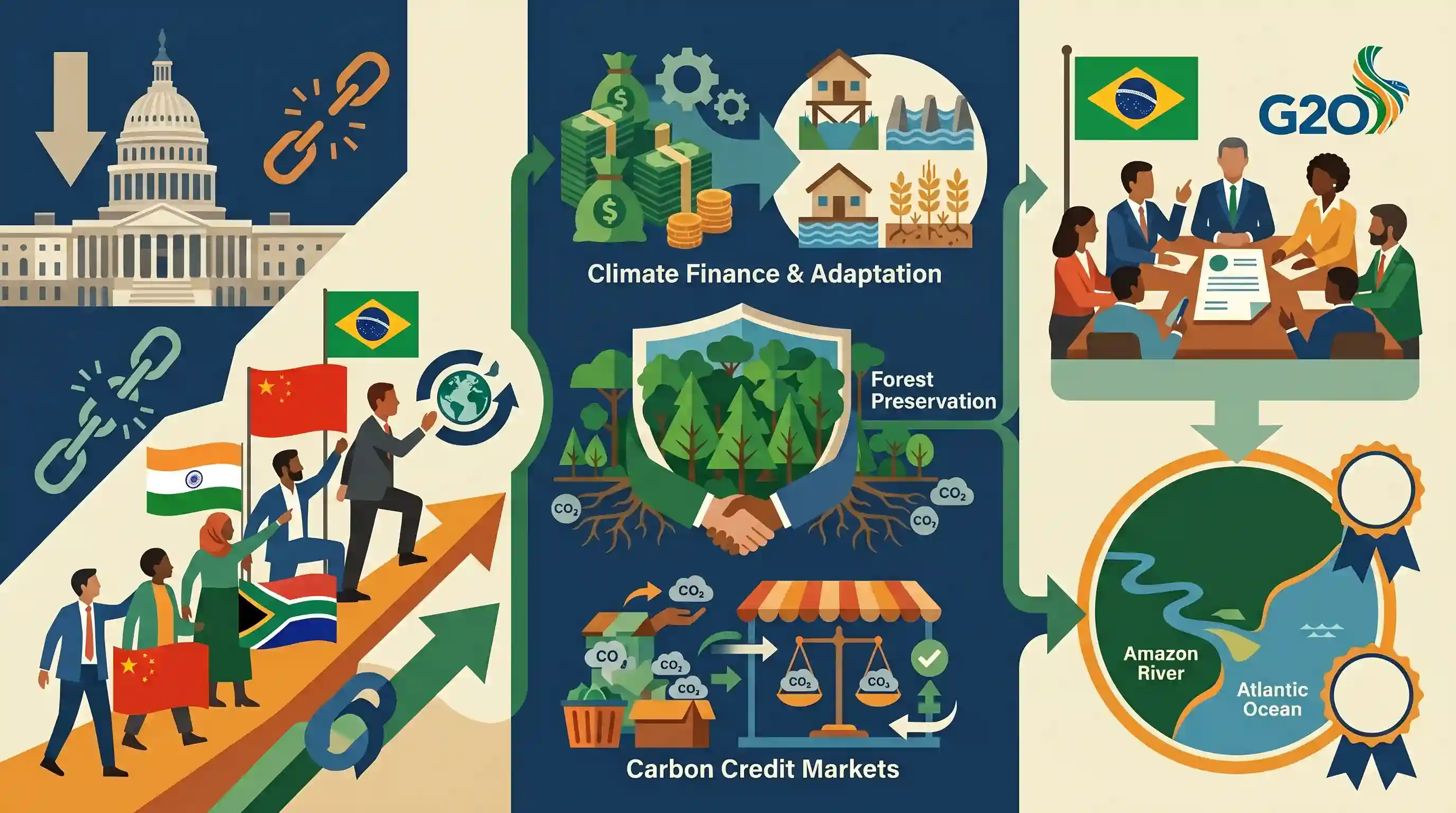
The upcoming COP30 in Belém, Brazil, represents a pivotal moment for global climate action, coinciding with the 10th anniversary of the Paris Agreement. Amidst a renewed U.S. withdrawal from the agreement and its hostility toward climate commitments, the burden of leadership is shifting toward large developing economies like India, China, Brazil, and South Africa. The article emphasizes the urgent need for actionable progress on adaptation financing, forest preservation, and robust carbon credit markets. To streamline the often unwieldy U.N. multilateral process, Brazil has proposed the creation of a 'climate council'. Ultimately, developing nations must seize this leadership vacuum by transparently recalibrating past positions on financial contributions to maintain global momentum against climate change.
मुख्य बिंदु
- COP30 in Belém, Brazil, will mark the 10th anniversary of the landmark Paris Agreement, serving as a critical juncture for global climate action.
- The anticipated withdrawal of the U.S. from the Paris Agreement and its hostility toward emission cuts, clean tech, and adaptation funding threaten global climate consensus.
- ब्राजील की अध्यक्षता शिखर सम्मेलन के फोकस को लंबी वार्ताओं से हटाकर जलवायु लक्ष्यों के ठोस 'कार्यान्वयन' की ओर स्थानांतरित कर रही है।
- Key unresolved issues include securing reliable adaptation financing, compensating nations for preserving natural forests, and establishing robust, trustworthy carbon credit markets.
- To make the multilateral process more agile and effective, Brazil has proposed the creation of a U.N. 'climate council'.
- Large developing economies like India, China, Brazil, and South Africa have a unique opportunity to assume global climate leadership by elevating their ambitions and offering transparent financial mechanisms.
महत्वपूर्ण शब्द
UNFCCC COP

The supreme decision-making body of the UNFCCC, meeting annually to review the implementation of the Convention and negotiate global climate agreements like the Paris Agreement.
UPSC context
GS Paper 3 (Environment). Essential for understanding global climate diplomacy and India's role in multilateral negotiations.
Paris Agreement
A legally binding 2015 international treaty aiming to limit global warming to well below 2°C, preferably 1.5°C, through nationally determined climate commitments (NDCs).
UPSC context
GS Paper 3. Core of environmental policy questions, focusing on India's NDCs and the Global Stocktake (GST).
Adaptation Finance
Financial resources specifically mobilized to help communities and ecosystems build resilience against the adverse impacts of climate change, such as droughts, floods, and sea-level rise.
UPSC context
GS Paper 3 (Economy/Environment). Critical for questions on climate justice and the funding gap between developed and developing nations.
Carbon Credit Markets
A market-based mechanism where tradable certificates representing one tonne of CO2 equivalent reduced or removed are bought by entities to offset their emissions.
UPSC context
GS पेपर 3 (पर्यावरण/अर्थव्यवस्था)। अनुच्छेद 6 वार्ताओं और भारत की नई घरेलू कार्बन क्रेडिट ट्रेडिंग स्कीम (CCTS) के लिए अत्यधिक प्रासंगिक।
जलवायु परिवर्तन परिषद
A Brazilian proposal to create a streamlined U.N. body to fast-track climate decisions, coordinate fragmented processes, and enhance accountability in implementing the Paris Agreement.
UPSC context
GS Paper 2 (International Relations) & GS Paper 3. Relevant for topics on the reform of multilateral institutions and climate governance.
International Maritime Organisation (IMO)
A UN specialized agency responsible for the safety of shipping and preventing marine and atmospheric pollution by ships.
UPSC context
GS Paper 2 (IR). Important for maritime security, 'Green Shipping' initiatives, and India's role in global trade regulations.
प्रारंभिक ट्रैप
The UN Climate Council is a newly established UNFCCC subsidiary body designed to bypass consensus-based COP negotiations.
It is currently just a proposal by Brazil to streamline the unwieldy multilateral process, not an established UN organ or a replacement for the COP process.
संबंधित अवधारणाएँ
What are the primary mechanisms for carbon markets under Article 6 of the Paris Agreement?
- अनुच्छेद 6.2: Enables bilateral or multilateral trading of emissions reductions through Internationally Transferred Mitigation Outcomes (ITMOs).
- Article 6.4: Creates a centralized, UN-supervised global carbon market mechanism, succeeding the Kyoto Protocol's Clean Development Mechanism (CDM).
- Article 6.8: Provides a framework for non-market approaches to foster cooperation in mitigation and adaptation without trading carbon credits.
How does the UNFCCC's REDD+ framework incentivize developing nations?
- Core Objective: Financially rewards developing countries for reducing emissions from deforestation and forest degradation.
- The 'Plus' Component: Expands the scope to include forest conservation, sustainable management, and the enhancement of forest carbon stocks.
- Results-Based Finance: Payments are strictly tied to verified and measured reductions in carbon emissions, funded by developed nations or international mechanisms.
अंतर-विषय पैटर्न
BASIC grouping & Global South leadership
जलवायु नेतृत्व की रिक्तता BASIC (ब्राजील, दक्षिण अफ्रीका, भारत, चीन) को रक्षात्मक वार्ता गुटों से सक्रिय कार्यसूची-निर्धारक के रूप में परिवर्तित होने का अवसर प्रदान करती है, जो WTO में CBDR का आह्वान करते हुए उनके सामूहिक विरोध के समानांतर है।
Global Article 6 vs Domestic Green Credits
As COP30 targets global carbon markets under Article 6, India's domestic Green Credit Programme broadens the scope, incentivizing non-carbon environmental actions like water conservation and afforestation.

Expect a 2026 Prelims multi-statement question interlinking Article 6 carbon markets, REDD+ financing, and Brazil's Climate Council pitch.
संबद्ध PYQ · 5
संबद्ध PYQ · 5
- 2025MainsGS3
Write a review on India's climate commitments under the Paris Agreement (2015) and mention how these have been further strengthened in COP26 (2021). In this direction, how has the first Nationally Determined Contribution intended by India been updated in 2022?
- 2014MainsGS3
Should the pursuit of carbon credits and clean development mechanisms set up under UNFCCC be maintained even though there has been a massive slide in the value of a carbon credit? Discuss with respect to India's energy needs for economic growth.
- 2021MainsGS3
Describe the major outcomes of the 26th session of the Conference of the Parties (COP) to the United Nations Framework Convention on Climate Change (UNFCCC). What are the commitments made by India in this conference?
- 2025PrelimsGS1
Consider the following statements : Statement I: Article 6 of the Paris Agreement on climate change is frequently discussed in global discussions on sustainable development and climate change. Statement II: Article 6 of the Paris Agreement on climate change sets out the principles of carbon markets. Statement III : Article 6 of the Paris Agreement on climate change intends to promote inter-country non-market strategies to reach their climate targets. Which one of the following is correct in respect of the above statements?
- 2011PrelimsGS1
Regarding “carbon credits”, which one of the following statements is not correct?
