Proposed Two-Slab GST Overhaul and Consumer Focus
Source:The Hindu ↗
Why It Matters
The rationalisation of the GST structure is a major macroeconomic reform. For UPSC aspirants, understanding the shift from a multi-slab system to a two-slab system (with a special rate for sin goods) is crucial for GS3 (Economy). Furthermore, the premature end of the GST Compensation Cess highlights a significant milestone in Centre-State fiscal relations, an important topic for GS2 (Polity and Governance).
Summary
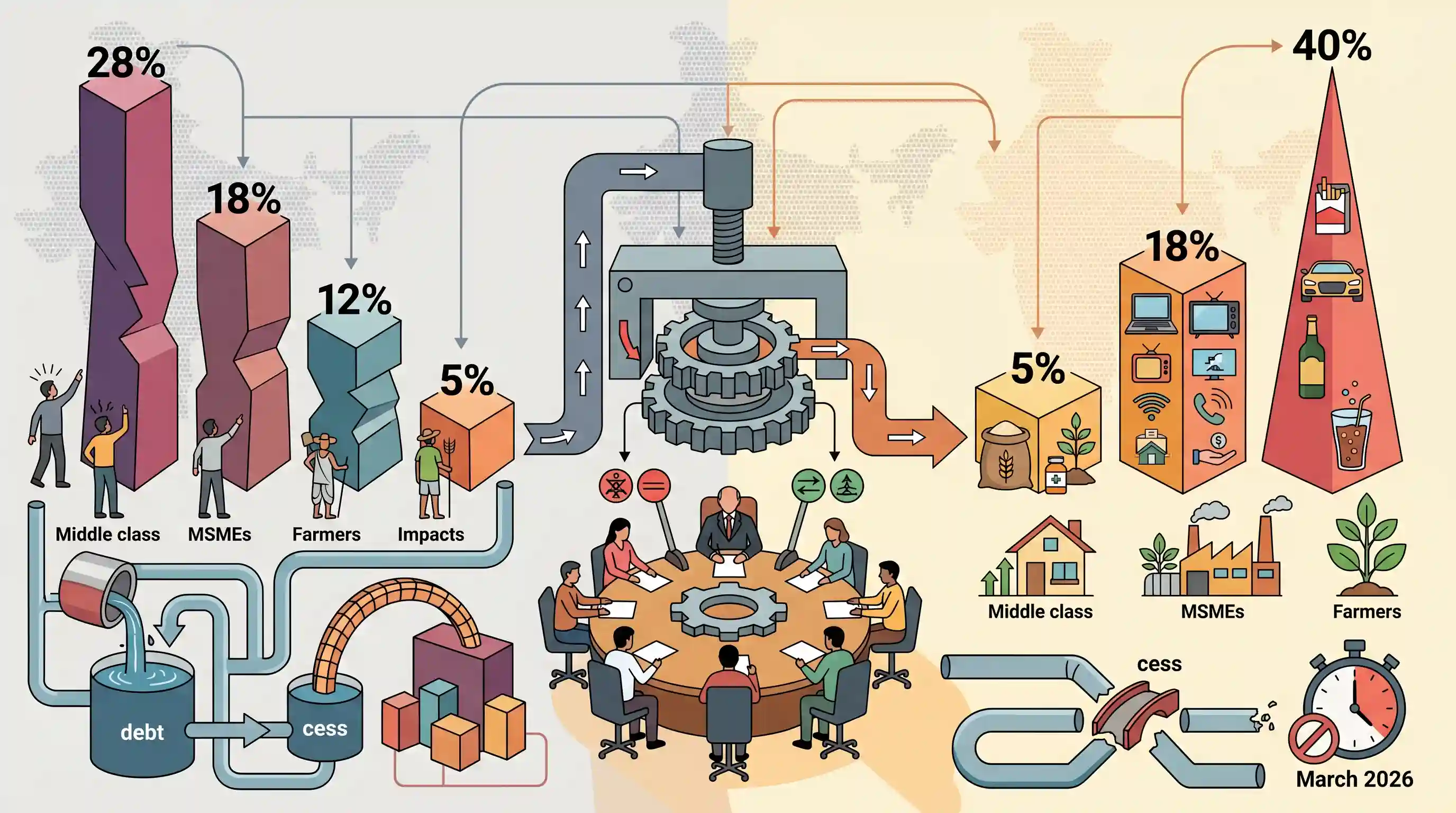
The Union Government is preparing to overhaul the Goods and Services Tax (GST) regime, aiming for a simpler, consumer-centric structure with primarily two slabs: 5% and 18%. Prime Minister Narendra Modi indicated that most items currently taxed at 28% will drop to 18%, providing relief to the middle class, MSMEs, and farmers. However, a small number of 'sin goods' will face a new peak rate of 40%. Concurrently, the GST Compensation Cess will end before its March 2026 deadline because the central loans taken to compensate states have been largely repaid. The GST Council is expected to finalize these structural reforms and rate rationalisations soon.
Key Points
- The Union Government plans to overhaul the GST regime to make it more 'consumer-centric', simplifying the tax structure to primarily two slabs: 5% and 18%.
- Most items currently under the 28% tax bracket will be downgraded to 18%, significantly lowering costs for the middle class, poor, farmers, and MSMEs.
- A new peak tax rate of 40% will be introduced exclusively for a small number of 'sin goods' like tobacco and aerated drinks.
- The GST Compensation Cess, originally scheduled to end on March 31, 2026, will cease earlier as the Centre's pandemic-era borrowing to compensate states has been nearly repaid.
- The final details of rate rationalisation and the future of the compensation cess will be approved by the GST Council.
Important Terms
Goods and Services Tax (GST)

A comprehensive, destination-based indirect tax on the supply of goods and services, subsuming most central and state indirect taxes under the 'One Nation, One Tax' vision.
UPSC context
GS Paper 3: Indian Economy; key for questions on fiscal policy, resource mobilization, and indirect tax reforms.
GST Council
A constitutional body established under Article 279A, chaired by the Union Finance Minister, to make recommendations on GST rates, exemptions, and administrative rules.
UPSC context
GS Paper 2: Statutory/Constitutional bodies; tests understanding of cooperative federalism and Centre-State fiscal relations.
GST Compensation Cess
An additional tax levied on luxury and demerit goods to compensate states for revenue losses arising from the transition to the GST regime.
UPSC context
GS Paper 3: Government Budgeting; critical for understanding state fiscal autonomy and revenue shortfall mechanisms.
Rate Rationalisation
The process of simplifying the GST structure by reducing the number of tax slabs and adjusting rates to optimize revenue and provide consumer relief.
UPSC context
GS Paper 3: Economic Development; concerns efficiency of the tax system and its impact on various economic sectors.
Sin Goods
Products considered socially or physically harmful, such as tobacco, alcohol, and aerated drinks, which attract higher tax rates to discourage consumption.
UPSC context
GS Paper 3: Resources; tests concepts of Pigovian taxes and demerit goods in public finance.
Groups of Ministers (GoMs)
Ad-hoc committees formed within the GST Council, comprising state finance ministers, to deliberate on complex issues like rate structures before final council approval.
UPSC context
GS Paper 2: Governance; examines the deliberative and recommendatory mechanisms in India's federal decision-making.
Prelims Trap
The GST Compensation Cess was extended until 2026 to continue guaranteeing states a 14% annual revenue growth.
The 14% revenue guarantee explicitly ended in June 2022. The cess was only extended to 2026 to repay the pandemic-era back-to-back loans taken by the Centre, not for fresh compensation.
Static Concepts Connected
How is voting power distributed within the GST Council?
- Centre's Weight: The Central Government holds one-third of the total votes cast in any meeting.
- States' Weight: All State Governments combined hold two-thirds of the total votes cast.
- Decision Threshold: Every decision requires a three-fourths (75%) majority of the weighted votes of the members present and voting.
What are Pigouvian Taxes in the context of GST 'Sin Goods'?
- Definition: A tax levied on a market activity that generates negative externalities, such as the consumption of tobacco or aerated drinks.
- Core Objective: The tax makes the product artificially more expensive to discourage consumption and offset the societal and healthcare costs incurred by the state.
- GST Application: Currently taxed at the peak 28% GST rate plus a specific cess, which is now proposed to merge into a single 40% peak rate.
Cross-Topic Patterns
Cess proliferation vs. Fiscal Federalism
The transition away from the GST Compensation Cess highlights the broader debate on the Centre's use of cesses and surcharges, which fall outside the divisible pool shared with states.
Tax Buoyancy and MSME formalization
Consolidating rates to 5% and 18% reduces compliance friction, directly linking tax simplification to the formalization of MSMEs and improved long-term tax buoyancy.

2026 Prelims is highly likely to test the precise distinction between the 2017-2022 revenue guarantee and the post-2022 cess extension.
Linked PYQs · 5
Linked PYQs · 5
- 2019MainsGS3
Enumerate the indirect taxes which have been subsumed in the Goods and Services Tax (GST) in India. Also, comment on the revenue implications of the GST introduced in India since July 2017.
- 2020MainsGS3
Explain the rationale behind the Goods and Services Tax (Compensation to States) Act of 2017. How has COVID-19 impacted the GST compensation fund and created new federal tensions?
- 2013MainsGS3
Discuss the rationale for introducing Goods and Services Tax (GST) in India. Bring out critically the reasons for the delay in roll out for its regime.
- 2025MainsGS2
Examine the evolving pattern of Centre-State financial relations in the context of planned development in India. How far have the recent reforms impacted the fiscal federalism in India?
- 2017PrelimsGS1
What is/are the most likely advantages of implementing 'Goods and Services Tax (GST)'? 1. It will replace multiple taxes collected by multiple authorities and will thus create a single market in India. 2. It will drastically reduce the 'Current Account Deficit' of India and will enable it to increase its foreign exchange reserves. 3. It will enormously increase the growth and size of economy of India and will enable it to overtake China in the near future. Select the correct answer using the code given below:
