Gravitational Wave Detection of Black Hole with Forbidden Mass
Source:The Hindu ↗
Why It Matters
Gravitational waves and black holes are core topics in the UPSC Science & Technology syllabus. Past Prelims have directly questioned the significance of black hole mergers (2019), and understanding the operational aspects of global collaborations (like LIGO) and India's participation (LIGO-India) is vital for both Prelims and Mains GS3 space technology questions.
Summary
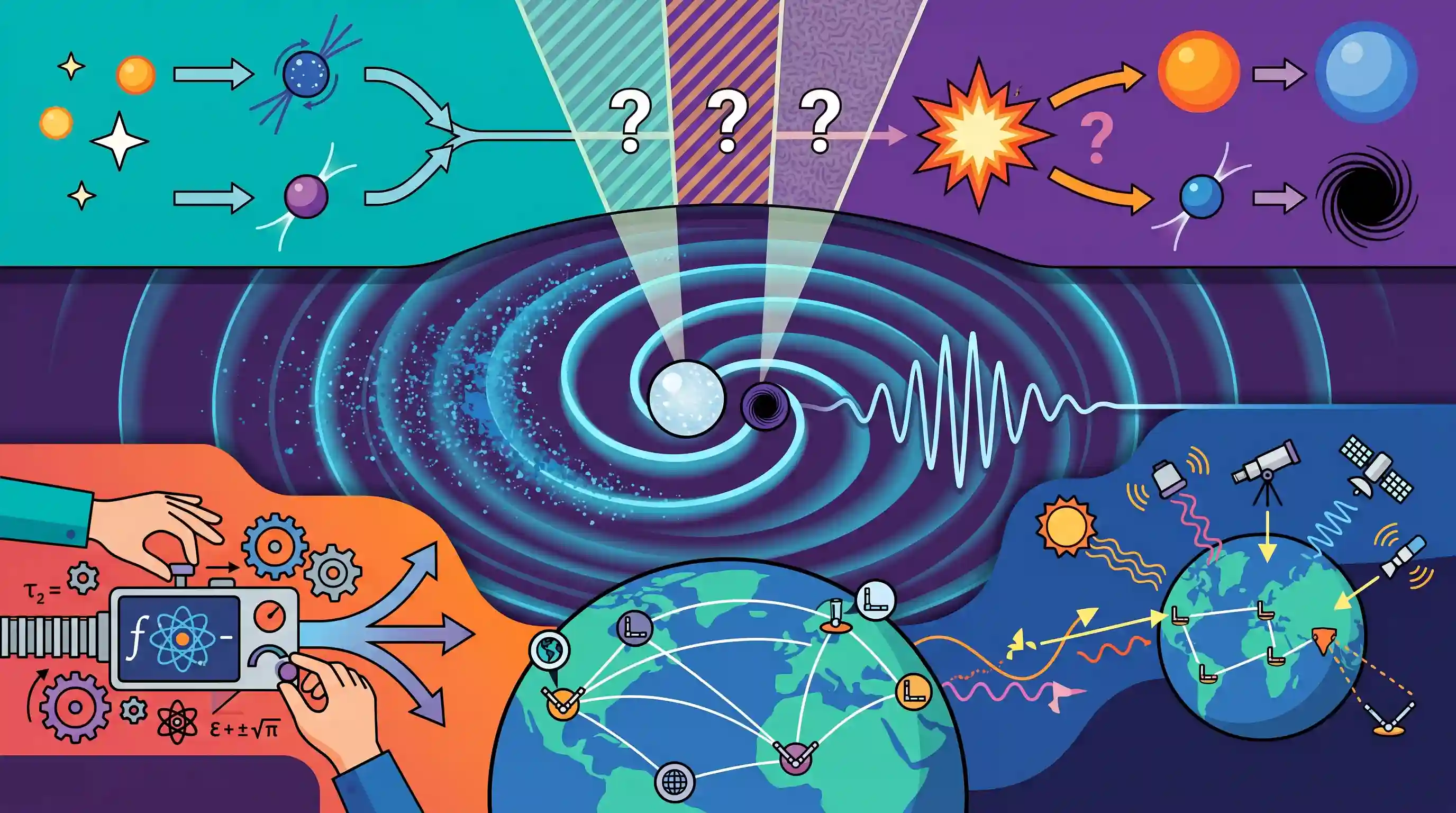
The article explores a groundbreaking discovery by the LIGO-Virgo-KAGRA (LVK) collaboration, which detected gravitational waves originating from a merger involving a black hole with a 'forbidden' mass. This mass falls squarely within the mysterious 'lower mass gap' (typically between 2.5 and 5 solar masses)—a range where scientists previously thought neither heavy neutron stars nor light black holes could exist. The detection challenges existing models of stellar evolution and supernova explosions, demonstrating the power of gravitational-wave astronomy in uncovering hidden cosmic phenomena. The finding also underscores the importance of upcoming global projects like LIGO-India in enhancing the world's multi-messenger astronomy capabilities.
Key Points
- Gravitational Waves: Ripples in spacetime generated by extreme cosmic events like the merger of black holes or neutron stars, confirming Einstein's General Theory of Relativity.
- The 'Mass Gap': Astrophysical models have traditionally predicted a 'forbidden' mass gap (between 2.5 and 5 solar masses) separating the heaviest possible neutron stars and the lightest possible black holes.
- Forbidden Mass Discovery: The latest gravitational wave signals detected by the LVK collaboration have revealed a compact object (a black hole) falling precisely within this previously unexplained lower mass gap.
- LIGO-Virgo-KAGRA (LVK) Collaboration: The global network of ultra-sensitive interferometers that makes the detection of these minute spacetime ripples possible.
- LIGO-India: A planned advanced gravitational-wave observatory in Hingoli, Maharashtra, which will join the LVK network to significantly improve the localization and precision of future detections.
Important Terms
LIGO-India

An advanced gravitational-wave observatory being constructed in Hingoli, Maharashtra, as a collaboration between India (DAE, DST) and the USA (NSF). It will be the fifth such detector globally.
UPSC context
GS Paper 3: Science & Technology. Indigenous research, international collaboration, and India's role in global mega-science projects.
Gravitational Waves
Ripples in the fabric of spacetime caused by massive accelerating objects like merging black holes. They travel at the speed of light and were first predicted by Einstein.
UPSC context
GS Paper 3: Science & Technology. Fundamental physics and space exploration breakthroughs.
Lower Mass Gap
The theoretical mass range (roughly 2.5 to 5 solar masses) where compact objects like neutron stars or black holes were thought to be exceptionally rare or non-existent.
UPSC context
GS Paper 3: Science & Technology. Astrophysics, stellar remnants, and testing existing cosmic models.
Multi-messenger Astronomy
The coordinated observation of cosmic events using multiple signals, including electromagnetic radiation (light), gravitational waves, neutrinos, and cosmic rays, to build a complete scientific picture.
UPSC context
GS Paper 3: Science & Technology. New observational paradigms and India's contributions via missions like AstroSat.
LVK Collaboration
An international network consisting of the LIGO (USA), Virgo (Italy), and KAGRA (Japan) observatories that collaborate on the detection and analysis of gravitational-wave signals.
UPSC context
GS Paper 3: Science & Technology. International scientific cooperation and global monitoring of cosmic events.
Stellar Evolution
The process by which a star changes over time, from its formation in a nebula to its final state as a white dwarf, neutron star, or black hole.
UPSC context
GS Paper 3: Science & Technology. Basic concepts of space, universe, and lifecycle of celestial bodies.
Prelims Trap
"The Chandrasekhar limit defines the mass threshold above which a dying star collapses into a black hole."
The Chandrasekhar limit (~1.44 solar masses) determines the white dwarf to neutron star boundary. The TOV limit (~2.5 solar masses) dictates the neutron star to black hole transition.
Static Concepts Connected
What are the key mass limits dictating stellar evolution?
- Chandrasekhar Limit: Maximum mass of a stable white dwarf (~1.44 solar masses). A stellar core exceeding this limit collapses to form a neutron star.
- TOV Limit: The upper mass limit for a stable neutron star (approx. 2.5 solar masses). Exceeding this limit leads to an unstoppable collapse into a black hole.
Why is the LIGO-India observatory strategically important?
- Global Triangulation: Adding a detector in India geographically expands the global LVK network, vastly improving the triangulation and precise localization of gravitational wave sources in the sky.
- Nodal Agencies: It is a collaborative mega-science project jointly funded and executed by the Department of Atomic Energy (DAE) and the Department of Science and Technology (DST).
Cross-Topic Patterns
Geography of Mega Science Projects
UPSC frequently tests the specific geographic and environmental rationale for mega-projects. LIGO-India is located in Hingoli, Maharashtra, chosen specifically for its low seismic noise and flat terrain.
General Relativity vs. Newtonian Physics
Gravitational waves confirm Einstein's General Relativity, distinguishing it from Newtonian gravity by proving gravity is not an instantaneous force, but rather ripples in spacetime travelling at the speed of light.

Expect a 2026 Prelims question contrasting the Chandrasekhar and TOV limits, alongside the geographic and structural facts of LIGO-India.
Linked PYQs · 3
Linked PYQs · 3
- 2019PrelimsGS1
Recently, scientists observed the merger of giant 'blackholes' billions of light-years away from the Earth. What is the significance of this observation?
- 2022MainsGS3
Launched on 25th December, 2021, James Webb Space Telescope has been much in the news since then. What are its unique features which make it superior to its predecessor Space Telescopes ? What are the key goals of this mission ? What potential benefits does it hold for the human race?
- 2023PrelimsGS1
Consider the following pairs: Objects in space Description 1. Cepheids: Giant clouds of dust and gas in space 2. Nebulae: Stars which brighten and dim periodically 3. Pulsars: Neutron stars that are formed when massive stars run out of fuel and collapse How many of the above pairs are correctly matched?
