Macroeconomic Growth Projections under New GDP Series
Source:Indian Express ↗
Why It Matters
Understanding GDP calculation methodologies, base year revisions, and the agencies involved (NSO/MoSPI) is a core component of the GS3 Economy syllabus. Changes in these metrics directly influence government policy, fiscal planning, and how economic growth is perceived globally.
Summary
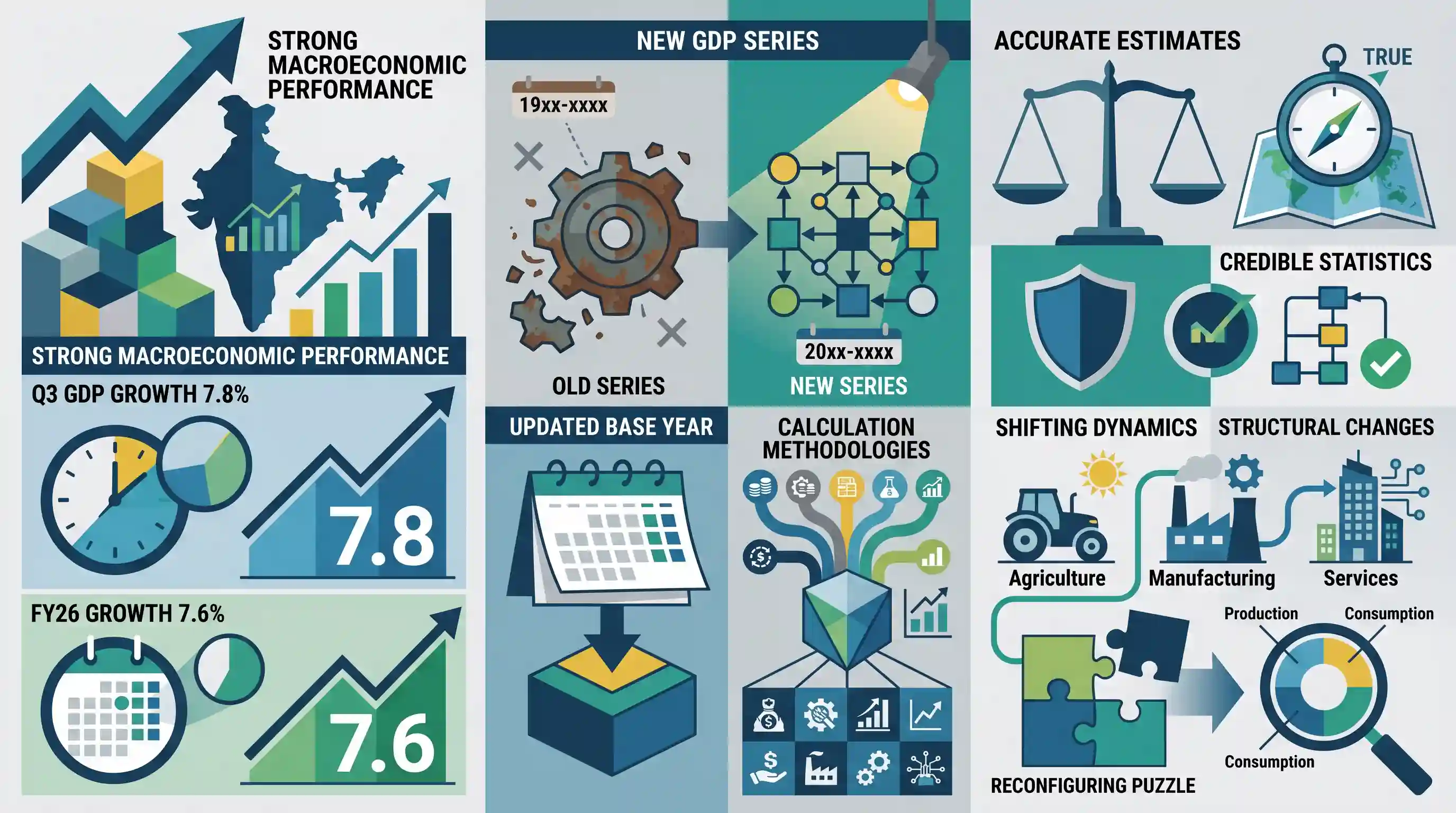
The article highlights India's strong macroeconomic performance, with Q3 GDP growth coming in at 7.8% under a new GDP series, and FY26 growth projected at 7.6%. The introduction of a new GDP series typically signifies an update in the base year and calculation methodologies, designed to more accurately capture the shifting dynamics of the Indian economy. Such statistical revisions ensure that growth estimates remain credible and reflect structural changes in production and consumption.
Key Points
- India's Q3 GDP growth has been recorded at a robust 7.8%, driven in part by calculations under a new GDP series.
- The growth forecast for the upcoming financial year (FY26) is pegged at an optimistic 7.6%, signaling sustained economic momentum.
- The introduction of a new GDP series usually involves changing the base year and methodology to better reflect current economic structures, consumption patterns, and new sectors.
- Revisions to national income accounting methodologies are essential for accurate policy-making and aligning with international statistical standards.
Important Terms
New GDP Series

A revised statistical framework (base year 2022-23) for measuring economic growth, incorporating updated datasets like GST and MCA-21 to reflect digitalization and formalization.
UPSC context
GS Paper 3: National Income Accounting. Tests understanding of base year revisions and economic transparency.
National Statistical Office (NSO)
India's central agency for official statistics, formed in 2019 by merging the CSO and NSSO. It compiles key indicators like GDP, CPI, and IIP.
UPSC context
GS Paper 2/3: Institutional frameworks for governance and economic data management.
Ministry of Statistics and Programme Implementation (MoSPI)
The nodal ministry for national statistics and infrastructure project monitoring. It oversees the NSO and ensures data-driven policymaking.
UPSC context
GS Paper 2: Government ministries and their roles in national development.
Gross Value Added (GVA)
A measure of the value of goods and services produced in an economy, calculated as output minus intermediate consumption. It is the basis for GDP.
UPSC context
GS Paper 3: Economic Growth. Distinguishing between sectoral performance (GVA) and overall economy (GDP).
Rebasing
The process of updating the reference year (now 2022-23) for economic calculations to ensure data reflects current production and consumption patterns.
UPSC context
GS Paper 3: Indian Economy. Key for understanding how statistical revisions impact fiscal ratios like debt-to-GDP.
Double Deflation
An accounting method where both output and intermediate inputs are separately deflated by their specific price indices to derive real GVA accurately.
UPSC context
GS Paper 3: Economic terminology. A technical improvement in the 2022-23 series to better adjust for inflation.
Prelims Trap
"Headline economic growth in India is officially measured using GDP at factor cost."
Since the 2015 statistical revision, India uses GDP at constant market prices for headline growth, not factor cost. Sectoral performance is measured by GVA at basic prices.
Static Concepts Connected
How is GDP at market prices derived from GVA at basic prices?
- GVA at basic prices: Measures sector-specific output minus intermediate consumption. It includes production taxes/subsidies (like stamp duty) but excludes product taxes/subsidies.
- The Formula: GDP at market prices = ∑ GVA at basic prices + Product Taxes (e.g., GST/excise) - Product Subsidies (e.g., food/fertilizer subsidies).
Why are GDP base years periodically revised?
- Structural Capture: To reflect changing consumption patterns, new products, and structural economic shifts (e.g., platform economy, post-pandemic realities) by updating the weights of goods and services.
- Global Standards: To maintain alignment with the UN's System of National Accounts (SNA 2008), ensuring India's macroeconomic data remains internationally comparable and credible.
Cross-Topic Patterns
Base Year impacts on FRBM targets
An upward revision in absolute nominal GDP mathematically alters key macroeconomic ratios, immediately lowering the reported fiscal deficit-to-GDP and debt-to-GDP metrics, impacting FRBM trajectory assessments.
MCA21 and formal sector data capture
Modern national income accounting relies heavily on the MCA21 database (statutory corporate filings) and GSTN data, linking digitization of compliance directly to the formalization of economic statistics.

A 2026 Prelims question will likely test the formula linking GVA at basic prices to GDP at market prices (product vs production taxes).
Linked PYQs · 3
Linked PYQs · 3
- 2021MainsGS3
Explain the difference between computing methodology of India's Gross Domestic Product (GDP) before the year 2015 and after the year 2015.
- 2020MainsGS3
Define potential GDP and explain its determinants. What are the factors that have been inhibiting India from realizing its potential GDP?
- 2000PrelimsGS1
The new Gross Domestic Product (GDP) series released by the Central Statistical Organisation (CSO) in February 1999 is with reference to base price of
