New Succulent Plant Species Discovered in Aravali Hills Near Jaipur
Source:The Hindu ↗
Why It Matters
UPSC frequently tests Prelims knowledge regarding newly discovered endemic species, their adaptations to specific geographical features (such as the Aravali hills' semi-arid landscape), and their IUCN conservation status.
Summary
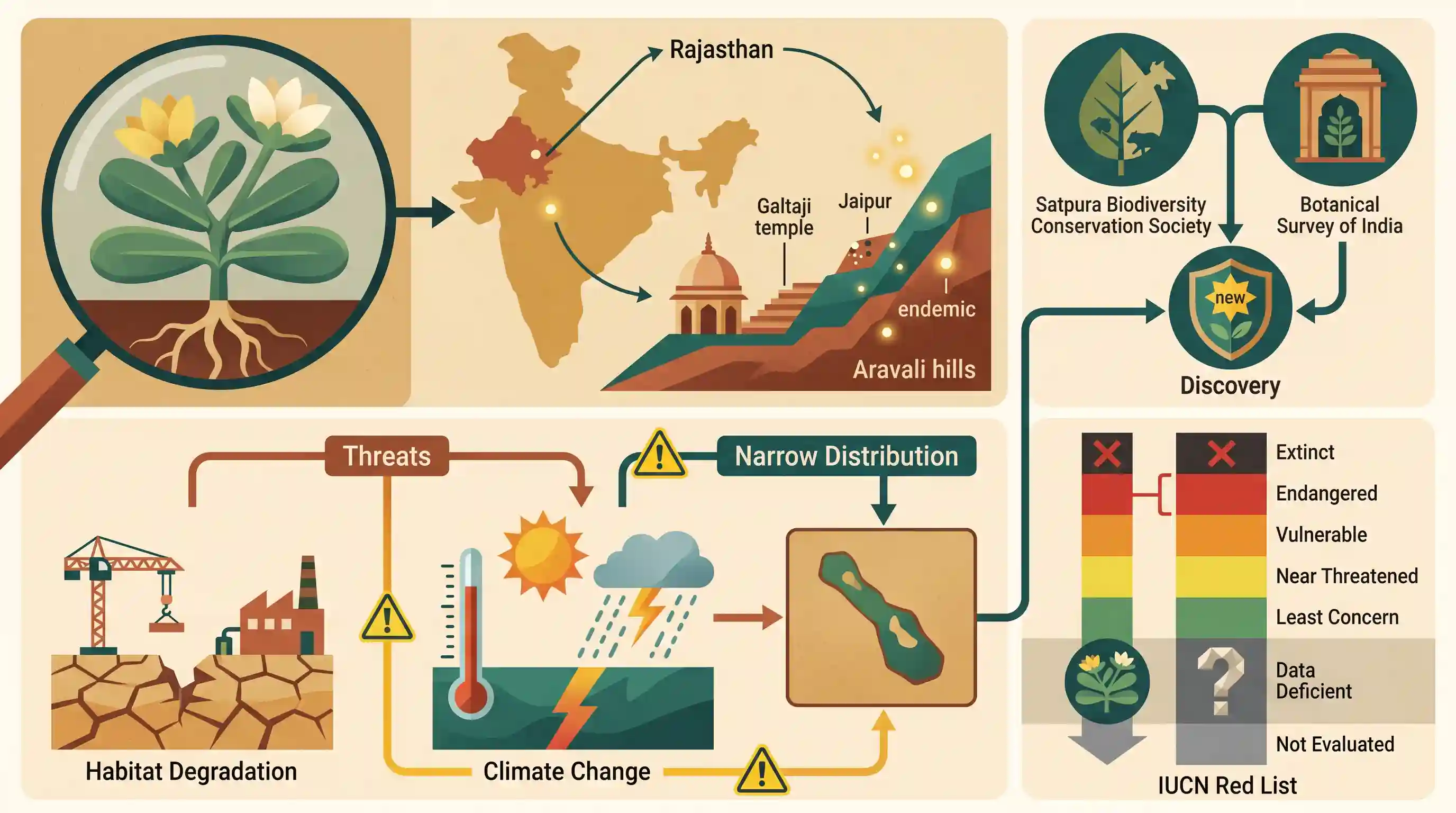
A new succulent plant species, *Portulaca bharat*, has been discovered in the Aravali hills near Jaipur's Galtaji temple. Adapted to harsh, semi-arid conditions, this endemic plant was identified by researchers from the Satpura Biodiversity Conservation Society and the Botanical Survey of India. Currently assessed as 'data deficient' under the IUCN Red List guidelines, the species faces significant threats from habitat degradation and climate change due to its extremely narrow geographical distribution.
Key Points
- The new species, Portulaca bharat, was found in a rocky, semi-arid environment within the Aravali hills near the Galtaji temple in Jaipur.
- The plant exhibits unique survival adaptations to harsh climates, including succulent leaves, thick roots, and glandular hairs, enabling it to thrive in extreme, nutrient-poor landscapes.
- The discovery was collaboratively made by scientists from the Satpura Biodiversity Conservation Society and the Botanical Survey of India, and was published in the journal Phytotaxa.
- As a narrow endemic species, it is highly vulnerable to habitat destruction and climate change, and is currently provisionally categorised as 'data deficient' under the IUCN Red List.
Important Terms
Botanical Survey of India (BSI)

Apex research organization under the Ministry of Environment, Forest and Climate Change. Established in 1890, it conducts taxonomic studies and documents India's wild plant diversity.
UPSC context
GS III: Environmental Institutions. Tests knowledge of national bodies responsible for flora documentation and taxonomic research.
IUCN Red List
The global standard for assessing the extinction risk of biological species. It provides critical data on range, population size, habitat, and threats to inform conservation policy.
UPSC context
GS III: Biodiversity. Essential for understanding global conservation status and international species protection frameworks.
Data Deficient (DD)
A specific IUCN category assigned when there is insufficient information on a species' distribution or population to assess its risk of extinction.
UPSC context
GS III: Biodiversity. Tests technical understanding of conservation status categories and the importance of ecological research.
Portulaca bharat
A newly discovered succulent flowering plant endemic to Jaipur’s Aravali hills. It is drought-resistant, with pale-yellow flowers and tissues adapted to semi-arid rocky terrain.
UPSC context
GS III: Species in News. Significant for current affairs related to Indian botanical discoveries and regional endemism.
Aravali Hills
One of the world's oldest fold mountain ranges, extending from Gujarat to Delhi. It acts as a critical biological corridor and a barrier against desert expansion.
UPSC context
GS I: Indian Geography. Tests knowledge of mountain systems and their ecological role in preventing land degradation.
Endemic Species
Species naturally restricted to a specific geographical area and not found elsewhere. Their narrow range makes them highly vulnerable to habitat loss and climate change.
UPSC context
GS III: Biodiversity. Central concept for identifying biodiversity hotspots and prioritizing conservation of localized wildlife.
Prelims Trap
Portulaca bharat is classified as 'Critically Endangered' under the IUCN Red List due to its extremely narrow geographical distribution.
Newly discovered species often lack sufficient baseline population data, placing them provisionally in the 'Data Deficient' category initially, regardless of obvious habitat threats.
Static Concepts Connected
What are the typical adaptations of xerophytic plants in arid regions?
- Succulence: Leaves and stems are modified to store water, allowing survival during prolonged dry spells.
- Thick roots: Deep taproots access underground water, or extensive shallow root systems quickly absorb surface moisture.
- Transpiration control: Presence of waxy cuticles, sunken stomata, or glandular hairs minimizes water loss through transpiration.
- CAM photosynthesis: Stomata open at night to fix carbon dioxide, reducing daytime water loss.
What is the geographical and ecological significance of the Aravali Range?
- Relict Mountains: It is one of the oldest fold mountain systems in the world, now existing as highly eroded relict mountains.
- Desertification Barrier: It acts as a crucial climatic and physical barrier, preventing the eastward expansion of the Thar Desert into the Gangetic plains.
- Water Divide: It serves as a major water divide separating the drainage of the Bay of Bengal (Banas/Chambal) and the Arabian Sea (Luni).
Cross-Topic Patterns
Aravalis as a desertification barrier
The discovery highlights the ecological fragility of the Aravalis, linking local biodiversity conservation directly to checking the eastward expansion of the Thar Desert (UNCCD targets).
Narrow Endemics and Climate Risks
Narrowly distributed endemic flora serve as indicator species for micro-climate shifts. UPSC frequently tests the vulnerability of such narrow endemics alongside climate change impacts in arid zones.

Expect a Prelims matching question on recently discovered species and their regions (Portulaca bharat - Aravalis) or xerophyte adaptations.
Linked PYQs · 3
Linked PYQs · 3
- 2016PrelimsGS1
Recently, our scientists have discovered a new and distinct species of banana plant which attains a height of about 11 metres and has orange-coloured fruit pulp. In which part of India has it been discovered?
- 2011PrelimsGS1
The “Red Data Books” published by the International Union for Conservation of Nature and Natural Resources (IUCN) contain lists of 1. Endemic plant and animal species present in the biodiversity hotspots. 2. Threatened plant and animal species. 3. Protected sites for conservation of nature and natural resources in various countries. Select the correct answer using the codes given below:
- 2023PrelimsGS1
Consider the following statements: 1. Amarkantak Hills are at the confluence of Vindhya and Sahyadri Ranges. 2. Biligirirangan Hills constitute the easternmost part of Satpura Range. 3. Seshachalam Hills constitute the southernmost part of Western Ghats. How many of the statements given above are correct?
