New Fish Species Discovered in Cauvery River
Source:Indian Express ↗
Why It Matters
UPSC frequently tests knowledge of species habitats (e.g., the Blue-finned Mahseer in the Cauvery River) and the geography of Indian river basins. Discoveries of new species in major ecological zones like the Western Ghats and Cauvery basin are highly relevant for Prelims environment questions.
Summary
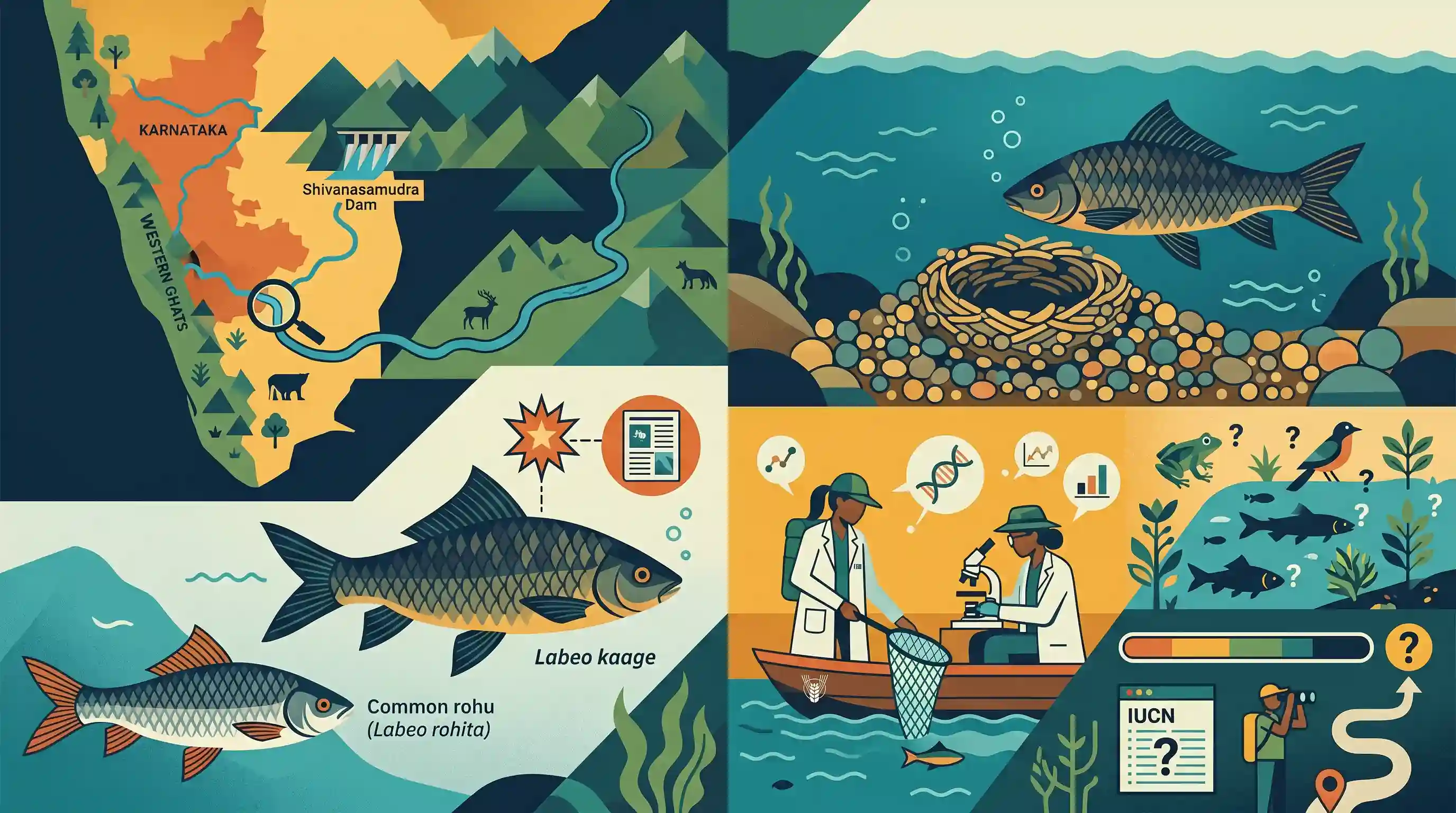
Researchers from the ICAR-National Bureau of Fish Genetic Resources (NBFGR) have discovered a new edible fish species, Labeo kaage, in the Cauvery River system near Karnataka's Shivanasamudra Dam. Closely related to the common rohu, the fish is uniquely known in its genus for building small gravel nests. The finding highlights the underexplored aquatic biodiversity of the Cauvery basin and the Western Ghats ecosystem, and underscores the need for continued ecological surveys to determine conservation statuses for newly identified species.
Key Points
- A new species of edible fish, Labeo kaage, has been discovered in the Cauvery River system in Karnataka by ICAR-NBFGR researchers.
- The species belongs to the same genus as the popular commercial fish Labeo rohita (rohu).
- Labeo kaage differs from the related Labeo nigrescens, which is endemic to the Chalakudi and Periyar rivers.
- Unlike other species in its genus, Labeo kaage exhibits unique behavior by building small nests out of gravel.
- The IUCN conservation status for this newly described species has yet to be assessed.
Important Terms
ICAR-National Bureau of Fish Genetic Resources (NBFGR)

The apex national institute under ICAR responsible for the exploration, characterization, and conservation of India's fish genetic resources and germplasm.
UPSC context
GS Paper III (Agriculture/Science); tests knowledge of institutional frameworks for biodiversity conservation and fisheries management.
Indian Council of Agricultural Research (ICAR)
An autonomous body under the Ministry of Agriculture and Farmers Welfare that coordinates, guides, and manages agricultural research and education in India.
UPSC context
GS Paper II & III; crucial for questions on food security, agricultural extension, and institutional reforms.
IUCN Red List
The world's most comprehensive inventory of the global conservation status of biological species, maintained by the International Union for Conservation of Nature.
UPSC context
GS Paper III (Environment); vital for identifying species extinction risks and international conservation priorities.
Cauvery River System
A major peninsular river originating in the Western Ghats (Talakaveri), serving as a vital ecosystem for endemic fish and a central figure in interstate water disputes.
UPSC context
GS Paper I (Geography); tests understanding of Indian drainage systems and associated ecological/political challenges.
Western Ghats Ecosystem
A UNESCO World Heritage site and one of the world's eight 'hottest hotspots' of biological diversity, hosting high levels of endemism.
UPSC context
GS Paper III (Biodiversity); core topic for ecological conservation, endemic species, and sustainable development.
Labeo kaage
A newly discovered freshwater fish species in the Cauvery River, uniquely characterized by its dark color and gravel-nest-building behavior.
UPSC context
Prelims (Species in News); tests awareness of newly discovered Indian biodiversity and its habitat.
Prelims Trap
"Labeo kaage is a critically endangered fish species recently discovered in the Periyar river basin."
Aspirants may conflate it with Labeo nigrescens (Periyar) and assume newly discovered species are immediately classified as Critically Endangered (it is currently Not Evaluated).
Static Concepts Connected
What are the key geographical features of the Cauvery River at Shivanasamudra?
- Island formation: The river bifurcates at the Shivanasamudra island, forming the segmented twin waterfalls of Gaganachukki and Bharachukki.
- Hydroelectric legacy: The falls host one of Asia's first major hydroelectric power stations, established in 1902 to supply electricity to the Kolar Gold Fields.
What is the mandate of the ICAR-National Bureau of Fish Genetic Resources (NBFGR)?
- Core mandate: It serves as the nodal agency tasked with cataloging, characterizing, and conserving India's fish germplasm resources.
- Headquarters location: The institute is headquartered in Lucknow, Uttar Pradesh.
Cross-Topic Patterns
Western Ghats endemism & river basins
UPSC frequently pairs new aquatic discoveries with specific drainage basins. Distinguishing Cauvery species from Periyar/Chalakudi endemics is a classic Prelims geographic mapping pattern.
Unique behavioral traits in fauna
The gravel nest-building behavior of Labeo kaage is highly testable, mirroring past Prelims questions that focus on unique animal survival behaviors, tool use, or specific nesting habits.

Expect a 2026 matching question linking recently discovered Western Ghats fishes to their specific river basins (Cauvery vs. Periyar).
Linked PYQs · 2
Linked PYQs · 2
- 2019PrelimsGS1
Consider the following pairs: Wildlife Naturally found in 1. Blue-finned Mahseer : Cauvery River 2. Irrawaddy Dolphin : Chambal River 3. Rusty-spotted Cat : Eastern Ghats Which of the pairs given above are correctly matched?
- 2020PrelimsGS1
Which of the following Protected Areas are located in Cauvery basin ? 1. Nagarhole National Park 2. Papikonda National Park 3. Sathyamangalam Tiger Reserve 4. Wayanad Wildlife Sanctuary Select the correct answer using the code given below:
