Major Banking and Tax Rule Changes Take Effect in Financial Year
Source:Indian Express ↗
Why It Matters
The transition to the Income-tax Act, 2025 represents a landmark shift in India's fiscal policy and taxation structure. Regulatory changes by the RBI and NPCI in the digital payments space highlight the continuous policy balancing act between promoting financial inclusion (via tools like RuPay) and securing the financial ecosystem against cyber fraud.
Summary
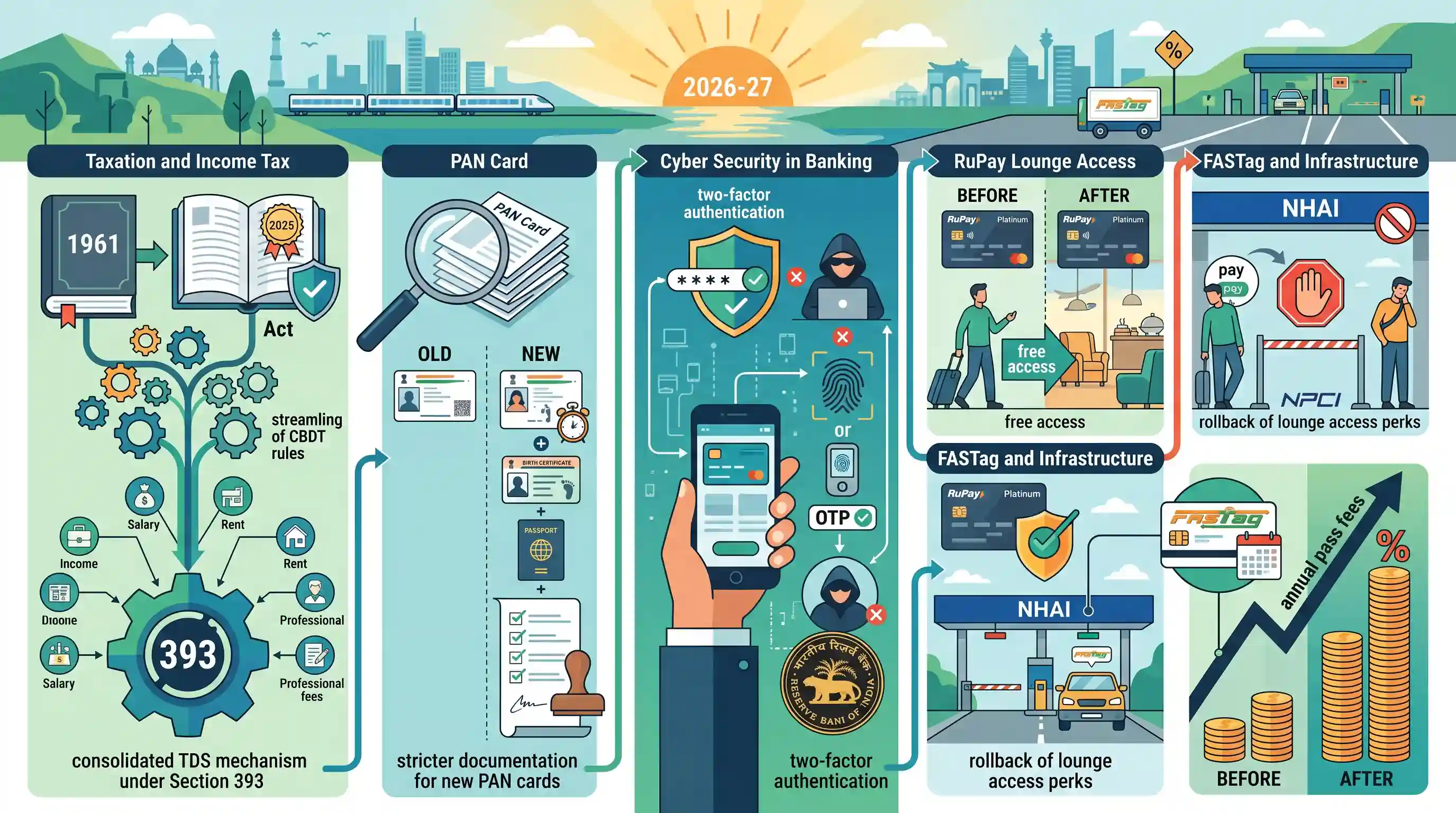
A series of major banking, taxation, and financial rule changes will take effect at the start of the 2026-27 financial year. The landmark Income-tax Act, 2025 will replace the outdated 1961 framework, featuring streamlined rules by the CBDT and a consolidated TDS mechanism under Section 393. Stricter documentation will be required for new PAN cards. In the digital payment ecosystem, the RBI is enforcing stricter two-factor authentication protocols to mitigate cyber fraud, while the NPCI is rolling back lounge access perks on RuPay Platinum debit cards. Additionally, the NHAI has implemented a steep hike in FASTag annual pass fees.
Key Points
- The Income-tax Act, 2025 replaces the 1961 Act starting April 1, 2026, aiming to streamline and simplify the tax regime under the new Income-tax Rules, 2026 notified by the CBDT.
- TDS provisions for non-salary payments have been consolidated into a single Section 393 to reduce compliance burden.
- PAN card applications now require more structured documentation beyond just Aadhaar to prevent misuse.
- The RBI has mandated two-factor authentication for digital transactions to curb fraud, though OTP verification will continue.
- The NPCI has withdrawn complimentary airport and railway lounge access for RuPay Platinum debit cardholders.
- NHAI has increased the FASTag annual pass fee drastically from Rs 3,000 to Rs 23,075.
Important Terms
Income-tax Act, 2025

The legislative overhaul replacing the 1961 Act starting April 2026, simplifying tax laws into 536 sections and introducing a unified "Tax Year" for better compliance.
UPSC context
GS Paper-III: Indian Economy; tests knowledge of fiscal reforms, legislative simplification, and modernization of direct tax administration.
Income-tax Act, 1961
The legacy framework for direct taxation in India for over 60 years, characterized by complex amendments and a dual Previous Year/Assessment Year system.
UPSC context
GS Paper-III: Taxation; vital for comparing historical tax structures with modern reforms and understanding resource mobilization history.
Central Board of Direct Taxes (CBDT)
A statutory body under the Ministry of Finance responsible for administering direct tax laws, formulating tax policy, and overseeing the Income Tax Department.
UPSC context
GS Paper-III: Institutional Framework; tests understanding of regulatory bodies managing India's revenue collection and taxpayer services.
National Payments Corporation of India (NPCI)
An umbrella organization for retail payment systems in India, developed by the RBI and IBA to manage UPI, RuPay, and other digital infrastructures.
UPSC context
GS Paper-III: Digital Infrastructure; tests knowledge of indigenous fintech and the transition toward a cashless economy.
FASTag
An electronic toll collection system using RFID technology to facilitate direct payments from linked accounts, managed by NHAI to improve highway transit efficiency.
UPSC context
GS Paper-III: Infrastructure; relevant to technology-led resource mobilization and improving logistics and road transport efficiency.
RuPay
India’s indigenous card payment network developed by NPCI to provide a secure, cost-effective domestic alternative to international gateways like Visa and Mastercard.
UPSC context
GS Paper-III: Economy; tests understanding of financial inclusion, digital sovereignty, and the evolution of domestic payment ecosystems.
National Highways Authority of India (NHAI)
An autonomous agency responsible for developing and managing India's National Highways network, including toll fee determination and infrastructure maintenance.
UPSC context
GS Paper-III: Infrastructure; tests knowledge of statutory bodies governing connectivity and revenue models like user-fee-based infrastructure.
Reserve Bank of India (RBI)
India's central bank and primary regulator for the banking sector, responsible for monetary policy, currency management, and ensuring financial stability.
UPSC context
GS Paper-III: Banking and Finance; tests understanding of monetary regulation, inflation control, and financial system oversight.
Prelims Trap
"The RBI has completely phased out OTP verification for digital transactions in favor of new 2FA protocols."
The article explicitly notes that while stricter two-factor authentication (2FA) is being enforced by the RBI, traditional OTP verification will continue to co-exist.
Static Concepts Connected
What is the statutory and organizational status of NPCI?
- Not-for-profit:: Registered under Section 8 of the Companies Act 2013, initiated by RBI and the Indian Banks' Association (IBA).
- Umbrella body:: Acts as the central node for retail payments in India, operating platforms like UPI, RuPay, AePS, and NETC (FASTag).
- Regulation:: Regulated by the RBI under the Payment and Settlement Systems Act, 2007.
How does the FASTag electronic toll collection system work?
- RFID Technology:: Utilizes passive Radio Frequency Identification (RFID) technology to read the tag affixed to the vehicle's windscreen.
- NETC Framework:: Operates on the National Electronic Toll Collection (NETC) framework, which was developed and is managed by NPCI.
- Interoperability:: Transactions are processed interoperably, clearing through the NPCI platform to deduct fees from the linked bank/prepaid account.
Cross-Topic Patterns
Direct Tax Code to IT Act 2025
The transition from the 1961 Act to the 2025 Act realizes long-pending Direct Tax Code reforms, linking GS3 Resource Mobilization directly with the 'ease of doing business' and tax compliance.
Cyber Security in DPI
RBI’s 2FA upgrade merges GS3 Cyber Security with Digital Public Infrastructure, reflecting a continuous policy struggle to balance anti-fraud mechanics with low-friction digital adoption.

Expect a 2026 Prelims question mapping NPCI products (RuPay, NETC) to their underlying tech (RFID) and regulatory backers (RBI vs NHAI).
Linked PYQs · 4
Linked PYQs · 4
- 2025PrelimsGS1
With reference to the Government of India, consider the following information: Organization Some of its functions It works under I. Directorate of Enforcement Enforcement of the Fugitive Economic Offenders Act, 2018 Internal Security Division-I, Ministry of Home Affairs II. Directorate of Revenue Intelligence Enforces the Provisions of the Customs Act, 1962 Department of Revenue, Ministry of Finance III. Directorate General of Systems and Data Management Carrying out big data analytics to assist tax officers for better policy and nabbing tax evaders Department of Revenue, Ministry of Finance In how many of the above rows is the information correctly matched?
- 2018MainsGS3
Comment on the important changes introduced in respect of the Long-term Capital Gains Tax (LCGT) and Dividend Distribution Tax (DDT) in the Union Budget for 2018-2019.
- 2017PrelimsGS1
Consider the following statements: 1. National Payments Corporation of India (NPCI) helps in promoting the financial inclusion in the country. 2. NPCI has launched RuPay, a card payment scheme. Which of the statements given above is/are correct?
- 2018PrelimsGS1
With reference to digital payments, consider the following statements: 1. BHIM app allows the user to transfer money to anyone with a UPI-enabled bank account. 2. While a chip-pin debit card has four factors of authentication, BHIM app has only two factors of authentication. Which of the statements given above is/are correct?
