Examining Regulatory Impact of Foreign Contribution Rules on NGOs
Source:Indian Express ↗
Why It Matters
This article provides critical, contemporary arguments concerning the ongoing tension between national security/regulatory compliance and democratic civil liberties. It is directly applicable to GS2 syllabus topics on the 'development processes and the development industry' as well as constitutional debates on executive overreach, delegated legislation, and the right to privacy.
Summary
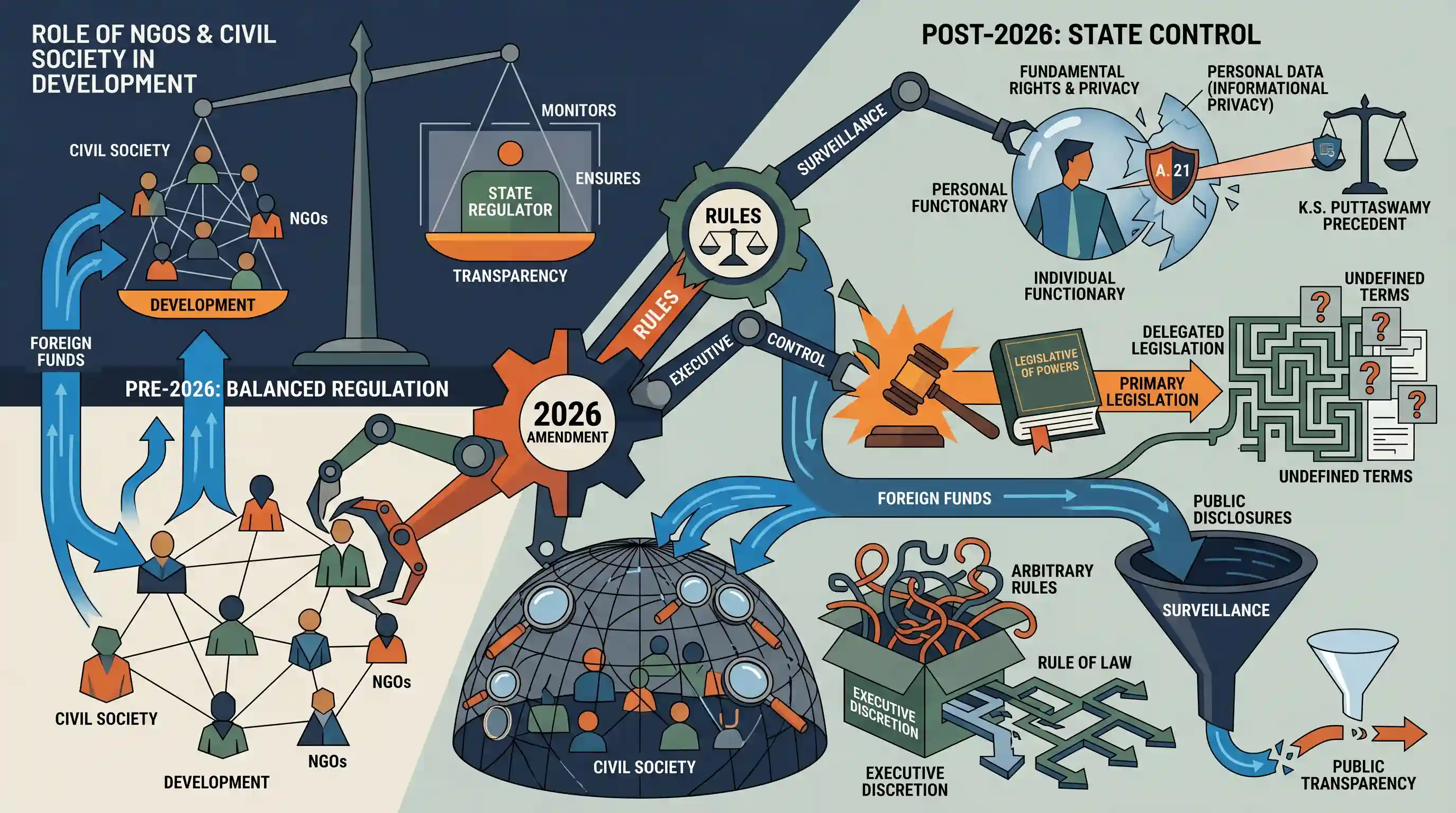
The article critically examines the Foreign Contribution (Regulation) Amendment Rules, 2026, arguing they shift the state's role from merely regulating foreign funds to exercising direct executive control over India's civil society. It highlights key constitutional concerns, including the expansion of unchecked administrative discretion through undefined terms, the infringement on informational privacy and freedom of expression (violating the K.S. Puttaswamy precedent), and a paradox of shrinking public transparency as regulatory oversight transforms into perpetual institutional surveillance.
Key Points
- The Foreign Contribution (Regulation) Amendment Rules, 2026, notified on June 22, mark a fundamental philosophical shift from regulating foreign funds to regulating the actual functioning and structure of voluntary organizations.
- The rules introduce vague and undefined terms like 'proselytisation' in their Schedule. Without clear statutory definitions in the parent Act or Rules, this grants unbridled administrative discretion to the executive, violating the rule of law and promoting institutional self-censorship.
- New reporting rules require NGOs to disclose publications, articles, websites, and social media activities. The authors argue this violates 'informational autonomy' (part of the Right to Privacy under Article 21, as upheld in the 2017 K.S. Puttaswamy case) by failing the tests of legality, necessity, and proportionality.
- The article highlights a paradox of declining transparency: while compliance for NGOs is increasingly intrusive, public transparency regarding the government's regulatory powers has shrunk, with detailed database records removed from the FCRA portal and parliamentary queries on cancellations blocked as 'secret'.
- Civil society is a vital constitutional space between the individual and the state. India's developmental history has been heavily shaped by autonomous voluntary organizations whose contribution to nation-building cannot be measured solely through financial statements.
Important Terms
Foreign Contribution (Regulation) Amendment Rules, 2026

A set of delegated rules notified on June 22, 2026, introducing purpose- and geography-specific registrations, stricter compliance, and wider definitions of 'key functionaries' for NGOs receiving foreign funds.
UPSC context
GS Paper II (Polity & Governance): Tests understanding of delegated legislation, civil society regulation, and administrative discretion.
Foreign Contribution (Regulation) Act (FCRA)
An Act of the Parliament of India originally enacted in 1976 and overhauled in 2010 to regulate the acceptance and utilization of foreign contributions by individuals, associations, and companies, ensuring national sovereignty.
UPSC context
GS Paper II (Polity & Governance): Essential for topics on NGO funding, civil society regulation, and internal security challenges.
Ministry of Home Affairs
A ministry of the Government of India responsible for internal security, public order, and domestic policy, which also serves as the nodal administrative body enforcing and regulating FCRA rules.
UPSC context
GS Paper II (Polity/Executive): Relates to the powers of executive ministries, regulatory oversights, and governance in internal security.
Supreme Court of India
The apex judicial body in India that interprets constitutional provisions, guarantees fundamental rights, and evaluates executive regulations, notably upholding the validity of FCRA restrictions in the Noel Harper precedent.
UPSC context
GS Paper II: Tests judiciary's role in balancing national security restrictions with fundamental freedoms and civil liberties under Article 19.
Prelims Trap
Organizations with any foreign national as a key functionary are completely barred from obtaining or renewing FCRA registration.
The 2026 rules make foreign nationals ineligible, but explicitly exempt Person of Indian Origin (PIO) and Overseas Citizen of India (OCI) cardholders.
Static Concepts Connected
What is the distinction between 'propagation' and 'conversion' under Article 25?
- Constitutional Text: Article 25 guarantees the freedom to profess, practice, and propagate one's religion.
- Stainislaus Precedent: The Supreme Court (1977) ruled that propagation means spreading tenets, not the right to convert.
- Conscience Paramount: Forcible or induced conversion infringes on another's freedom of conscience, which is equally protected.
What is the Puttaswamy test for state infringement on privacy?
- Legality: The restriction must be backed by a clear, existing law, not mere executive action.
- Legitimate Aim: The state must demonstrate a legitimate state aim or compelling public interest.
- Proportionality: The measure must be the least intrusive means to achieve the objective, with safeguards against abuse.
Cross-Topic Patterns
Delegated legislation and legislative oversight
Shifting core statutory philosophy through rules rather than parliamentary amendments tests the constitutional limits of executive rule-making and delegated legislation.
Civil society and Article 19(1)(c)
Prohibitive regulatory thresholds and geographical locks on NGOs challenge the Article 19(1)(c) guarantee to form associations and carry out advocacy.

FCRA Rules 2026 + Puttaswamy proportionality test will likely feature as a critical mains question on state control vs civil society.
Linked PYQs · 3
Linked PYQs · 3
- 2015MainsGS2
Examine critically the recent changes in the rules governing foreign funding of NGOs under the Foreign Contribution (Regulation) Act (FCRA), 1976.
- 2017MainsGS2
Examine the scope of Fundamental Rights in the light of the latest judgement of the Supreme Court on Right to Privacy.
- 2024MainsGS2
Right to privacy is intrinsic to life and personal liberty and is inherently protected under Article 21 of the constitution. Explain. In this reference discuss the law relating to D.N.A. testing of child in the womb to establish its paternity.
