Manipur ethnic conflict and emerging Kuki Zo Naga fault lines
Source:The Hindu ↗
ఇది ఎందుకు ముఖ్యం
Understanding the evolving multi-ethnic dimensions of the Manipur conflict is critical for analyzing internal security threats, administrative governance in tribal areas, and long-term peacebuilding strategies in Northeast India.
సారాంశం
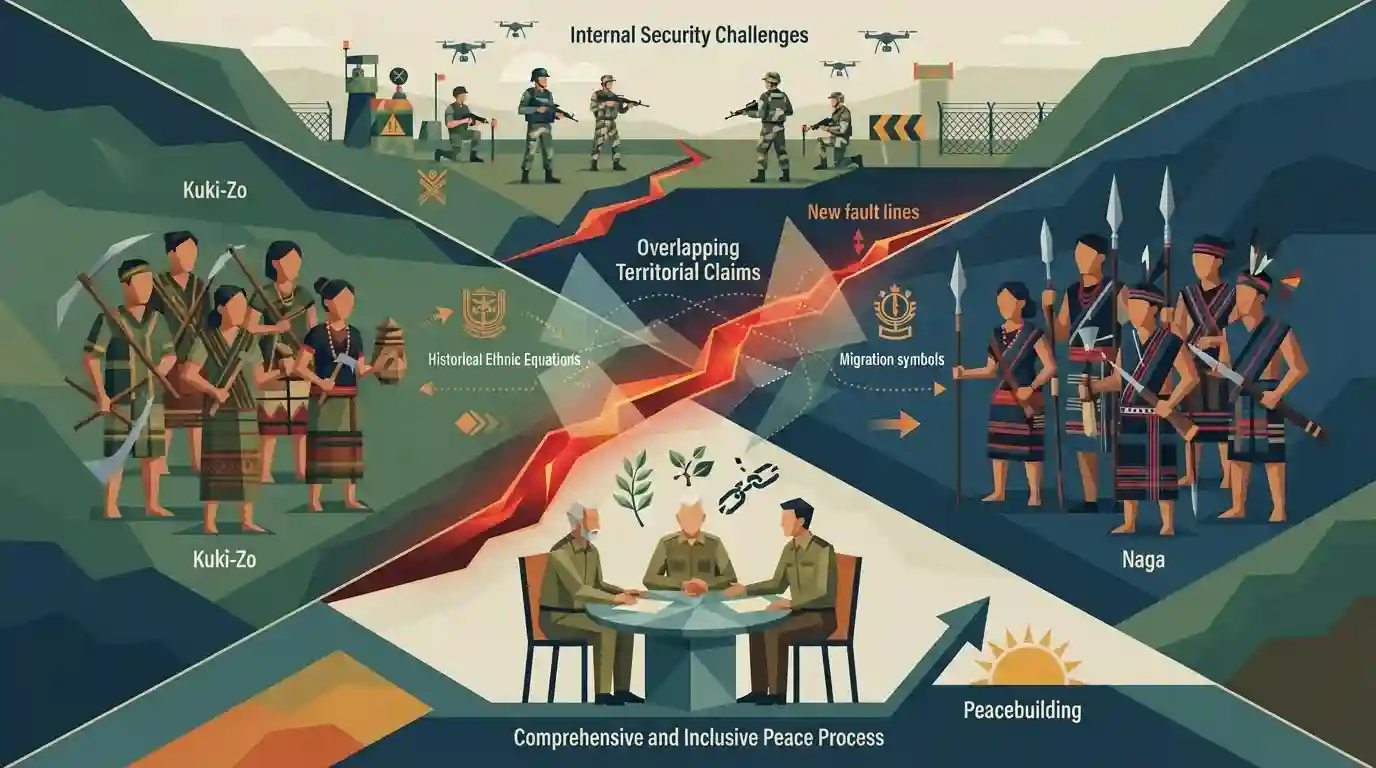
The editorial analyzes the emergence of new fault lines in Manipur's protracted conflict, focusing specifically on the growing friction between the Kuki-Zo and Naga communities. It highlights how overlapping territorial claims and historical ethnic equations are compounding the state's security crisis, necessitating a comprehensive and inclusive peace process.
ముఖ్య అంశాలు
- The ongoing ethnic conflict in Manipur has expanded beyond the Meitei-Kuki-Zo divide to include tensions between the Kuki-Zo and Naga communities, creating new fault lines.
- Competing territorial and administrative claims, particularly concerning overlapping ancestral lands and autonomous councils, fuel the hostility between tribal groups.
- The escalation threatens broader regional stability in Northeast India, where delicate inter-tribal equations are easily disrupted.
- There is an urgent need for inclusive, politically sensitive dialogue involving all ethnic stakeholders to prevent multi-polar ethnic polarization in Manipur.
ముఖ్యమైన పదాలు
Kuki-Zo council

An apex socio-political organization representing the Kuki-Zo tribal leadership and community in Manipur, advocating for their political rights, security, and separate administration demands amid regional ethnic conflicts.
UPSC context
GS Paper III (Internal Security - North-East India): Tests understanding of tribal politics, ethnic fault lines, and insurgent dynamics.
United Naga Council (UNC)
The apex socio-cultural and political organization representing the Naga community in Manipur, advocating for Naga rights, territorial integrity, and ancestral land claims.
UPSC context
GS Paper II/III (Polity and Internal Security): Evaluates regional ethnic assertions, civil society bodies, and conflict resolution in the Northeast.
ప్రిలిమ్స్ ఉచ్చు
The ethnic conflict in Manipur is strictly limited to a binary divide between the Meitei and Kuki-Zo communities.
Aspirants often assume Northeast tribal conflicts are strictly binary (e.g., Meitei vs Kuki-Zo), ignoring complex multi-polar fault lines involving Naga and other groups.
అనుసంధానమైన స్థిర భావనలు
What are the constitutional provisions for the administration of tribal areas in Northeast India?
- Sixth Schedule:: Provides for autonomous district councils (ADCs) with legislative, judicial, and executive powers over land, forest, and social customs in parts of Assam, Meghalaya, Tripura, and Mizoram.
- Fifth Schedule:: Governs tribal areas not falling under the Sixth Schedule through Tribes Advisory Councils (TACs) and specific gubernatorial notifications for state-level tribal protection.
- Article 371 variants:: Grants special autonomous status and administrative safeguards to regions like the hill districts of Manipur under specific historical and legislative frameworks.
అంతర-అంశ నమూనాలు
Manipur ethnic crisis + Act East policy
Manipur's multi-ethnic friction directly impacts India's Act East policy and border trade corridors through Myanmar, highlighting how domestic ethnic security intersects with international neighborhood diplomacy.
Sixth Schedule devolution + tribal land conflicts
Sixth Schedule autonomy demands and overlapping territorial claims illustrate the recurring friction between administrative decentralization and state integration across the Northeast.

Manipur ethnic crisis + Sixth Schedule limitations + insurgent group pacts will likely feature in a multi-statement Mains/Prelims combo.
అనుసంధాన PYQలు · 3
అనుసంధాన PYQలు · 3
- 2019MainsGS3
Cross-border movement of insurgents is only one of the several security challenges facing the policing of the border in North-East India. Examine the various challenges currently emanating across the India-Myanmar border. Also, discuss the steps to counter the challenges.
- 2017MainsGS3
The North-East region of India has been infested with insurgency for a very long time. Analyze the major reasons for the survival of armed insurgency in this region.
- 2021MainsGS3
Analyse the multidimensional challenges posed by external state and non-state actors, to the internal security of India. Also discuss measures required to be taken to combat these threats.
