Uttarakhand Assembly Election Preparations and EVM Deployment
Source:thestatesman ↗
Why It Matters
Understanding the administrative and logistical preparations for elections—such as the deployment and First Level Check (FLC) of EVMs/VVPATs and the revision of electoral rolls—is crucial for the Polity and Governance section. It highlights the functional independence and procedural rigor of the Election Commission of India in conducting free and fair elections.
Summary
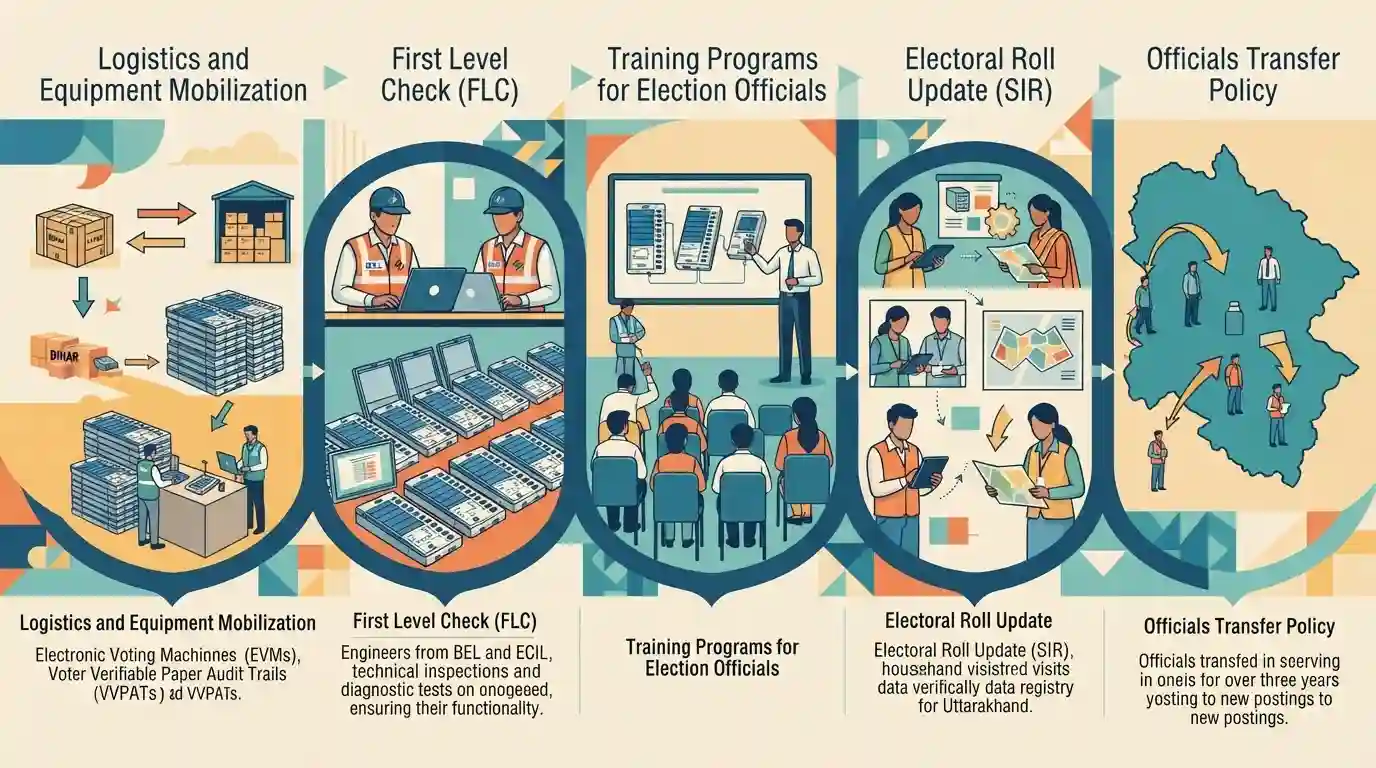
The Election Commission of India (ECI) has initiated early preparations for the Uttarakhand state assembly elections scheduled for 2027. Under a 21-month schedule laid out by the Chief Electoral Officer, around 13,000 new Electronic Voting Machines (EVMs) and VVPATs have been brought in from Bihar. The preparatory activities include the First Level Check (FLC) of the voting machines by BEL and ECIL engineers, training programs for election officials, updating the electoral rolls through a Special Intensive Revision (SIR), and executing the standard transfer policy for officials serving in one place for over three years. This early initiation emphasizes the logistical complexities and rigorous protocols required to ensure free and fair elections.
Key Points
- The Election Commission of India has commenced preparations for the 2027 Uttarakhand state assembly elections with a 21-month advanced schedule.
- Approximately 13,000 new Electronic Voting Machines (EVMs) and Voter Verifiable Paper Audit Trails (VVPATs) have been transported from Bihar to Uttarakhand.
- The First Level Check (FLC) of EVMs and VVPATs will be conducted by engineers from Bharat Electronics Limited (BEL) and Electronics Corporation of India Limited (ECIL).
- Further preparations include the training of District Election Officers (DEOs) and Returning Officers (ROs), Special Intensive Revision (SIR) of electoral rolls, and the mandatory transfer of officers posted at the same location for over three years.
Important Terms
Election Commission of India (ECI)

An autonomous constitutional body established under Article 324 of the Indian Constitution responsible for administering Union and State election processes, including Parliament, State Legislatures, and the offices of President and Vice-President.
UPSC context
Relevant for GS Paper II (Polity and Governance); tests understanding of constitutional bodies, electoral reforms, and democratic integrity.
Chief Electoral Officer (CEO)
A state-level official designated or nominated by the Election Commission of India in consultation with the state government to supervise the preparation of electoral rolls and the conduct of elections within a State or Union Territory.
UPSC context
Important for GS Paper II (Polity); tests knowledge of administrative machinery, statutory roles under RPA, and decentralised election management.
Voter Verifiable Paper Audit Trail (VVPAT)
An independent verification system attached to EVMs that allows voters to visually confirm their vote by displaying a printed paper slip with the candidate’s serial number, name, and symbol for seven seconds.
UPSC context
Relevant for GS Paper II (Electoral Processes & Reforms); tests understanding of transparency, judicial decisions, and audit mechanisms protecting democratic trust.
Bharat Electronics Limited (BEL)
A multi-unit, multi-technology public sector undertaking under the Ministry of Defence that co-designs, manufactures, and services Electronic Voting Machines (EVMs) and VVPAT devices used in Indian elections.
UPSC context
GS Paper II (Electoral Reforms) and GS Paper III (Technology); tests understanding of secure manufacturing systems and indigenisation.
Electronics Corporation of India Limited (ECIL)
A public sector enterprise under the Department of Atomic Energy that collaborated with the ECI to design the country's first Electronic Voting Machines and remains one of the two authorized manufacturers of EVMs and VVPATs.
UPSC context
GS Paper II (Governance) and GS Paper III (Technology); tests awareness of critical public sector roles in securing democratic infrastructure.
Prelims Trap
EVMs and VVPATs are designed and manufactured by specialized private corporations under MeitY's direct supervision.
Aspirants frequently assume these highly technical electronic devices are manufactured by the Ministry of Electronics and Information Technology (MeitY) or private tech firms.
Static Concepts Connected
What is the statutory basis and manufacturing authority for EVMs in India?
- Statutory Backing: Section 61A of the Representation of the People Act, 1951, explicitly empowers the ECI to adopt voting machines.
- Manufacturing Monopoly: Indigenously produced only by Bharat Electronics Limited (MoD) and Electronics Corporation of India Limited (Dept. of Atomic Energy).
- Procedural Rules: Governed strictly under the Conduct of Elections Rules, 1961, which regulate voting procedures and machine custody.
What constitutes the First Level Checking (FLC) of EVMs?
- Technical Verification: Physical and electronic diagnostics of EVMs/VVPATs performed strictly by authorized engineers from BEL/ECIL before elections.
- Political Oversight: Executed at district headquarters in the direct presence of representatives from recognized political parties.
Cross-Topic Patterns
ECI Transfer Mandate vs State Autonomy
The ECI’s pre-poll transfer policy often intersects with state executive authority, highlighting the delicate balance between autonomous constitutional oversight and state cadre management.
EVM Verifiability and Article 324
Judicial scrutiny over VVPAT verification limits demonstrates how technological integration in voting must continuously reconcile with constitutional mandates for administrative transparency under Article 324.

Statutory backing of EVMs (RPA 1951) combined with ECI's administrative transfer rules likely to feature in 2026 Polity papers.
Linked PYQs · 1
Linked PYQs · 1
- 2016UKPSC_PRELIMSGS1
Who recognizes the political parties in India?
