New EPF Scheme and Social Security Code Implementation
Source:Indian Express ↗
Why It Matters
This article represents a concrete, operational milestone in the roll-out of India's 2020 Labour Codes. The introduction of the 'principal employer' liability addresses critical social security loopholes for casual and contract workers, making it a highly relevant topic for mains questions on labor market reforms and inclusive growth, as well as prelims questions on EPFO regulations.
Summary
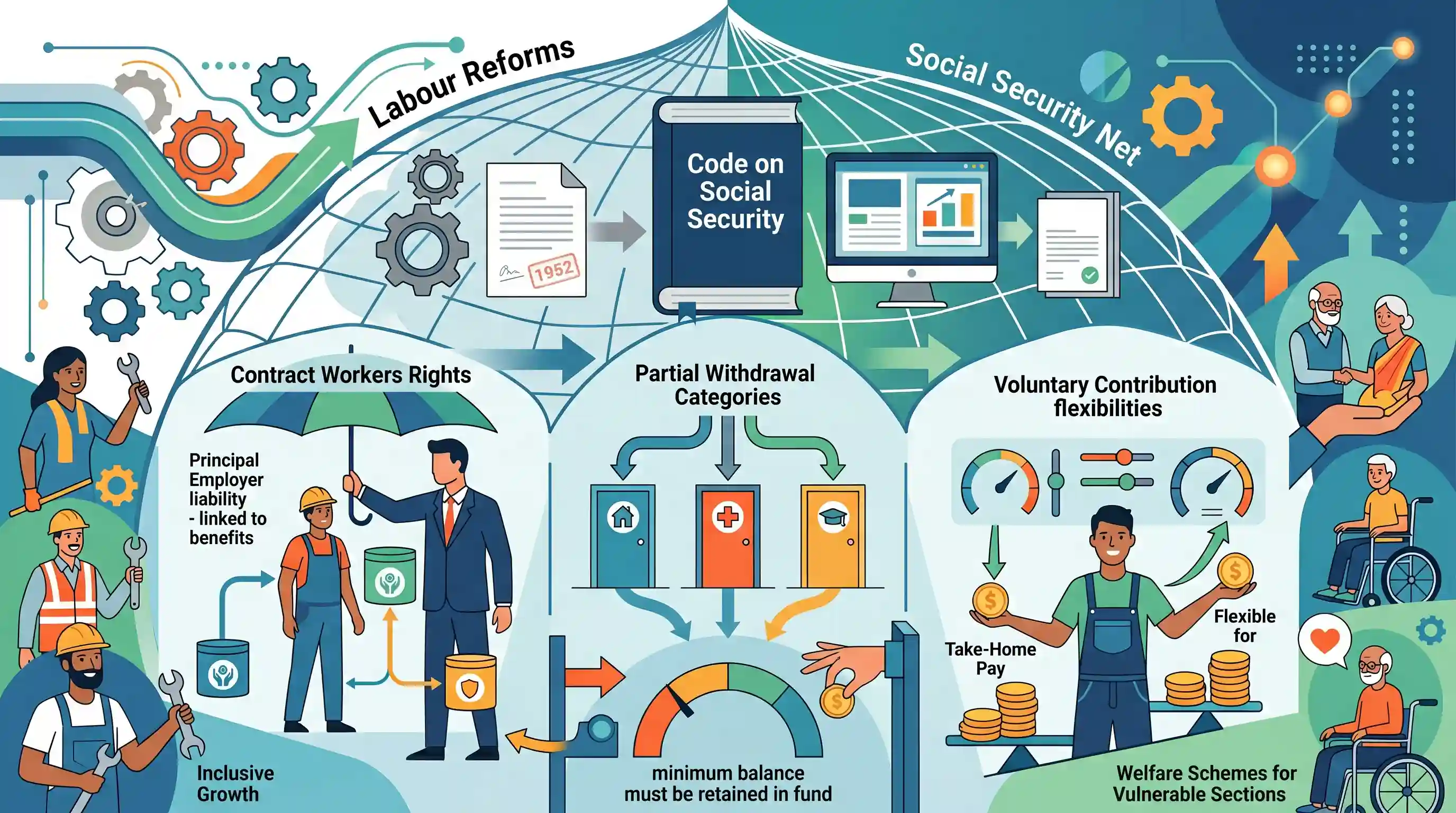
The Union Ministry of Labour and Employment has notified the Employees' Provident Funds Scheme, 2026, replacing the decades-old 1952 scheme to align with the Code on Social Security, 2020. Key changes include safeguarding contract workers' rights by introducing the 'principal employer' liability, reducing partial withdrawal categories to three streamlined divisions while mandating a 25% minimum balance, and providing voluntary contribution flexibilities to increase take-home pay when desired.
Key Points
- The Union Government has notified the 'Employees' Provident Funds Scheme, 2026', replacing the legacy 'Employees' Provident Funds Scheme, 1952' with effect from June 29, 2026, as part of implementing the Code on Social Security, 2020.
- Introduces the 'principal employer' concept for contract workers, holding the principal employer ultimately responsible for EPF contributions, even when contract labor is hired through unregistered contractors.
- Streamlines withdrawal rules from 13 categories into 3 broad pillars: essential needs (illness, education, marriage), housing needs, and special circumstances, subject to maintaining a mandatory minimum aggregate balance of 25%.
- Allows up to 100% of the 'eligible member balance' (representing 75% of total funds, given the 25% minimum balance) for illness of self/family after 12 months, and allows a full 100% withdrawal of total funds only after remaining unemployed for a continuous year.
- Sets frequency limits on partial withdrawals during the membership period: capped at 10 times for education and 5 times for marriage or housing needs.
- Maintains the mandatory contribution rate of 12% (and 10% for certain notified establishments) up to the statutory wage ceiling, but explicitly permits additional voluntary contributions from both employees and matching employers, which can be altered or discontinued to provide flexibility in take-home pay.
- Retains mandatory coverage and special withdrawal rules for international workers, allowing withdrawals generally only upon retirement after reaching 58 years of age (unless covered under specific bilateral social security agreements).
Important Terms
Employees' Provident Funds Scheme, 2026

A newly notified scheme replacing the 1952 framework to align provident fund operations with the Code on Social Security, 2020, introducing simplified withdrawal rules, contractor liability, and enhanced digital compliance.
UPSC context
GS Paper II/III (Social Justice, Labour Reforms); tests understanding of social security nets, financial regulations, and welfare schemes for vulnerable sections.
Employees' Provident Funds Scheme, 1952
The decades-old regulatory framework that governed the administration of provident fund savings for organized sector employees in India before being formally replaced by the modernized 2026 scheme.
UPSC context
GS Paper II/III (Welfare Schemes, Economy); tests historical labor laws, transition of social security frameworks, and retirement fund management.
Code on Social Security, 2020
One of India's four labor codes consolidating nine central social security laws to simplify, extend, and secure welfare benefits like provident funds, pension, and insurance to organized and unorganized workers.
UPSC context
GS Paper III (Labour Reforms, Inclusive Growth); tests structural shifts in employment regulations, ease of doing business, and social security expansion.
Employees' Provident Fund Organisation (EPFO)
A statutory body under the Ministry of Labour and Employment that manages some of the world's largest social security schemes, including provident funds, pension benefits, and deposit-linked insurance.
UPSC context
GS Paper II (Statutory Bodies, Welfare Policies); tests governance of social safety nets, institutional delivery of benefits, and financial regulatory roles.
Ministry of Labour and Employment
The Union Ministry of India responsible for protecting workers' interests, improving welfare measures, enforcing labor legislation, and administering nation-wide social security programs.
UPSC context
GS Paper II (Government Ministries, Institutional Framework); tests statutory implementation, policymaking for labor force welfare, and social security infrastructure.
Prelims Trap
Subscribers can withdraw 100% of their accumulated EPF balance at any time for emergency medical treatment of self or family.
The 2026 scheme mandates a 25% minimum aggregate balance; hence, partial withdrawals for essential needs are capped at 75% of the balance. A 100% withdrawal requires 12 months of continuous unemployment.
Static Concepts Connected
What are the four consolidated Labour Codes of India?
- Code on Wages, 2019: Consolidates laws on minimum wages, bonus payments, and prohibits gender discrimination in wages.
- Industrial Relations Code, 2020: Consolidates laws on trade unions, industrial disputes, and conditions of service in industrial establishments.
- Code on Social Security, 2020: Amalgamates security-related laws to extend benefits like EPF, ESIC, maternity benefits, and gratuity.
- OSH Code, 2020: Regulates health, safety, and working conditions of workers across diverse sectors.
What is the Employees' Provident Fund Organisation (EPFO)?
- Statutory Body: Established under the Employees' Provident Funds and Miscellaneous Provisions Act, 1952.
- Administrative Control: Operates under the administrative control of the Ministry of Labour and Employment.
- Triple Schemes: Administers three key schemes: Provident Fund (EPF), Pension Scheme (EPS), and Deposit Linked Insurance (EDLI).
Cross-Topic Patterns
Social Security vs. Business Compliance Costs
Tightening 'principal employer' liability protects vulnerable contract workers, but increases compliance oversight and financial liability for corporate entities employing large indirect workforces.
Gig workers and social security transition
While EPF 2026 reforms formal-sector contract labor, extending institutionalized provident benefits to informal gig and platform workers remains a critical challenge under the 2020 Code.

UPSC may frame a statement-based question comparing the 2026 EPF features with the 2020 Social Security Code's definition of contract labor.
Linked PYQs · 2
Linked PYQs · 2
- 2024MainsGS3
Discuss the merits and demerits of the four 'Labour Codes' in the context of labour market reforms in India. What has been the progress so far in this regard?
- 2021PrelimsGS1
With reference to casual workers employed in India, consider the following statements : 1. All casual workers are entitled for Employees Provident Fund coverage. 2. All casual workers are entitled for regular working hours and overtime payment. 3. The government can by a notification specify that an establishment or industry shall pay wages only through its bank account. Which of the above statements are correct?
