Delhi Air Quality Index and Pollution Management
Source:The Hindu ↗
Why It Matters
Delhi's severe air pollution is a recurring and multi-dimensional issue spanning GS1 (urban geography and mega-cities) and GS3 (environmental conservation, pollution, and health impacts). Aspirants must understand the technical parameters of the Air Quality Index (AQI), the specific pollutants tracked, institutional frameworks (like CPCB and DSS), and how India's National Ambient Air Quality Standards (NAAQS) compare to global guidelines (like WHO standards).
Summary
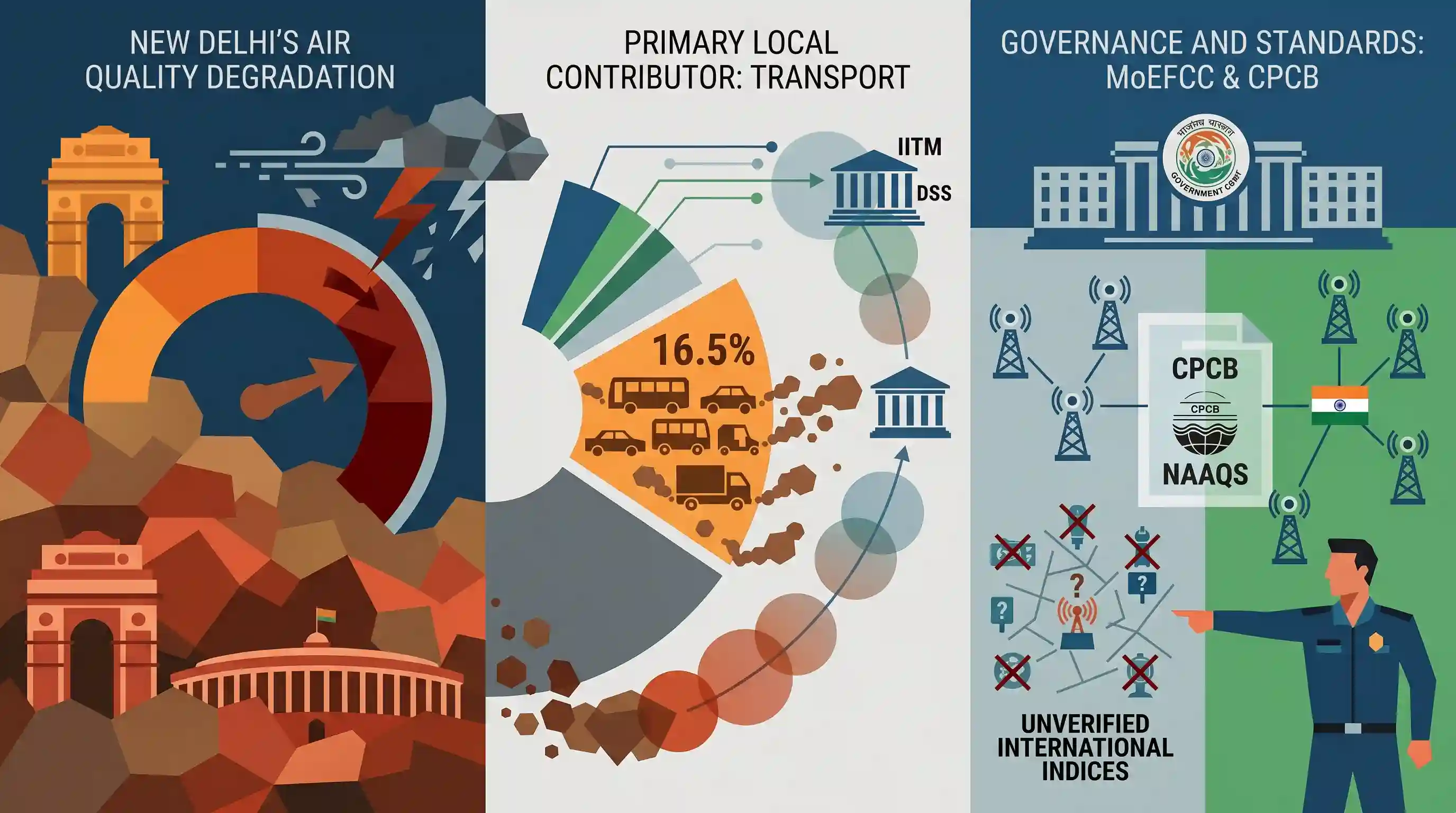
New Delhi's air quality has deteriorated to the 'very poor' category, with a 24-hour average AQI of 349. Adverse meteorological conditions are expected to push the air quality further into the 'severe' zone. According to the Decision Support System (DSS) developed by the Indian Institute of Tropical Meteorology, the transport sector is the primary local contributor to this pollution, responsible for 16.5% of emissions. In response to global rankings, the Ministry of Environment, Forest and Climate Change clarified that India relies strictly on its own National Ambient Air Quality Standards (NAAQS) and the Central Pollution Control Board's (CPCB) official network rather than unverified international indices.
Key Points
- New Delhi's 24-hour average Air Quality Index (AQI) dropped to 349, categorizing it as 'very poor', with forecasts predicting it could turn 'severe'.
- The transport sector was identified by the Decision Support System (DSS) as the largest local contributor to the city's air pollution, accounting for 16.5%.
- India's Ministry of Environment emphasized that the country follows its own National Ambient Air Quality Standards (NAAQS) and does not rely on global private indices for air quality rankings.
- The Central Pollution Control Board (CPCB) classifies AQI into six categories: good (0-50), satisfactory (51-100), moderate (101-200), poor (201-300), very poor (301-400), and severe (401-500).
Important Terms
National Ambient Air Quality Standards (NAAQS)

National regulatory limits set by the CPCB for 12 major pollutants (e.g., PM2.5, PM10, SO2) to define permissible air quality levels across the country.
UPSC context
GS Paper III (Environment); essential for understanding pollution thresholds and identifying non-attainment cities under NCAP.
Central Pollution Control Board (CPCB)
A statutory body established in 1974 responsible for monitoring air and water quality, setting environmental standards, and advising the Central Government on pollution control.
UPSC context
GS Paper II (Governance) and III (Environment); tested for its statutory powers under the Water and Air Acts.
Ministry of Environment, Forest and Climate Change (MoEFCC)
The nodal central ministry responsible for planning and implementing India's environmental, forest, and climate change policies and international commitments.
UPSC context
GS Paper II and III; key for understanding national environmental governance and global climate negotiations.
Air Quality Index (AQI)
A color-coded numerical tool (0-500) launched in 2014 to communicate daily air quality status to the public based on eight major pollutants.
UPSC context
GS Paper III (Environment); highly relevant for Prelims/Mains regarding its categories and the specific pollutants monitored.
National Clean Air Programme (NCAP)
A national-level framework launched in 2019 aimed at a 20-30% reduction in particulate matter concentrations by 2024 across identified non-attainment cities.
UPSC context
GS Paper III (Environment/Pollution); critical for questions on urban air quality management and sectoral mitigation strategies.
Indian Institute of Tropical Meteorology (IITM)
An autonomous institute under the Ministry of Earth Sciences focused on meteorology research, monsoon forecasting, and developing air quality decision support systems.
UPSC context
GS Paper III (Science & Technology); relevant for its technical role in weather forecasting and air pollution modeling.
Prelims Trap
The daily National Air Quality Index (AQI) calculates its score using all 12 pollutants listed under the National Ambient Air Quality Standards (NAAQS).
NAAQS sets legal limits for 12 pollutants, but the AQI only uses 8 (PM10, PM2.5, NO2, SO2, CO, O3, NH3, Pb). Carbon dioxide (CO2) is not included in either.
Static Concepts Connected
What is the distinction between NAAQS and the National Air Quality Index (AQI)?
- NAAQS (12 Pollutants): Notified by CPCB, it sets legal concentration limits for 12 pollutants, including toxic compounds like Benzene, Arsenic, Benzo(a)pyrene, and Nickel.
- AQI (8 Pollutants): Transforms complex air quality data into a daily color-coded public index using only 8 of the 12 NAAQS pollutants.
- CO2 Exclusion: Neither AQI nor NAAQS measure Carbon Dioxide (CO2), which is a greenhouse gas, not a criteria air pollutant. This is a common UPSC trick.
What is the mandate of the Commission for Air Quality Management (CAQM)?
- Statutory Backing: Established by a 2021 Act, it supersedes the EPCA and has overriding statutory jurisdiction over Delhi-NCR and adjoining states (Punjab, Haryana, UP, Rajasthan).
- GRAP Enforcement: It dynamically triggers the Graded Response Action Plan (GRAP) based on AQI categories to impose emergency measures like halting construction or restricting heavy vehicles.
Cross-Topic Patterns
NCAP + 15th FC Urban Grants
The National Clean Air Programme links performance-based financial grants to cities based on verifiable air quality improvements, merging environmental governance with 15th Finance Commission fiscal devolution.
Winter Smog + Temperature Inversion
Delhi's severe pollution is exacerbated by winter temperature inversions and anticyclonic subsidence, providing a direct link between physical geography concepts and urban environmental crises.
Transport Emissions + Biofuels & EVs
With transport contributing over 15% of emissions, air quality interventions directly align with India's push for BS-VI norms, PM E-DRIVE subsidies, and the Ethanol Blended Petrol programme.

Expect a 2026 Prelims question testing the exact pollutants under AQI vs NAAQS, alongside the statutory powers of the CAQM.
Linked PYQs · 5
Linked PYQs · 5
- 2016PrelimsGS1
In the cities of our country, which among the following atmospheric gases are normally considered in calculating the value of Air Quality Index? 1. Carbon dioxide 2. Carbon monoxide 3. Nitrogen dioxide 4. Sulfur dioxide 5. Methane Select the correct answer using the code given below.
- 2022PrelimsGS1
In the context of WHO Air Quality Guidelines, consider the following statements: 1. The 24-hour mean of PM2.5 should not exceed 15 µg/m³ and annual mean of PM2.5 should not exceed 5 µg/m³. 2. In a year, the highest levels of ozone pollution occur during the periods of inclement weather. 3. PM10 can penetrate the lung barrier and enter the bloodstream. 4. Excessive ozone in the air can trigger asthma. Which of the statements given above are correct?
- 2015MainsGS1
Mumbai, Delhi and Kolkata are the three mega cities of the country but the air pollution is much more serious problem in Delhi as compared to the other two. Why is this so?
- 2020MainsGS3
What are the key features of the National Clean Air Programme (NCAP) initiated by the Government of India?
- 2021MainsGS3
Describe the key points of the revised Global Air Quality Guidelines (AQGs) recently released by the World Health Organisation (WHO). How are these different from its last update in 2005? What changes in India's National Clean Air Programme are required to achieve these revised standards?
