West Asia Peace Plans Face Complex Regional Security Realities
Source:The Hindu ↗
Why It Matters
West Asia is strategically vital to India's energy security, diaspora, and geopolitical initiatives like the I2U2 grouping. Understanding the evolving dynamics of the Israel-Palestine conflict, the Abraham Accords, and the interplay between state and non-state actors is essential for analyzing India's foreign policy challenges and regional stability for GS Paper 2.
Summary
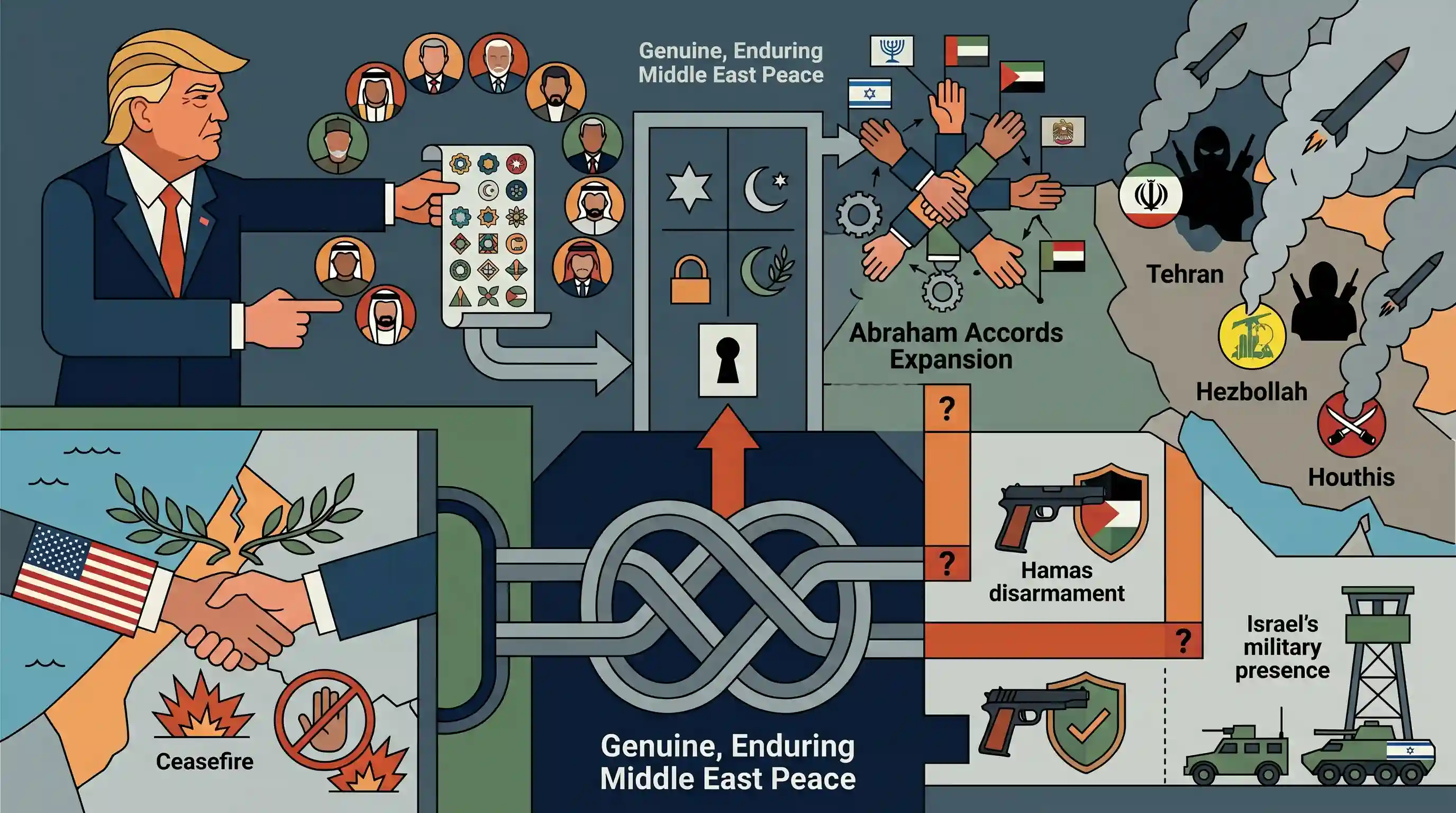
The editorial analyzes the recent US-brokered Gaza ceasefire agreement and the broader geopolitical vision for West Asia proposed by US President Donald Trump. While highlighting a 20-point peace plan endorsed by regional leaders and pushes to expand the Abraham Accords, it notes that critical ambiguities remain, particularly regarding Hamas's disarmament and Israel's ongoing military presence. Furthermore, it emphasizes that despite claims of neutralizing Iran's threat, Tehran and its regional allies (Hezbollah, Houthis) retain significant influence. Ultimately, the article argues that genuine, enduring peace in the Middle East is impossible without a definitive resolution to the foundational Israel-Palestine conflict.
Key Points
- A US-brokered Gaza ceasefire plan has led to a 20-point peace proposal endorsed by key Arab and Muslim nations.
- A joint diplomatic declaration emphasized safeguarding the fundamental rights of both Palestinians and Israelis.
- Ambiguities persist around the disarmament of Hamas and the duration of Israel's military presence in the Gaza Strip.
- US President Donald Trump envisions an expanded "new Middle East" built on the Abraham Accords and claims the regional threat from Iran is neutralized.
- Iran and its allied factions, including Hezbollah in Lebanon and the Houthis in Yemen, remain influential players capable of disrupting regional stability.
- The editorial argues that lasting peace in West Asia relies intrinsically on resolving the core Palestine issue and ending the Israeli occupation.
Important Terms
Abraham Accords

US-brokered 2020 normalization agreements between Israel and Arab states (UAE, Bahrain, Sudan, Morocco). They prioritize regional economic/security cooperation over traditional Arab-Israeli consensus on Palestinian statehood.
UPSC context
GS-II (IR). Tests knowledge of shifting West Asian geopolitics, India's 'Link West' policy, and plurilateral groupings like I2U2.
Hamas
A Palestinian Sunni-Islamic fundamentalist, militant, and nationalist organization. It has governed the Gaza Strip since 2007 and is a central actor in the ongoing conflict with Israel.
UPSC context
GS-II (IR). Essential for analyzing the Israel-Palestine conflict, non-state actors, and security challenges in the Middle East.
Hezbollah
An Iran-backed Shia Islamist political party and militant group based in Lebanon. It is a key member of the 'Axis of Resistance' and a significant regional adversary of Israel.
UPSC context
GS-II (IR). Relevant for understanding Lebanon's internal dynamics, regional proxy wars, and Iran's strategic 'Axis of Resistance'.
Houthis
An Iran-backed Zaydi Shia militant group in Yemen. They control northern Yemen and have significantly impacted Red Sea maritime security through drone and missile attacks.
UPSC context
GS-II (IR). Key to discussing the Yemen crisis, global supply chain security (Red Sea), and regional power struggles.
Knesset
The 120-member unicameral national legislature of Israel. It possesses supreme authority, passing laws, electing the President and Prime Minister, and supervising government actions.
UPSC context
GS-II (IR). Important for understanding the political structure and legislative processes of a key strategic partner for India in West Asia.
Prelims Trap
The Abraham Accords provide a formal framework for establishing an independent Palestinian State.
The Accords normalized diplomatic ties between Israel and select Arab states (UAE, Bahrain) but explicitly bypassed the core Palestinian statehood issue, leaving it unresolved.
Static Concepts Connected
What is India's 'De-hyphenation' policy regarding Israel and Palestine?
- Independent trajectories: India builds parallel, independent relationships with both Israel and Palestine, assessing each on its own merits rather than linking or balancing them against one another.
- Strategic pragmatism: It marks a shift to pragmatic balancing—deepening defense, agriculture, and tech ties with Israel while continuing diplomatic support for a Two-State solution for Palestine.
Which strategic maritime chokepoints are vulnerable to West Asian conflicts?
- Bab-el-Mandeb: Connects the Red Sea to the Gulf of Aden; highly vulnerable to disruptions by Yemen-based Houthi rebels, heavily impacting Suez Canal commercial traffic.
- Strait of Hormuz: Connects the Persian Gulf to the Gulf of Oman; a critical global oil transit route where Iran exerts significant geopolitical and military leverage.
Cross-Topic Patterns
Abraham Accords enabling I2U2 and IMEEC
Arab-Israeli normalization provided the geopolitical foundation for India's expanded strategic footprint in West Asia, directly enabling plurilateral groupings like I2U2 and the India-Middle East-Europe Economic Corridor (IMEEC).
Non-state actors driving global inflation
The Houthis' ability to disrupt Bab-el-Mandeb shipping links regional asymmetric warfare directly to global supply chain shocks, elevated freight costs, and imported inflation for developing economies.

Expect a 2026 map-based prelims question matching West Asian non-state actors (Houthis, Hezbollah) to their adjacent strategic straits.
Linked PYQs · 2
Linked PYQs · 2
- 2022MainsGS2
How will I2U2 (India, Israel, UAE and USA) grouping transform India's position in global politics?
- 2018MainsGS2
“India’s relations with Israel have, of late, acquired a depth and diversity, which cannot be rolled back.” Discuss.
