Revised CPI inflation index points towards prolonged rate pause
Source:Indian Express ↗
Why It Matters
The Consumer Price Index (CPI) is the nominal anchor for the RBI's Flexible Inflation Targeting Framework. Any structural change in how CPI is calculated directly impacts monetary policy decisions, interest rates, and the broader macroeconomic environment. Understanding the relationship between CPI composition (like food weightage) and RBI rate decisions is crucial for the UPSC GS-3 Economy syllabus.
Summary
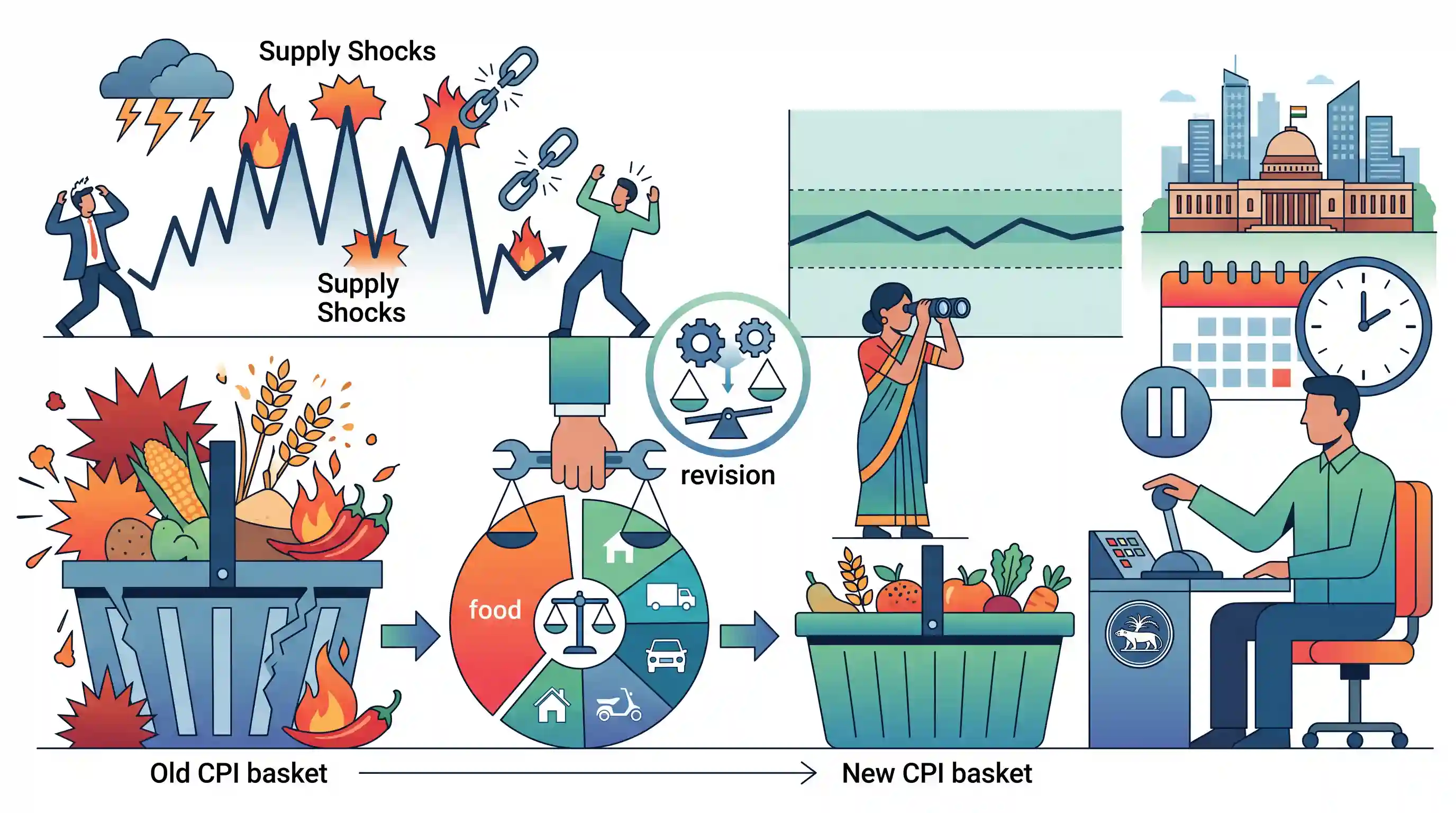
The article discusses the implications of revising the Consumer Price Index (CPI) basket, which is expected to result in a less volatile inflation metric due to an updated weighting of goods, particularly a potential reduction in the weight of volatile food items. A more stable headline inflation figure allows the Reserve Bank of India (RBI) to better gauge underlying economic conditions without being overly swayed by temporary supply shocks. Consequently, this structural reduction in volatility suggests that the RBI's Monetary Policy Committee (MPC) is likely to maintain a prolonged pause on interest rates, as the urgency for reactive rate adjustments diminishes.
Key Points
- The revision of the Consumer Price Index (CPI) basket typically involves updating the base year and adjusting the weightage of goods to reflect modern consumption patterns, often reducing the weight of food items.
- Since food prices are highly susceptible to supply-side shocks, a reduced weightage for food makes the headline CPI index less volatile.
- A smoother, less volatile inflation index helps the RBI filter out transient noise and focus on underlying core inflation trends.
- The anticipated stability in the new CPI readings suggests that the RBI's Monetary Policy Committee (MPC) may maintain a 'prolonged pause' on benchmark interest rates, avoiding both premature cuts and reactive hikes.
Important Terms
Flexible Inflation Targeting Framework

A monetary policy framework where the RBI targets a retail inflation of 4% (with a +/- 2% tolerance band) while supporting economic growth, established via a 2016 amendment to the RBI Act.
UPSC context
GS Paper 3 (Economy). Tests understanding of price stability, growth trade-offs, and the statutory mandate for inflation control in India.
Monetary Policy Committee (MPC)
A statutory 6-member committee (3 from RBI, 3 external) that determines the benchmark repo rate to achieve the government's inflation target while maintaining economic growth.
UPSC context
GS Paper 3 (Economy). Tests knowledge of institutional decision-making, composition, and the legal shift from Governor-led to committee-based interest rate setting.
Reserve Bank of India (RBI)
India's central bank, established in 1935, responsible for regulating the monetary system, issuing currency, managing foreign exchange, and acting as the banker to the government and commercial banks.
UPSC context
GS Paper 3 (Economy). Fundamental for questions on banking regulation, financial stability, and the implementation of monetary policy in India.
Ministry of Statistics and Programme Implementation (MoSPI)
The nodal ministry responsible for the collection and dissemination of national statistics, including the Consumer Price Index (CPI), Gross Domestic Product (GDP), and the Index of Industrial Production (IIP).
UPSC context
GS Paper 3 (Economy). Important for understanding data governance, the technical process of index revision (base years), and evidence-based policymaking.
Prelims Trap
"Under the FIT framework, the RBI's Monetary Policy Committee targets Core CPI to avoid food price volatility."
The RBI is legally mandated to target Headline CPI, not Core CPI. The updated basket makes Headline CPI less volatile, but the legal anchor under the RBI Act remains Headline CPI.
Static Concepts Connected
What is the difference between Headline and Core Inflation?
- Headline Inflation: Total inflation measure representing the cost of a broad basket of goods and services, including volatile items like food and fuel.
- Core Inflation: Calculated by stripping out highly volatile food and energy components from headline inflation to reflect underlying long-term macroeconomic price trends.
- RBI Policy Target: The RBI's Monetary Policy Committee is legally bound to target Headline CPI (4% +/- 2%), not Core Inflation, under the Flexible Inflation Targeting (FIT) framework.
How do CPI and WPI differ in basket composition and publishing?
- Services Inclusion: CPI includes consumer services such as housing, education, and medical care, whereas WPI measures only the wholesale prices of physical goods.
- Food Weightage: Food items constitute a significantly larger share in the CPI basket compared to the WPI basket, making CPI historically more sensitive to agricultural supply shocks.
- Publishing Agencies: CPI is released by the National Statistical Office (NSO) under MoSPI, while WPI is published by the Office of the Economic Adviser, Ministry of Commerce and Industry.
Cross-Topic Patterns
HCES data linked to Poverty Estimation
The Household Consumption Expenditure Survey (HCES), used to revise the CPI base year to 2024, is also the critical data source utilized to estimate India's poverty line under the Tendulkar and Rangarajan methodologies.
Monetary Policy limits on supply shocks
RBI's repo rate tools curb demand but cannot fix supply-side food inflation (e.g., erratic monsoons). A lower food-weight CPI prevents the MPC from initiating reactive, growth-stifling rate hikes during temporary agricultural shocks.

Expect a multi-statement question in 2026 comparing the new CPI (2024 base) basket weights against WPI and the legal mandate of the MPC.
Linked PYQs · 5
Linked PYQs · 5
- 2020PrelimsGS1
Consider the following statements: 1. The weightage of food in Consumer Price Index (CPI) is higher than that in Wholesale Price Index (WPI). 2. The WPI does not capture changes in the prices of services, which CPI does. 3. Reserve Bank of India has now adopted WPI as its key measure of inflation and to decide on changing the key policy rates. Which of the statements given above is/are correct?
- 2022PrelimsGS1
In India, which one of the following is responsible for maintaining price stability by controlling inflation?
- 2015PrelimsGS1
Which of the following brings out the 'Consumer Price Index Number for Industrial Workers?
- 2021PrelimsGS1
With reference to Indian economy, demand-pull inflation can be caused/ increased by which of the following? 1. Expansionary policies 2. Fiscal stimulus 3. Inflation-indexing wages 4. Higher purchasing power 5. Rising interest rates Select the correct answer using the code given below.
- 2024MainsGS3
What are the causes of persistent high food inflation in India? Comment on the effectiveness of the monetary policy of the RBI to control this type of inflation.
