Cooperative Policy Opposition and State List Federalism
Source:The Hindu ↗
Why It Matters
This article intersects multiple core UPSC themes, specifically the constitutional division of powers (Entry 32 of the State List), cooperative federalism, and the legal trajectory of the 97th Constitutional Amendment Act. It also touches upon the socio-economic implications of agriculture policy and the debate over the corporatisation of the farm sector versus cooperative farming, making it highly relevant for GS2 (Polity and Governance) and GS3 (Agriculture and Economy).
Summary
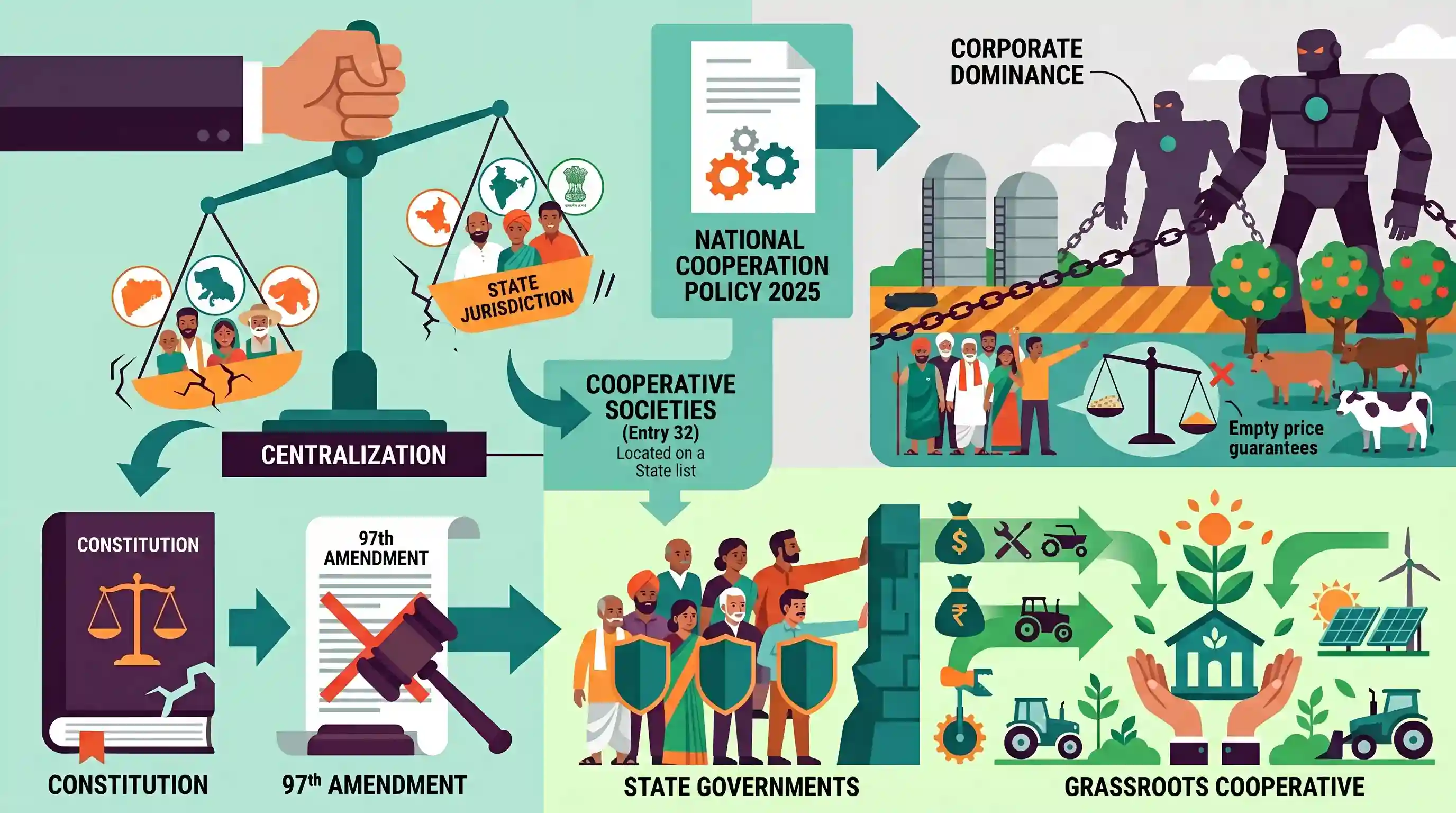
The Samyukt Kisan Morcha (SKM) has strongly criticised the newly unveiled National Cooperation Policy-2025, accusing the Union government of violating the Constitution and undermining cooperative federalism. SKM asserts that cooperative societies fall under the State List (Entry 32), and highlights a past Supreme Court verdict invalidating parts of the 97th Constitutional Amendment for bypassing State ratification. The farmers\' organisation warns that the policy lacks safeguards for minimum support prices (MSP) and farmers\' livelihoods, potentially paving the way for corporate dominance over agriculture, horticulture, and dairy sectors. It has urged State governments to resist this centralisation of power and demand resource-sharing to modernise grassroots cooperatives.
Key Points
- Samyukt Kisan Morcha (SKM) alleges the National Cooperation Policy-2025 centralises power and infringes upon State government rights.
- According to the Constitution, cooperative societies fall under Entry 32 of the State List (List II) in the Seventh Schedule.
- SKM cited a Supreme Court ruling that struck down portions of the 97th Amendment Act (Part IXB) for cooperatives within a single state due to a lack of ratification by at least half of the State legislatures.
- The farmers\' body claims the policy lacks measures to protect farmers\' rights regarding minimum support price (MSP), livelihoods, and minimum wages, potentially facilitating a corporate takeover of agriculture.
- SKM urged States and political parties to defend cooperative federalism and suggested that 50% of Union resources be provided to States to modernise cooperative societies instead of allowing corporate dominance.
Important Terms
National Cooperation Policy-2025

Strategic framework launched in 2025 to modernize India's cooperative sector, aiming for 'Sahkar se Samriddhi' (prosperity through cooperation) by tripling the sector's GDP contribution and establishing cooperatives in every village.
UPSC context
GS Paper 2/3: Government policies, agriculture, and rural development; tests understanding of cooperative reforms and center-state dynamics.
97th Constitutional Amendment Act
2011 amendment that granted constitutional status to cooperatives, making the right to form them a Fundamental Right (Art 19) and adding a Directive Principle (Art 43B).
UPSC context
GS Paper 2: Indian Constitution and its amendments; focuses on fundamental rights, DPSPs, and the federal structure.
Entry 32, State List
Provision in the Seventh Schedule of the Constitution that places 'cooperative societies' under the exclusive legislative domain of State governments.
UPSC context
GS Paper 2: Federalism and distribution of powers; tests knowledge of the division of legislative subjects between Centre and States.
Supreme Court Verdict on Part IXB
A 2021 ruling (Union of India v. Rajendra N. Shah) quashing parts of the 97th Amendment for violating the federal structure by bypassing State ratification for a State List subject.
UPSC context
GS Paper 2: Judiciary and Separation of Powers; tests understanding of the Doctrine of Severability and constitutional validity of laws.
Samyukt Kisan Morcha (SKM)
The umbrella coalition of over 400 farmers' unions that led the 2020-21 protests against farm laws and currently advocates for a legal guarantee of MSP.
UPSC context
GS Paper 3: Issues related to direct and indirect farm subsidies and MSP; tests understanding of agrarian movements and pressure groups.
Union Ministry of Cooperation
A Union Ministry established in July 2021 to provide a separate administrative, legal, and policy framework for strengthening the cooperative movement across India.
UPSC context
GS Paper 2: Statutory, regulatory and various quasi-judicial bodies; tests knowledge of institutional changes in governance.
Prelims Trap
"The 2021 Supreme Court judgment struck down the entire 97th Constitutional Amendment Act."
The Supreme Court only invalidated Part IXB for intra-state cooperatives. The amendment remains completely valid for Multi-State Cooperative Societies (Union List) and Union Territories.
Static Concepts Connected
How does the Indian Constitution protect and promote cooperative societies?
- Fundamental Right: Article 19(1)(c) guarantees the formation of cooperative societies as a Fundamental Right.
- DPSP: Article 43B directs the State to promote voluntary formation, democratic control, and professional management of cooperatives.
- Part IXB: Part IXB was inserted by the 97th CAA to provide structural guidelines, though its application to intra-state cooperatives was struck down.
How is jurisdiction over cooperatives divided between the Centre and States?
- State List: Entry 32 grants States exclusive jurisdiction over the incorporation, regulation, and winding up of intra-state cooperatives.
- Union List: Entry 44 grants Parliament authority over Multi-State Cooperative Societies (MSCS) whose operations span more than one state.
- Article 368 Ratification: The SC ruled that amending intra-state cooperative rules requires ratification by half the State legislatures under Article 368(2).
Cross-Topic Patterns
FPOs, Cooperatives and Corporate Farming
SKM’s anxiety over corporatization in the 2025 policy mirrors the 2020 Farm Laws protests. UPSC often tests the structural differences between modern FPOs (Companies Act) and traditional Cooperatives (State laws).
Central Policies on State List Subjects
Similar to Model APMC Acts or the National Water Policy, the Centre relies on national frameworks and umbrella ministries to standardize State List subjects, triggering continuous cooperative federalism debates.

Expect a tricky 2026 Prelims statement mixing Art 19(1)(c) with Entry 32 (State) and Entry 44 (Union) to test multi-state jurisdiction.
Linked PYQs · 5
Linked PYQs · 5
- 2015MainsGS2
The concept of cooperative federalism has been increasingly emphasized in recent years. Highlight the drawbacks in the existing structure and the extent to which cooperative federalism would answer the shortcomings.
- 2023MainsGS2
Explain the significance of the 101st Constitutional Amendment Act. To what extent does it reflect the accommodative spirit of federalism?
- 2024MainsGS2
What changes has the Union Government recently introduced in the domain of Centre-State relations ? Suggest measures to be adopted to build the trust between the Centre and the States and for strengthening federalism.
- 2014MainsGS3
In the villages itself no form of credit organization will be suitable except the cooperative society. -All India Rural Credit Survey. Discuss this statement in the background of agricultural finance in India. What constraints and challenges do financial institutions supplying agricultural finance face? How can technology be used to better reach and serve rural clients?
- 2021PrelimsGS1
With reference to Urban Cooperative Banks' in India, consider the following statements : 1. They are supervised and regulated by local boards set up by the State Governments. 2. They can issue equity shares and preference shares. 3. They were brought under the purview of the Banking Regulation Act, 1949 through an Amendment in 1966. Which of the statements given above is/are correct?
