CGIAR Climate Action Plan for Tamil Nadu Disaster Resilience
Source:The Hindu ↗
Why It Matters
The article provides an excellent practical case study for GS3 answers on Disaster Management and Agriculture. It showcases how institutional collaboration (CGIAR, state departments) can build resilience against dual extremes (urban flooding and droughts) using digital advisories and climate-smart agriculture, directly addressing the UPSC's focus on micro-watershed development, water-use efficiency, and climate-induced disasters.
Summary
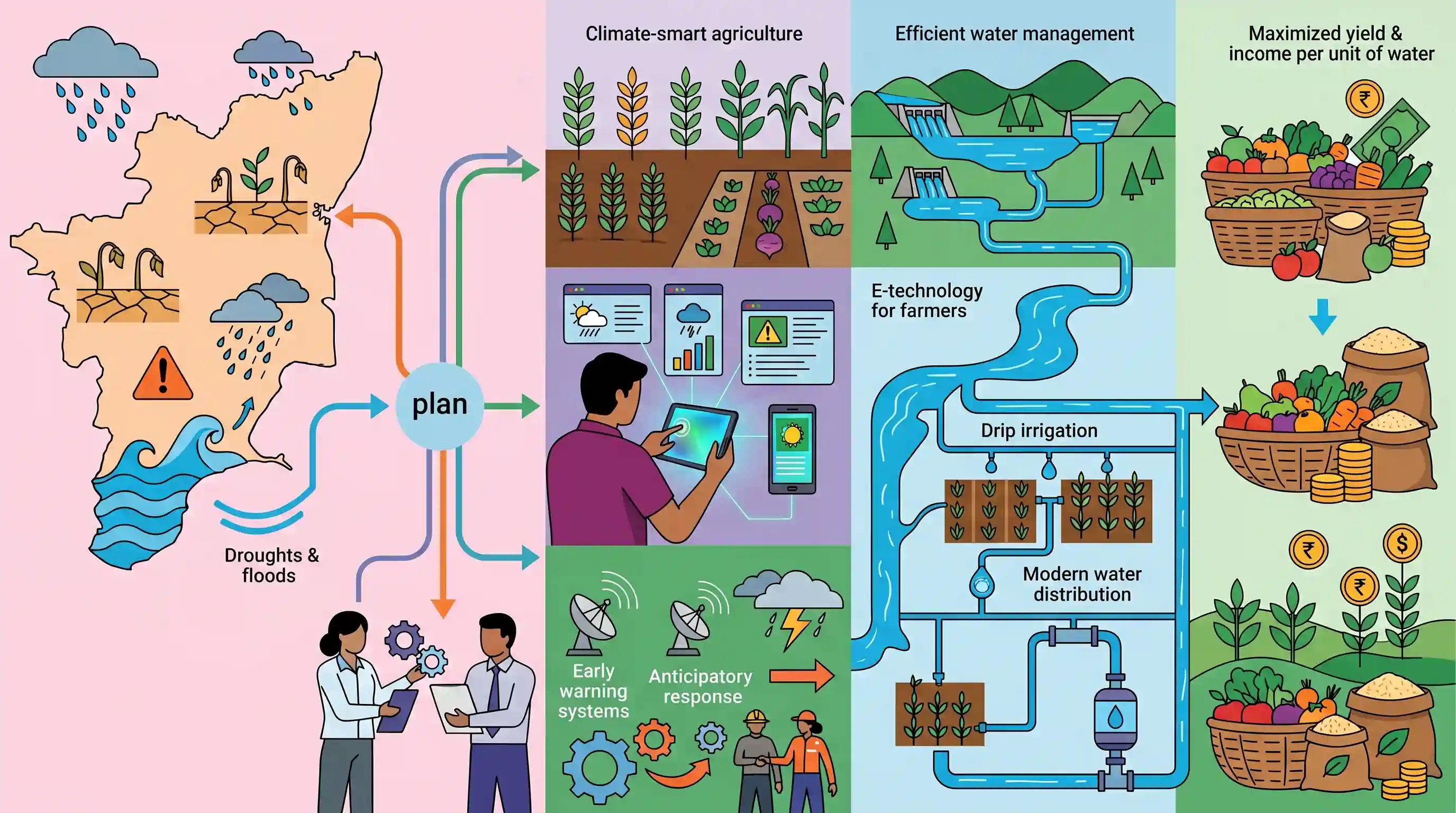
CGIAR has launched a new Climate Action Plan for Tamil Nadu to bolster resilience in districts highly susceptible to droughts and floods. Implemented alongside the International Water Management Institute (IWMI) and state agencies, the initiative seeks to safeguard food systems against extreme weather. It addresses severe water scarcity in drought-prone areas and urban/riverine flood risks exacerbated by the Northeast monsoon. Interventions focus on climate-smart agriculture, digital climate advisories, efficient water management from the watershed to the farm scale, and anticipatory disaster response, ultimately aiming to maximize agricultural yield and income per unit of water.
Key Points
- CGIAR has introduced a new Climate Action Plan for Tamil Nadu to assist vulnerable communities in managing risks associated with droughts and floods.
- The plan targets drought-prone districts like Ramanathapuram, Sivagangai, and Virudhunagar, addressing water scarcity and agricultural distress in alignment with the Tamil Nadu Drought Mitigation Project.
- Flood interventions focus on areas vulnerable to riverine and urban flooding during the Northeast monsoon, such as Chennai, Cuddalore, and Thanjavur.
- Key strategies include integrated climate risk management, real-time digital weather/farming advisories, anticipatory actions for extreme events, and community-led adaptation.
- A major focus is on promoting climate-smart agriculture by maximizing crop yield and income per unit of water through watershed-to-farm level water management.
Important Terms
CGIAR

A global research partnership that unites international organizations engaged in research about food security, aiming to reduce rural poverty and improve human health and nutrition.
UPSC context
GS III: Agriculture and Food Security; tests knowledge of international institutional frameworks supporting Indian agricultural resilience.
International Water Management Institute (IWMI)
An international non-profit research organization under CGIAR focusing on sustainable water and land use to ensure food security and climate resilience.
UPSC context
GS III: Water Resources and Disaster Management; relevant for sustainable irrigation and flood/drought mitigation strategies.
Climate Action Plan (CGIAR)
A science-driven framework launched in 2025 to scale climate-smart agriculture, digital advisories, and anticipatory disaster response across Tamil Nadu’s vulnerable districts.
UPSC context
GS III: Environment and Conservation; focuses on state-specific adaptation strategies and international collaboration.
Tamil Nadu Drought Mitigation Project
An ongoing state initiative focused on addressing water scarcity and agricultural distress in arid regions through integrated risk management and disaster mitigation funds.
UPSC context
GS III: Disaster Management; examines regional responses to hydro-climatic hazards and irrigation management.
Tamil Nadu State Planning Commission
The apex advisory body for the Tamil Nadu government that formulates developmental plans and coordinates sectoral strategies like climate-resilient growth.
UPSC context
GS II: Governance; highlights the role of state-level planning bodies in mainstreaming climate science into policy.
Tamil Nadu Agricultural University (TNAU)
A leading academic institution providing the technical research, forecasting models, and climate-smart farm advisories essential for the state's agricultural adaptation.
UPSC context
GS III: E-technology in the aid of farmers; tests awareness of institutional support for agricultural innovation.
Institute for Water Studies (IWS)
A state-level technical organization responsible for hydrological data collection, water budgeting, and providing scientific inputs for climate risk assessments.
UPSC context
GS III: Conservation and Water Resources; significant for technical ground-level implementation of water management plans.
Prelims Trap
Tamil Nadu's flood-prone coastal and delta districts receive the majority of their rainfall from the South-West Monsoon.
Unlike most of India, Tamil Nadu is in the rain-shadow of the Western Ghats during the SW monsoon and receives the bulk of its precipitation from the Northeast (retreating) monsoon.
Static Concepts Connected
What are the three foundational pillars of Climate-Smart Agriculture (CSA)?
- Productivity: Sustainably increasing agricultural productivity and farmers' incomes to ensure food security.
- Adaptation: Adapting and building resilience of agricultural and food security systems to climate change at multiple levels.
- Mitigation: Reducing and/or removing greenhouse gas emissions from agriculture, where possible and appropriate.
What characterizes the Northeast (Winter) Monsoon in India?
- Origin: Triggered by the withdrawal of the SW monsoon and the establishment of high-pressure systems over the Tibetan plateau.
- Moisture Source: Winds blow from northeast to southwest, picking up significant moisture as they cross the Bay of Bengal.
- Impact Areas: Provides the primary rainfall (Oct-Dec) for Tamil Nadu, coastal Andhra Pradesh, Rayalaseema, and Puducherry, often causing riverine/urban floods.
Cross-Topic Patterns
CGIAR + National Agri-Research linkage
UPSC frequently tests international agricultural bodies (e.g., ICRISAT). CGIAR's collaboration with state bodies like TNAU exemplifies the localization of global climate-resilient crop research for GS-3 Agriculture.
Sendai Framework + E-technology advisories
The shift from post-disaster relief to anticipatory digital climate advisories perfectly illustrates the application of 'e-technology in the aid of farmers' under the Sendai Framework's risk reduction mandate.

Expect a GS-3 Mains question linking micro-watershed management and digital climate advisories to climate-smart agriculture in rain-shadow areas.
Linked PYQs · 4
Linked PYQs · 4
- 2021PrelimsGS1
In the context of India's preparation for Climate-Smart Agriculture, consider the following statements : 1. The 'Climate-Smart Village' approach in India is a part of a project led by the Climate Change, Agriculture and Food Security (CCAFS), an international research programme. 2. The project of CCAFS is carried out under Consultative Group on International Agricultural Research (CGIAR) headquartered in France. 3. The International Crops Research Institute for the Semi-Arid Tropics (ICRISAT) in India is one of the CGIAR's research centres. Which of the statements given above are correct?
- 2024MainsGS3
Flooding in urban areas is an emerging climate-induced disaster. Discuss the causes of this disaster. Mention the features of two such major floods in the last two decades in India. Describe the policies and frameworks in India that aim at tackling such floods.
- 2016MainsGS1
In what way micro-watershed development projects help in water conservation in drought-prone and semi-arid regions of India?
- 2024MainsGS3
What are the major challenges faced by Indian irrigation system in recent times? State the measures taken by the government for efficient irrigation management.
